



Selling in Spain: EPR requirements
If you sell physical products in Spain (e-commerce, B2B, retail), you are probably subject to EPR requirements in Spain (Extended Producer Responsibility). This European regulation, transposed into Spanish law, requires every market participant to fund the collection, sorting and recycling of waste linked to its products. Packaging, electrical equipment, batteries, textiles, tyres, medication: the list of streams concerned keeps growing, and sanctions for non-compliance can reach €3.5 million for very large infringements.
This article explains exactly what EPR is, who is concerned in Spain, how to comply stream by stream (packaging, WEEE, batteries, textiles), how to register with the relevant eco-organisations (SCRAP), how to declare your volumes placed on the market, and which mistakes save you from fines. We also detail typical annual costs for an e-commerce seller.
What is EPR and where does this obligation come from?
EPR is a long-standing European principle but recently tightened in Spain.
The European principle
EPR (Extended Producer Responsibility) rests on the "polluter pays" principle. The producer or market participant of a product is responsible for the environmental impact throughout the life cycle, including end of life. Concretely, they must fund the collection and treatment of waste generated by their products.
Transposition in Spain
Spain has transposed European EPR directives via several main texts:
- Ley 7/2022 de Residuos y Suelos Contaminados: general framework.
- Real Decreto 110/2015 on WEEE (electrical and electronic equipment).
- Real Decreto 106/2008 on batteries and accumulators.
- Real Decreto 1055/2022 on packaging (recent update).
- And specific decrees by stream (textiles, medication, oils, etc.).
Why it has become a major issue
With the growth of cross-border e-commerce, many foreign producers sell in Spain without being EPR-registered. The Spanish state has tightened controls since 2023 and collaborates with customs and platforms (Amazon, eBay) to identify non-compliant sellers. Fines have become very significant.
Who is concerned by EPR in Spain?
EPR concerns a very broad range of economic players.
Every market participant
Any person (individual or legal) placing a product on the market in Spain is concerned:
- Spanish manufacturers.
- Importers (buying abroad to sell in Spain).
- Foreign e-commerce sellers selling via their site or via Amazon FBA, eBay, etc.
- Distributors and wholesalers.
- Marketplaces (Amazon, AliExpress) with shared responsibility depending on seller status.
Turnover threshold
There is generally no minimum threshold: even a small e-commerce seller selling 100 products a year is concerned. Some streams have specific thresholds (for example WEEE for very small enterprises).
Special case of foreign companies without establishment
If you sell in Spain from an EU/non-EU country without permanent establishment in Spain, you must appoint an authorised representative (equivalent to a mandatary) who registers and declares on your behalf. To grasp the associated tax obligations, see apply for NIF in Spain for foreign companies.
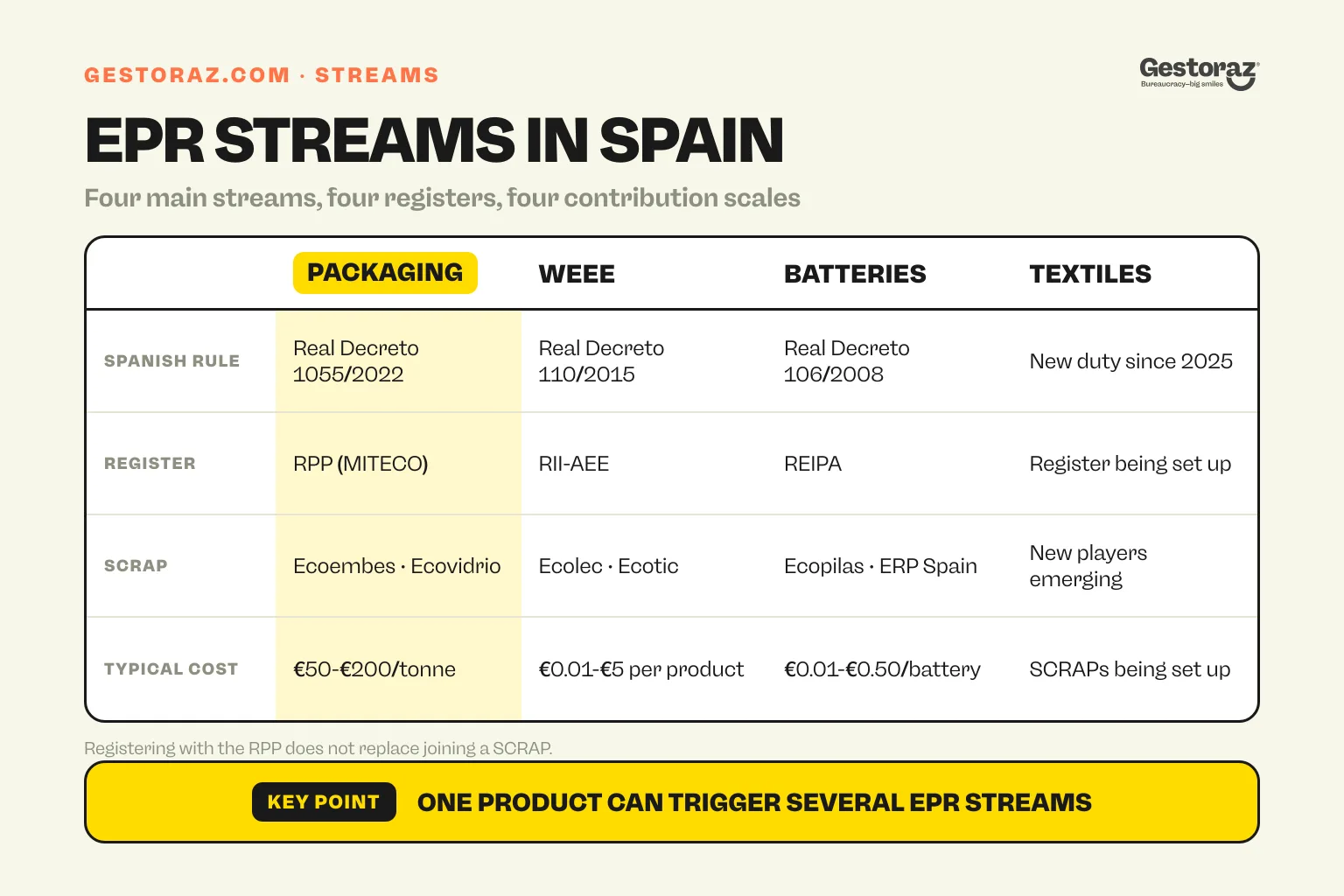
What are the main EPR streams in Spain?
The most common streams for e-commerce sellers and industrials.
Packaging
Real Decreto 1055/2022: every commercial or industrial packaging (cardboard, plastic, glass, metal, wood) is concerned. You must register with the Registro de Productores de Producto (RPP) managed by MITECO and join a SCRAP (extended responsibility system):
- Ecoembes for household packaging (paper, plastic, light metal).
- Ecovidrio for glass packaging.
Typical contribution: €50-€200/tonne depending on packaging type.
WEEE (electrical and electronic equipment)
Real Decreto 110/2015: any product with electrical or electronic component (household appliances, computers, phones, electronic toys, LED bulbs). Registration with the RII-AEE and joining a SCRAP:
- Ecolec: generalist, leader.
- Ecotic: alternative.
- Ambilamp: lighting specialist.
Contribution: €0.01 to €5 per product depending on category.
Batteries
Real Decreto 106/2008: standard batteries, accumulators, lithium batteries. Registration with the REIPA and joining:
- Ecopilas: historic leader.
- ERP Spain: alternative.
Contribution: €0.01 to €0.50 per battery depending on type.
Textiles (since 2025)
New obligation since 2025: every clothing and textile seller is concerned. The register and textile SCRAPs are being structured. New players are emerging.
Other streams
- Industrial and lubricant oils: SIGAUS.
- Tyres: Signus, TNU.
- Medication: SIGRE.
- End-of-life vehicles: SIGRAUTO.
- Agricultural plastics: SIGFITO.
How do you comply step by step?
The EPR path includes five main steps.
Step 1: identify your streams
For each product you sell, identify the EPR streams concerned. A laptop can be both WEEE (the laptop), packaging (cardboard and plastic), and battery (internal battery). Several SCRAP memberships may be necessary.
Step 2: register with the national register
Registration with the Registro de Productores de Producto (RPP) of the Ministry of Ecological Transition (MITECO) or with specific registers (RII-AEE for WEEE, REIPA for batteries).
Step 3: join a SCRAP
You choose a SCRAP per stream concerned and you sign a membership contract. Typical entry fee: €100-€500 + annual contribution proportional to volumes placed on the market.
Step 4: periodic declarations
Depending on the SCRAP, you declare quarterly or annually the volumes placed on the market (number of units, weight by category). The SCRAP then calculates your corresponding contribution.
Step 5: marking and information
Some products must carry a specific marking (recycling logo, point vert for Ecoembes, crossed-out WEEE symbol). You must also inform your customers about sorting and recycling at end of life.
How much does EPR compliance cost?
Costs vary widely with volumes and streams.
Entry cost
- RPP/RII-AEE registration: €50-€200.
- SCRAP membership fees per stream: €100-€500.
- EPR consultant fees (recommended for first steps): €500-€2,000.
Recurring annual cost
For an average e-commerce seller:
- Small volume (< 10 tonnes/year, 1,000 WEEE units): €500-€2,000/year.
- Medium volume (50-200 tonnes/year): €5,000-€20,000/year.
- Large volume (> 500 tonnes/year): €50,000 and more.
The marketplace case
If you sell via Amazon FBA, AliExpress, eBay, some marketplaces handle part of the EPR compliance for you (notably Amazon since 2023 on some streams). Check what the platform covers and what remains your responsibility.
What sanctions for non-compliance?
Sanctions are structured by Ley 7/2022.
Light infringements
Small lapses: fines of €900 to €9,000. Concerns declaration delays, occasional oversights.
Serious infringements
Systematic non-declaration, non-membership of a SCRAP: fines of €9,001 to €1,200,000 depending on volumes concerned.
Very serious infringements
Recidivism, concealment of significant volumes, placing on the market without any compliance: fines that can reach €3,500,000.
Indirect consequences
Beyond fines, non-compliant sellers risk: suspension of their listings on platforms (Amazon, eBay collaborate with authorities), customs blocking (customs check EPR declarations), and a global tax audit by the Agencia Tributaria. For an e-commerce seller, this can be destructive.
What pitfalls are common with EPR?
Several mistakes recur with foreign e-commerce sellers.
Thinking marketplaces handle everything
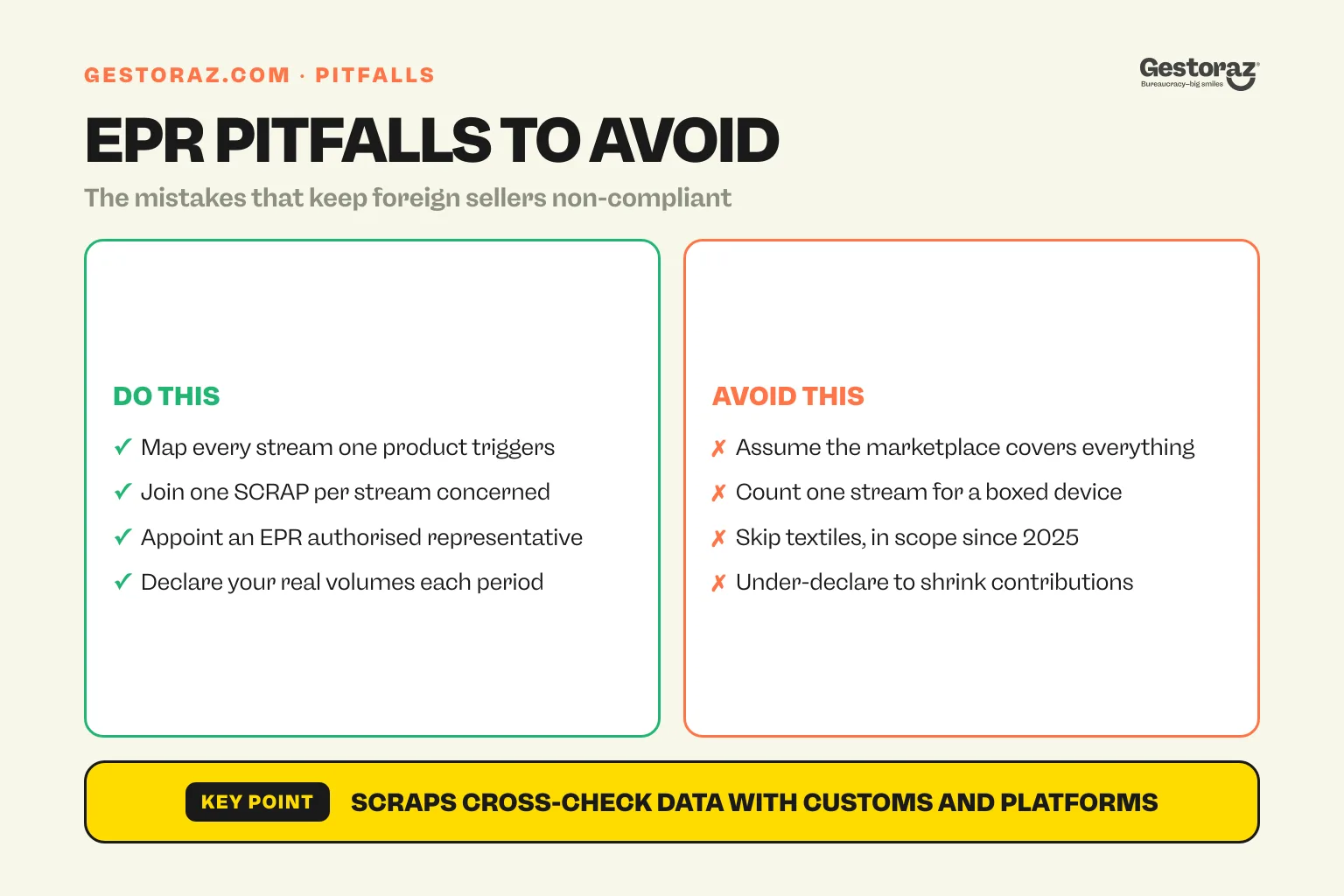
Many e-commerce sellers think Amazon or eBay handle EPR for them. That is false: marketplaces handle a limited part (often Amazon FBA shipping packaging) but the seller remains responsible for global compliance, especially for the products themselves.
Underestimating the diversity of streams
A single product can generate several EPR streams. A phone sold in a box with a battery and a charger generates 3 streams: WEEE (the phone), packaging (the cardboard), batteries (the battery). You must join 3 different SCRAPs.
Forgetting new textile obligations
Since 2025, textiles are concerned by EPR. Many clothing e-commerce sellers have not yet integrated this obligation and accumulate delay.
No authorised representative for foreigners
If you sell in Spain from abroad without establishment, you must appoint an authorised EPR representative. Without a representative, you are non-compliant by default, even if you pay the contributions.
Confusing EPR and tax obligations
EPR is distinct from tax obligations (VAT, IS, IRNR). Holding a Spanish NIF does not exempt from EPR, and vice versa. See check which VAT rate applies in 2025 for the fiscal side.
Not declaring correct volumes
Under-declaring your volumes to minimise your contributions is risky. SCRAPs cross-reference their data with customs and platforms. An audit can generate reassessments over 4 years plus penalties.
Where to start to manage your activity's EPR
The EPR requirements in Spain have become unavoidable for any seller of physical products. The practical rule: identify all streams concerned by your products, register with the corresponding registers, join the appropriate SCRAPs, and automate the declaration of your volumes via an EPR partner or specialised gestoría.
The annual cost remains modest for a small e-commerce seller (< €2,000) but can climb quickly with volumes. It is a cost to integrate into your selling prices rather than try to avoid. Sanctions for non-compliance largely exceed the cost of being in order. The wider tax framework on selling in Spain sits in check which VAT rate applies in 2025 and the company set-up route in apply for NIF in Spain for foreign companies.
Are you starting a sales activity in Spain or want to regularise an existing EPR situation? At gestoraz, working with environmental specialists, we can identify your streams concerned, manage SCRAP registrations, and automate your annual declarations to avoid delays and fines.
Official sources
- MITECO, Ministerio para la Transición Ecológica, miteco.gob.es: EPR regulation and producer registers.
- Ley 7/2022 de Residuos y Suelos Contaminados (BOE), boe.es/buscar/act.php?id=BOE-A-2022-5809: general EPR framework.
- Real Decreto 110/2015 on WEEE (BOE), boe.es/buscar/act.php?id=BOE-A-2015-1762: regulation on electrical equipment.
- Real Decreto 1055/2022 on packaging (BOE), boe.es/buscar/act.php?id=BOE-A-2022-21340: regulation on packaging.
- Ecoembes, ecoembes.com: household packaging SCRAP.
- Ecolec, ecolec.es: WEEE SCRAP.
- Directive (EU) 2018/851, eur-lex.europa.eu: European framework directive on waste.


Obtain your Digital Certificate entirely remotely.
Request your Digital Certificate completely remotely.

