



When does an autónomo use IRPF withholding (7%, 15% and 0%)?
The autónomo IRPF withholdings in Spain are among the most poorly understood elements for new self-employed workers. On your invoices to Spanish companies, you must apply a withholding (generally 15%, sometimes 7% in the first year, or 0% in some specific cases). This withholding is not a cost for you: it is an advance on your annual IRPF that your client pays directly to the Agencia Tributaria. But forgetting it or picking the wrong rate generates accounting complications and invoice rejections.
This article explains exactly what these withholdings are for, in which cases you use 15%, 7% or 0%, how they fit into your annual fiscal calendar, how your client declares them via the modelo 111, and how you yourself claim them as a tax advance on your modelo 100. We also detail the pitfalls to avoid, especially in year one.
What are IRPF withholdings used for in business invoicing?
IRPF withholdings are an advance tax mechanism used by the Spanish state to smooth IRPF collection from autónomos.
The principle: quarterly advance rather than annual
Without withholding, the autónomo would pay their IRPF in one shot after their annual return (modelo 100), which would create cash flow issues for the state and insolvency risk for the taxpayer. With withholding, your B2B client withholds part of your fees (15% generally) and pays it monthly to the Agencia Tributaria via their modelo 111. At the end of the year, this advance is deducted from your total IRPF.
Who withholds and who does not?
Withholding only applies between two professional entities in Spain. Concretely:
- If your client is a company or another autónomo in Spain: they withhold 15% (or 7%) on your invoice.
- If your client is an individual in Spain: they withhold nothing. You collect the full amount.
- If your client is abroad: they withhold nothing (but other rules apply for intra-EU VAT).
Associated declaration obligations
Your client files the modelo 111 monthly or quarterly (depending on size) with the list of withholdings practised. Annually, they file the modelo 190 with the summary. You mention the withholdings suffered on your annual modelo 100 as a tax advance to regularise.
When do you use the 15% withholding?
This is the default rate for most professional services.
The standard case
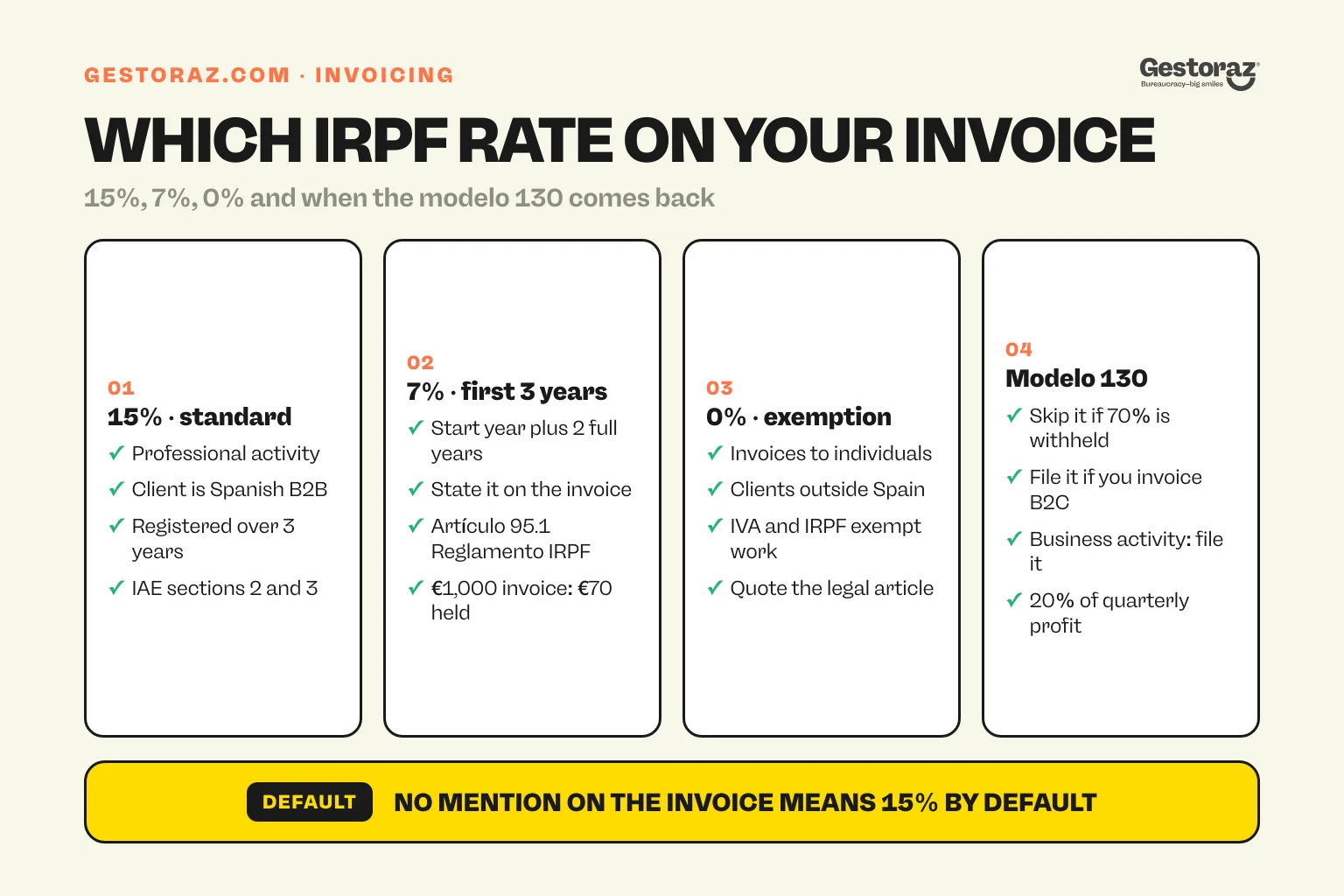
The 15% withholding applies to services invoiced by an autónomo in activity for more than 3 years, to any Spanish company or other autónomo. It is the rate you find on most B2B invoices in Spain.
Activities concerned
The 15% covers professional activities in the Spanish fiscal sense: consulting services (consultants, lawyers, accountants, architects, designers), intellectual services (authors, translators, trainers), technical services (IT, engineering). If your activity falls within the actividades profesionales list (sections 2 and 3 of the IAE tariff), 15% applies.
Concrete calculation on an invoice
You invoice €1,000 net for a consulting service to a Spanish company:
- Taxable base: €1,000.
- IVA 21%: €210.
- IRPF withholding 15%: −€150 (on the net base).
- Net to receive: €1,000 + €210 − €150 = €1,060.
Your client pays €1,060 to your account and pays €150 to the Agencia Tributaria via their modelo 111. You recover those €150 as a tax advance the following year when filing your modelo 100.
Exception: business activities
Business activities (commerce, restaurant, crafts, hospitality: section 1 of the IAE tariff) are not subject to withholding. If you are a trader or craftsperson, you invoice without withholding to your B2B clients and you pay your IRPF in full via the quarterly modelo 130.
When do you use the 7% withholding?
The reduced rate is reserved for new professional autónomos.
The 7% conditions
The 7% withholding applies to professional autónomos (professional activities, not business) during their first year of activity and the two following. That is the start year + 2 full calendar years (3 calendar years total in the best case).
How to activate the 7%
To benefit from 7%, you must explicitly mention it on your invoices: "Retención IRPF 7% conforme al artículo 95.1 del Reglamento del IRPF". If you mention 15% by default, your client will apply 15%, and you will recover the difference at the annual return (but it is more complex).
Concrete calculation with 7%
Same €1,000 net but in year one:
- IRPF withholding 7%: −€70.
- Net to receive: €1,000 + €210 − €70 = €1,140.
The gap is €80 on this invoice, or 8% of turnover immediately available. Over a year at €30,000 of turnover, the 7% instead of 15% leaves €2,400 more in cash, to be regularised later in annual IRPF.
The exact 7% timing
If you start as an autónomo in March 2026, you can apply 7% in 2026, 2027 and 2028. From 1 January 2029, you switch automatically to 15%. For complementary details on start-up costs and the Tarifa Plana, see how to become an autónomo in Spain and taxes and contributions for autónomos.
When do you use 0% withholding (exemption)?
A few specific cases let you avoid the withholding.
Specifically exempt activities
Some activities are exempt from withholding: services exported outside the EU (the withholding is geographically limited), activities exempt from IVA and IRPF (for example some medical or educational services), some specific agricultural operations.
Self-application of the exemption
To apply 0%, you must mention on your invoice the legal basis for the exemption (specific article of the Ley IRPF or Reglamento IRPF). Without that mention, your client will apply 15% by default. If you are not sure of applicability, consult a gestoría: applying 0% wrongly generates a tax adjustment at year end.
Invoices to individuals
When you invoice an individual (non-company, non-autónomo), there is no withholding in any case. The individual does not have the modelo 111 and does not practise withholding. You collect the full invoice (net + IVA) and you pay your IRPF in full via the quarterly modelo 130.
Invoices abroad
For invoices to European Union companies (B2B), no withholding (the VAT reverse charge applies). For invoices to non-EU companies, no withholding either. The withholding is strictly an intra-Spanish mechanism.
How do these withholdings interact with your modelo 130?
The modelo 130 is the other IRPF advance mechanism for autónomos.
The role of the modelo 130
The modelo 130 is a quarterly IRPF instalment that you calculate yourself on your cumulative quarter profit. You pay 20% of that profit as an advance, and you regularise on the annual modelo 100.
When you do NOT need to file the modelo 130
If more than 70% of your income comes from B2B clients who have already withheld 15% (or 7%) on your invoices, you are exempt from filing the modelo 130. The withholdings suffered serve as a tax advance and the modelo 130 would be redundant.
When you DO have to file the modelo 130
If you mainly invoice individuals, exports, or you are in a business activity (without withholding), you must file the quarterly modelo 130: before 20 April, July, October and January. The calculation is complex and is typically a case where a gestoría adds value.
Annual regularisation via the modelo 100
At year end, the modelo 100 consolidates everything: your IRPF due on all income minus withholdings already paid by your clients (modelo 111) and your own advances (modelo 130). You pay the balance or receive a refund if you advanced too much.
How do you know which rate to put on your invoices?
Here is a practical decision tree.
Step 1: is your client in Spain?
If no (foreign EU or non-EU): no withholding, mention "Operación intracomunitaria" or "Exportación".
Step 2: is your client an individual?
If yes (individual non-entrepreneur): no withholding.
Step 3: is your activity "profesional" or "empresarial"?
If empresarial (commerce, restaurant, crafts of section 1 of the IAE tariff): no withholding, payment via quarterly modelo 130.
If profesional (consulting, technical, intellectual of sections 2-3 of the IAE tariff): mandatory withholding.
Step 4: how long have you been registered as autónomo?
If less than 3 calendar years: 7% withholding.
If 3 years or more: 15% withholding.
Step 5: do you fall under a specific exemption?
If yes (medical/educational exempt activities, exports outside the EU): 0% withholding with legal mention.
Otherwise: apply the rate determined in the previous steps.
What pitfalls are common with IRPF withholdings?
Several mistakes recur and complicate the life of new autónomos.
Forgetting the withholding on invoices
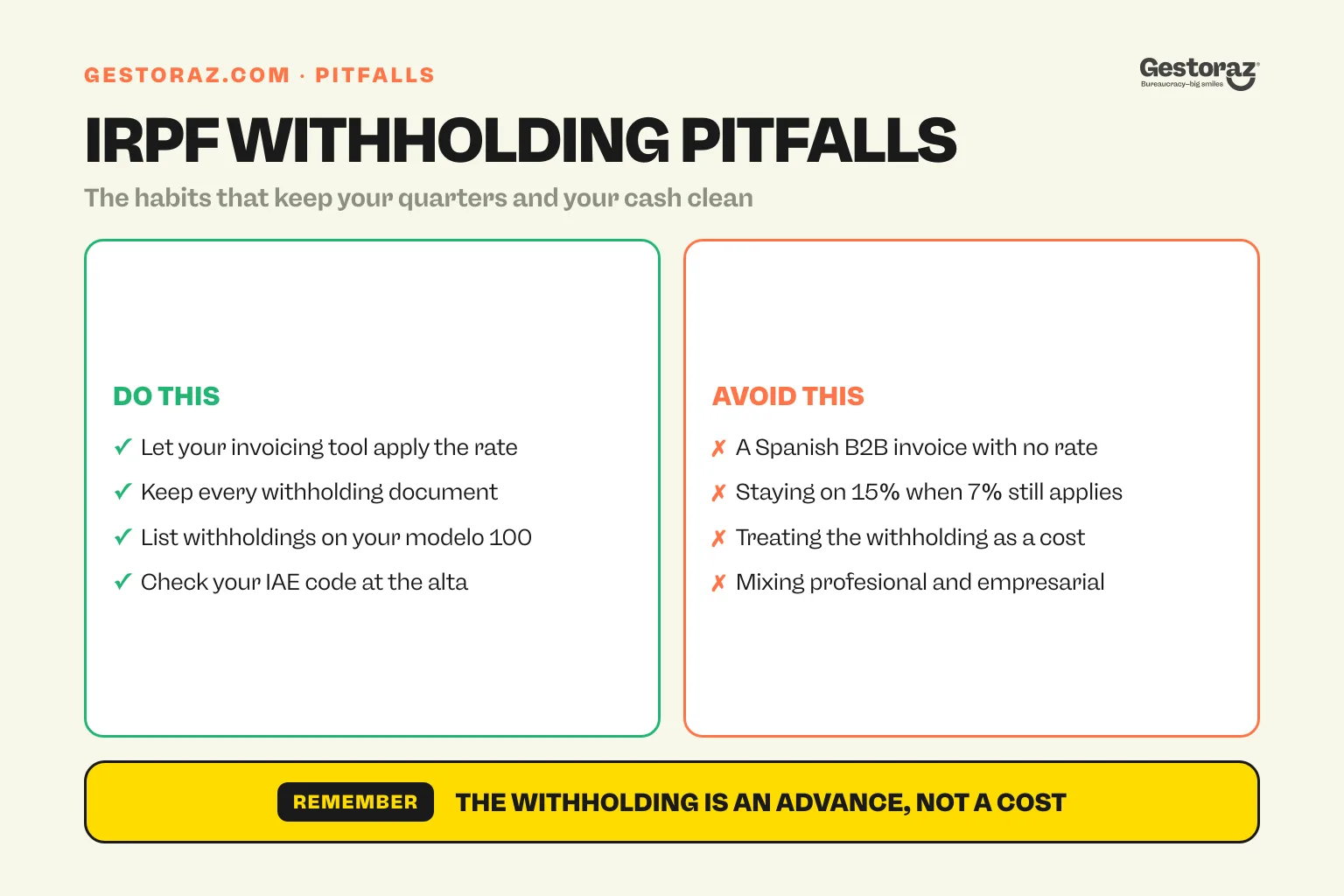
Mistake number one: issuing a B2B invoice in Spain without mentioning the withholding. Your client will withhold anyway (because they are required to) but your invoice will be "non-conform" and they may reject it or ask for a re-issue. Configure your invoicing tool to apply the withholding automatically.
Wrong rate mentioned
Mentioning 15% when you are eligible for 7% is an optimisation error. You can recover the difference at the annual return, but you lose the immediate cash benefit. And vice versa: applying 7% when your 3 years are over generates a reassessment.
Believing the withholding is a cost
The withholding is NOT an economic cost: it is a tax advance. At the annual return, you deduct all withholdings suffered from your total IRPF. Many beginners overestimate their "loss" and underestimate their actual cash flow.
Failing to declare withholdings correctly on the modelo 100
When filing your modelo 100, you must mention every withholding your clients have paid in your name. That is what lets you recover the advance. If you forget, you pay twice (the withholding already paid + the full IRPF). Carefully keep all withholding supporting documents (each invoice issued + the annual summary received from each client).
Confusing professional and business activity
If you are a trader (e-commerce, restaurant), you do not apply withholding but you must file the modelo 130. If you are a consultant (professional activity), you practise withholding and you are often exempt from the 130. Check your IAE code at the autónomo alta. The full procedure sits in how to become an autónomo in Spain and the broader picture in the difference between autónomo and SL.
Not anticipating the IRPF regularisation
Withholdings are advances calculated on the gross. If you have many deductions, you may end up with overpayment at year end (refund). If you have few deductions and many non-withheld B2C revenues, you may have a significant balance to pay. Anticipate via a provision.
Where to start practising IRPF withholdings as an autónomo
The autónomo IRPF withholdings in Spain are a structural mechanism of the fiscal system that is best understood from the start. The practical rule: 15% by default on B2B invoices in Spain (professional activity), 7% in the first 3 years, 0% in specific exemption cases. No withholding on invoices to individuals or abroad.
Configure your invoicing tool to apply the right rate automatically, keep all withholding supporting documents throughout the year, and declare them correctly on your annual modelo 100 to recover the advances. Good withholding practice smooths your cash flow and avoids unpleasant regularisations. The full taxation context sits in taxes and social security contributions for autónomos.
Are you starting as an autónomo and want to set up your invoicing correctly, or are you in doubt about the rate applicable to your situation? At gestoraz, we can configure your system, check eligibility for 7% or 0%, and manage the modelos 130, 100, 111, 190 as a whole.
Official sources
- Agencia Tributaria, professional withholdings, sede.agenciatributaria.gob.es: rules of application of the 7%, 15% and 0% withholdings.
- Reglamento del IRPF, Real Decreto 439/2007 (BOE), boe.es/buscar/act.php?id=BOE-A-2007-7457: article 95 on professional withholdings.
- Ley 35/2006 IRPF (BOE), boe.es/buscar/act.php?id=BOE-A-2006-20764: reference text on IRPF.
- Modelo 111, sede.agenciatributaria.gob.es: monthly/quarterly withholding declaration by payers.
- Modelo 130, sede.agenciatributaria.gob.es: IRPF instalment for autónomos.
- Modelo 100, sede.agenciatributaria.gob.es: annual IRPF return.


Obtain your Digital Certificate entirely remotely.
Request your Digital Certificate completely remotely.

