



Everything you need to know about the NUSS number in Spain
The NUSS number in Spain is the social security identifier that connects you to the Spanish protection system: public healthcare, pension, sick leave, unemployment, maternity and paternity leave. Without a NUSS, you cannot work as an employee, register as an autónomo, or access care via the Seguridad Social. It is the social counterpart of the NIE (which is the administrative and fiscal identifier) and many expats do not realise they need both to settle long-term in Spain.
This article explains what the NUSS is, what it is used for, who must obtain one, how to request it depending on your status (employee, autónomo, SL director, EU pensioner with S1), and how it interacts with the TSI (health card) for actual access to care. We also detail the common pitfalls for newcomers and the related steps to plan ahead.
What exactly is the NUSS?
Before the procedures, you have to grasp the nature and role of this identifier.
A unique social security identifier
The NUSS (Número de Usuario de la Seguridad Social) is allocated by the Tesorería General de la Seguridad Social (TGSS) to anyone with a relationship to the Spanish protection system. Format: 12 digits in the form XX/XXXXXXXX/XX where the first two digits indicate the province of allocation. Like the NIE, the NUSS is allocated for life: you only have one, even if you change activity or region.
Distinct from the NIE and the NIF
Many people confuse the NUSS with the NIE/NIF. They are entirely different identifiers: the NIE/NIF serves administrative and fiscal identification, the NUSS serves social identification. To grasp the full ecosystem, see the NIE in Spain and the difference between NIE and NIF.
Linked to but distinct from the TSI
The NUSS is not the TSI (Tarjeta Sanitaria Individual). The NUSS is your numerical social security identifier; the TSI is the plastic card issued by your autonomous community that actually lets you visit the doctor, collect a prescription or go to hospital. The TSI is issued from the NUSS, but obtaining it is a separate step at your local centro de salud.
What is the NUSS used for?
The NUSS opens access to every social benefit in Spain.
Access to public healthcare
With your NUSS and your TSI, you can consult a GP, see a specialist with a referral, undergo surgery in a public hospital, access reimbursed medication, and benefit from emergency care. To understand the full system, see the Spanish healthcare system for expats.
Pension contributions
All your social contributions (whether you are an employee, autónomo or SL director) are recorded under your NUSS and feed your Spanish pension account. At legal age (66-67 depending on cohorts), those contributions determine the size of your pension.
Sick leave and incapacity benefits
If you go on sick leave as an employee, the employer pays the first days then social security takes over (60% of salary from day 4, 75% from day 21). For autónomos, equivalent benefits exist following recent improvements to the regime. For details, see how the Spanish social security system works for self-employed and businesses.
Unemployment and family leave
The SEPE (Public Employment Service) pays unemployment benefits based on your NUSS and contribution history. Likewise, maternity leave (16 weeks paid at 100%), paternity leave (16 weeks since 2021), and other family benefits are linked to the NUSS.
Who must obtain a NUSS number?
The NUSS concerns anyone interacting with the Spanish social system.
Employees
Anyone signing an employment contract with a Spanish company receives a NUSS automatically when the employer files the alta via the Sistema RED. The employer withholds employee contributions on the gross and pays its own employer contribution. For the detail of social charges for businesses, see how the Spanish social security system works.
Autónomos
To become an autónomo, registration with the RETA (Régimen Especial de Trabajadores Autónomos) requires a NUSS. If you do not have one yet, you request it together with your autónomo alta via the modelo TA0521. For the full path, see how to become an autónomo in Spain.
SL directors
The director of a Spanish SL must register personally as an autónomo societario with the TGSS and pay a monthly cuota (€350-€590 depending on tramo). This registration requires a NUSS, used throughout the director's professional life. To understand the SL set-up, see the step-by-step guide to setting up an SL.
EU pensioners with S1
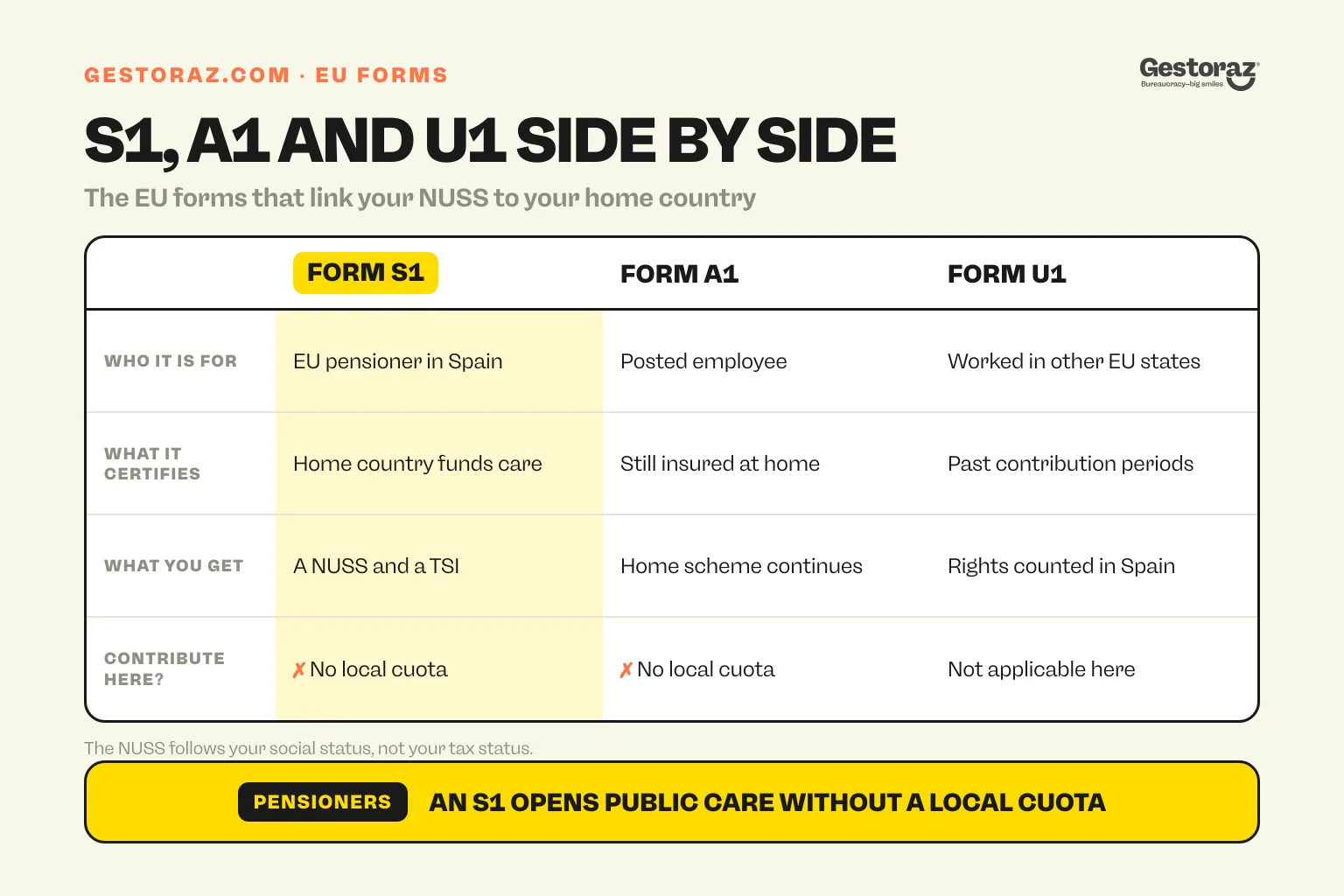
EU/EEA pensioners settling in Spain can request a NUSS via the S1 form (issued by the social security in the country of origin). The S1 transfers health cover without requiring contributions in Spain: you access the TSI and the public system without paying a local cuota. For resident status, see everything about residency in Spain.
Interns and apprentices
Paid programme interns, apprentices, and beneficiaries of public scholarships with social cover also receive a NUSS, generally managed by the host institution.
How do you obtain your NUSS?
Three main routes depending on your status.
Route 1: through your employer (employee)
If you sign a Spanish employment contract and do not yet have a NUSS, your employer requests it for you via the Sistema RED at the moment of registering you with social security. You have nothing to do: the NUSS arrives within days and appears on your first payslip.
Route 2: by yourself via the TGSS (autónomo, director)
If you are an autónomo or SL director, you request your NUSS directly from the TGSS via the Sede Electrónica (with a digital certificate or Cl@ve, see the digital certificate and Cl@ve) or in person with a cita previa. The form modelo TA1 lets you request only the NUSS, or you can combine with your RETA alta via the modelo TA0521. Lead time: a few days, sometimes immediate.
Route 3: via a gestoría
For expats who want to delegate or who do not master administrative Spanish, a gestoría can handle the NUSS request as part of broader support (autónomo alta, SL set-up). Cost: included in the global fees, generally €50-€150 for the NUSS request alone.
Required documents
Whatever the channel, you must provide: your valid NIE/NIF, your passport or ID card, the completed modelo TA1, your fiscal address in Spain, and depending on the case the motive (employment contract, autónomo alta, SL articles).
How do you activate the TSI (health card) after obtaining your NUSS?
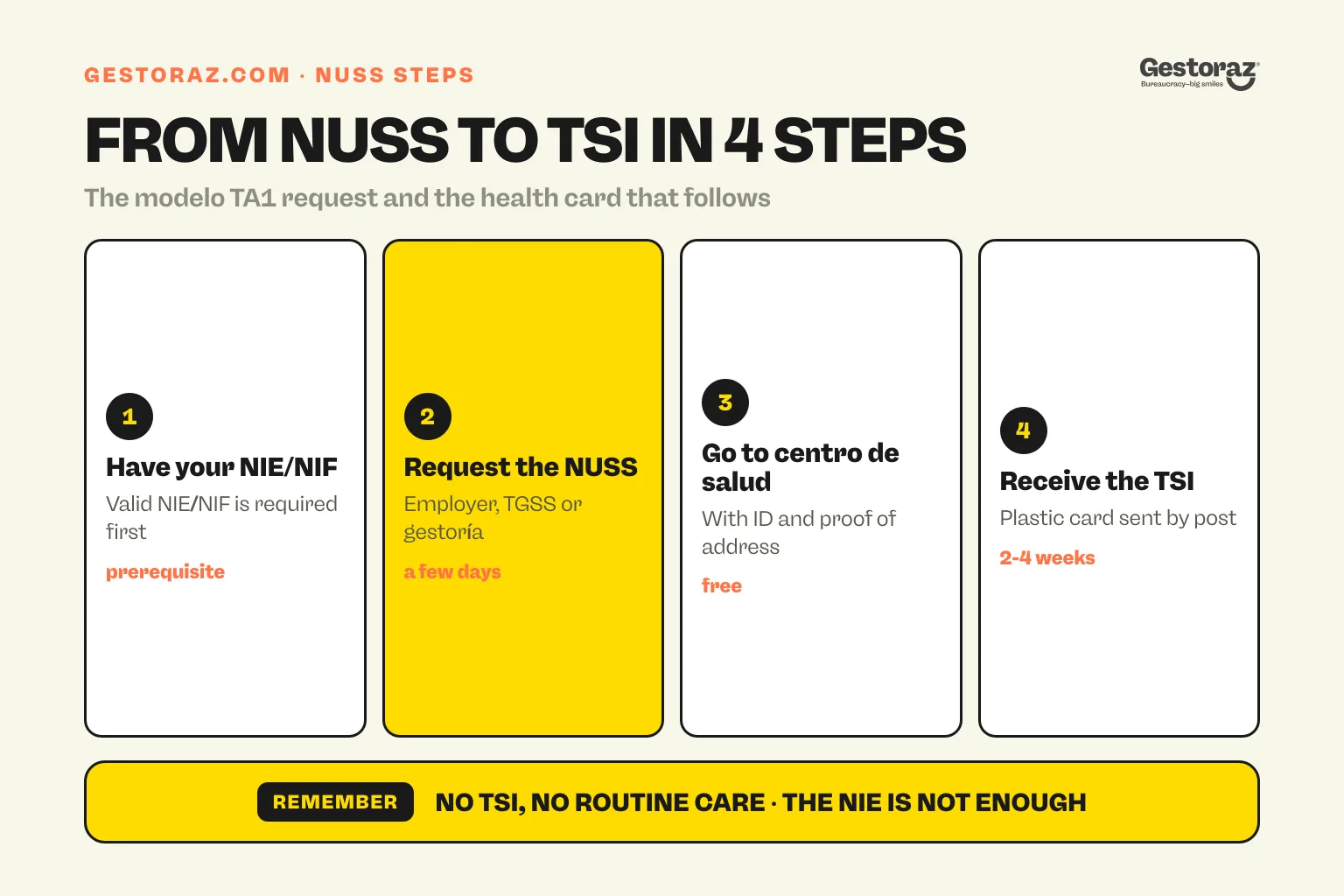
The NUSS alone does not give you access to care. You must activate your health card.
Go to the centro de salud
With your NUSS, your ID and your proof of address in Spain (padrón or lease), you go to the centro de salud (health centre) closest to your home. Registration is free and lets you choose a family doctor (médico de familia) and a paediatrician if you have children.
Receive the TSI
The TSI (Tarjeta Sanitaria Individual) is sent by post within 2-4 weeks of registration. It is the plastic card you present at consultations and at the pharmacy for reimbursed medication. Without TSI, you cannot be treated routinely (except emergencies).
Use public healthcare day-to-day
With your TSI, you have free access to the GP, to specialists with a referral, to public hospitalisation, and to reimbursed medication (with copayment varying by income). For the operating details, see the Spanish healthcare system for expats.
How does your NUSS interact with your resident status?
The NUSS is linked to your social status, not your fiscal status.
You can have a NUSS without being a tax resident
A foreign worker temporarily in Spain (3-6 month assignment without moving) can hold a NUSS to contribute during the stay, without becoming a Spanish tax resident (if they do not exceed 183 days). To grasp this distinction, see the difference between fiscal and social residence.
You can be a tax resident without a NUSS
A pensioner with capital income who settles in Spain becomes a tax resident (taxed on worldwide income via IRPF) but may not hold a NUSS if they do not contribute (for example with private health insurance and no S1). The NUSS and tax residency are independent things. The interplay with the NIE is detailed in the impact of your NIE on your tax status in Spain.
The S1 form for EU pensioners
The S1 is the key instrument for EU pensioners settling in Spain. Issued by the social security of the country of origin, it certifies that your country continues to fund your care in Spain. You obtain a NUSS and a TSI without contributing locally, and Spain bills the care to your country of origin. It is the equivalent of the reciprocal system for European expats.
Forms A1 and U1
The A1 is used for posted workers (employees temporarily sent by their original employer to Spain): they continue to contribute in their country and do not need to contribute in Spain. The U1 certifies the contribution history in another EU country for the calculation of unemployment or pension entitlements in Spain.
What pitfalls are common with the NUSS?
Several mistakes recur with newcomers.
Believing the NIE gives access to healthcare
Mistake number one: thinking that holding an NIE is enough to see a doctor. The NIE is just the administrative identifier. You must obtain a separate NUSS to enter the social security system. Without a NUSS, you can buy private health insurance but you will not have the public TSI. The same myth is dismantled in nine misconceptions about the NIE number.
Forgetting to activate the TSI
Holding a NUSS does not automatically give you the TSI. You must go to the centro de salud to register and receive your card. Many expats have had their NUSS for months but never activated their TSI, complicating medical visits.
Confusing personal NUSS and employer CCC
If you are an employer (a company hiring in Spain), your company has a separate Código de Cuenta de Cotización (CCC), which is not a NUSS. The NUSS is allocated to natural persons, the CCC to companies. Do not confuse the two.
Failing to request an S1 as an EU pensioner
Many EU pensioners settling in Spain take out private health insurance when they could have requested an S1 and accessed public healthcare for free. The procedure takes 4-8 weeks but saves several hundred euros a year of private insurance.
Holding multiple NUSS
There should only be one per person. If you have accumulated multiple altas in error, contact the TGSS to merge the files and keep a single NUSS. Diverging multiple NUSS complicate the calculation of your pension entitlements.
What to do after obtaining your NUSS?
Several related steps complete social registration.
Open the TSI
Top priority: go to the centro de salud to register and receive the TSI. Without it, you do not really have access to public healthcare.
Check your contributions
Create an account on the Sede Electrónica de la Seguridad Social (with digital certificate or Cl@ve) to consult your contribution history, accrued entitlements, and projected pension account.
Update your file in case of change
If you change address, name (marriage), or professional status (employee to autónomo, autónomo to SL director), inform the TGSS. Undeclared administrative changes can generate inconsistencies between files.
Sync with the Agencia Tributaria
Your NUSS and your NIE/NIF must be consistent across databases. Administrations share their data but inconsistencies (different address, misspelled name) can appear. Check with both administrations if you spot discrepancies.
In short on the NUSS number
The NUSS number in Spain is the identifier that links you to the Spanish social system: healthcare, pension, benefits, unemployment, leave. Distinct from the NIE and the NIF, it is obtained automatically via your employer (employee), through a personal request (autónomo, director), or via the S1 form (EU pensioner).
The practical rule: as soon as you start a professional activity or settle long-term in Spain, request your NUSS quickly and activate your TSI in the same momentum. Without these two bricks, your access to the social system stays theoretical. The NUSS is allocated for life and follows you through every change of status. To understand related identifiers, see where to find the número de soporte.
Preparing a move, a change of activity, or an S1 file for your retirement in Spain? At gestoraz, we can manage the NUSS request, the TSI activation, and the coordination with your fiscal status so you are in order on every front.
Official sources
- Tesorería General de la Seguridad Social, sede.seg-social.gob.es: NUSS request, modelo TA1, contributor account management.
- INSS, Instituto Nacional de la Seguridad Social, sede.seg-social.gob.es: social benefits and entitlements.
- SEPE, Servicio Público de Empleo Estatal, sepe.es: unemployment benefits and employment history.
- Sistema Nacional de Salud, sanidad.gob.es: public healthcare and TSI coordination by autonomous community.
- Real Decreto Legislativo 8/2015 (Ley General de la Seguridad Social) (BOE), boe.es/buscar/act.php?id=BOE-A-2015-11724: reference text on social security.
- Regulation (EC) 883/2004, eur-lex.europa.eu/legal-content/EN/TXT/?uri=CELEX:32004R0883: coordination of EU social systems and forms S1, A1, U1.


Obtain your Digital Certificate entirely remotely.
Request your Digital Certificate completely remotely.

