



How to become a tax resident in Spain
Becoming a tax resident in Spain is less a voluntary step than a status that triggers automatically when certain criteria are met. Many expats believe they choose their tax residency by filling in a form. Reality is different: it is the Agencia Tributaria that qualifies you as resident or non-resident, based on objective criteria (days of presence, economic interests, family). These criteria apply whether you want them to or not, and with significant fiscal consequences.
This article explains exactly the three criteria that trigger Spanish tax residency, how they interact with your status in your home country, what tax residency changes day-to-day (taxation of worldwide income via IRPF, modelo 720 on foreign assets), and how to intelligently plan the switch from non-resident to resident to avoid nasty surprises.
What are the criteria for tax residency in Spain?
The Agencia Tributaria uses three independent criteria. A single one is enough to qualify you as resident.
Criterion 1: more than 183 days a year in Spain
This is the best-known and most mechanical criterion. If you spend more than 183 days on Spanish territory during a calendar year (1 January to 31 December), you are automatically a tax resident for that year. Partial days count as full days: an arrival at 10pm counts as a full day, a departure at 8am counts too.
Sporadic absences (foreign holidays, business trips) do not suspend this calculation as long as your centre of life remains in Spain. The Agencia Tributaria can consider an absence "sporadic" even if it exceeds 30 days, as long as you return afterwards to your usual Spanish home.
Criterion 2: centre of economic interests in Spain
You can become a tax resident without exceeding 183 days if your main centre of economic interests is in Spain. This includes: your main professional activity (salary, autónomo, SL director), your main assets (property, accounts), or your main income sources. This criterion is more subjective than the 183 days and gives rise to interpretations sometimes diverging between the administration and the taxpayer.
Criterion 3: spouse and minor children resident in Spain
If your spouse and minor children habitually reside in Spain (unless proven otherwise by separation), you are presumed a Spanish tax resident, even if you personally live abroad. This presumption is used by the administration to track taxpayers who claim to live abroad while having their family settled in Spain.
What does tax residency concretely change?
Becoming a Spanish tax resident profoundly changes your obligations to the tax office.

Worldwide income taxation via IRPF
As a tax resident, Spain taxes you on all your worldwide income: Spanish and foreign salaries, dividend income, capital gains, foreign property rents, pensions, social benefits. Everything is aggregated into a single return, the modelo 100, filed between April and June for the previous year. The scale is progressive: 19% up to €12,450, 24% up to €20,200, 30% up to €35,200, 37% up to €60,000, 45% up to €300,000, 47% above.
Modelo 720 for foreign assets
If you hold foreign assets (bank accounts, securities, property) above €50,000 per category, you must declare them every year before 31 March via the modelo 720. It is an information return (no direct taxation) but failure or delay is heavily penalised: historical minimum fine of €1,500, lightened by European case law but still significant.
Access to bilateral tax treaties
In return, you gain access to the tax treaties Spain has signed with your country of origin (UK, France, Germany, Netherlands, etc.). Those treaties avoid double taxation by allocating the right to tax to one of the two countries depending on the nature of the income. That is what protects you against UK-Spain double taxation on your pension or rental income.
Difference with non-resident status
If you are not a tax resident, Spain only taxes you on your Spanish-source income via the IRNR (modelo 210), with a flat rate of 19% (EU/EEA) or 24% (non-EU). For details, see how much tax a non-resident pays in Spain.
How is the year of the non-resident to resident switch calculated?
This is one of the most delicate questions for expats settling mid-year.
No proration: it is all or nothing
Spain does not practise proration: if you meet the tax residency criteria during a calendar year, you are resident for the entire year, from 1 January to 31 December. Concretely, if you move on 1 June and finish the year at 215 days in Spain, you are a tax resident for the 12 months, including for income earned before your arrival.
Consequences for income at the start of the year
This can generate delicate situations: your January-May UK earnings can become taxable in Spain in addition to being taxed in the UK. The UK-Spain tax treaty generally allocates the right to tax to the UK for days worked in the UK, but Spain recovers via global taxation plus deduction of tax already paid. This mechanism is complex and requires fiscal planning.
The alternative rule: last-day criterion
Some expats try to manage a calendar that keeps them under 183 days during the moving year, to switch to tax residency only the following year. This is legal if the other criteria (centre of interests, family) are not met either. But the Spanish administration verifies the year afterwards on the basis of supporting evidence (plane tickets, invoices, contracts).
What to do before the switch to tax residency?
A few months of planning before the move can save several thousand euros.
Realise your capital gains in the country of origin
If you have a share portfolio or a property with latent gains, selling before becoming a Spanish tax resident avoids Spanish taxation on the capital gain. Those gains are then taxed in your country of origin under its rules, which may be more favourable.
Trigger dividends or capital distributions
Receiving dividends or capital withdrawals before the switch to tax residency places them under your country of origin's regime. Once a Spanish resident, those flows enter your worldwide income taxed at IRPF (up to 28% for capital income).
Restructure your assets
For expats with significant assets, it can be wise to restructure beforehand: trust declarations, transfers between accounts, etc. Any major operation must be done before Spanish tax residency to avoid falling under the modelo 720 or under wealth tax (Impuesto sobre el Patrimonio) which exists in some autonomous communities.
Choose the right moving moment
If you can choose, moving in the second semester lets you remain a non-resident for the moving year (since you do not exceed 183 days). You become a resident from the following calendar year, leaving time to finalise operations in your country of origin.
Special regimes: Beckham and impatriates
Spain offers two attractive regimes for some expats.
The Beckham regime (flat tax)
The impatriate regime (often called the "Beckham law" because David Beckham benefited from it) allows an expat settling in Spain for professional reasons to be taxed at a flat rate of 24% on employment income up to €600,000/year, and 47% above. This regime applies during the year of arrival and the 5 following years (6 years total).
Conditions: not having been a Spanish tax resident in the 5 years preceding the move, moving for professional reasons (Spanish employment contract, transfer, or autónomo alta in some cases), and filing the modelo 149 within 6 months of social security registration.
Digital nomad regime (nomad visa)
Since 2022, Spain offers a visa and a fiscal regime for digital nomads: 24% on income up to €600,000, with relaxed conditions (work can be for a foreign employer). This regime is more accessible than the historic Beckham law but remains reserved for foreign teleworkers.
When are these regimes worth it?
These regimes are attractive for high-income expats (above €60,000) who would otherwise have fallen into the upper IRPF brackets. Below that, the standard IRPF regime is often more advantageous thanks to personal deductions. A simulation is recommended before choosing.
What pitfalls are common when switching to tax residency?
Several mistakes recur and can prove costly.
Believing inaction maintains non-resident status
Doing nothing is not enough: if you meet the criteria, you are a tax resident regardless of the absence of a declarative step. The Agencia Tributaria can requalify your status retroactively with tax assessments over 4 years plus penalties.
Confusing tax residency with other residencies
Tax residency is independent of administrative residency (NIE, TIE) and social residency (NUSS, social security). You can be a tax resident without being administrative resident, and vice versa. To grasp the distinctions, see everything about residency in Spain and the difference between fiscal and social residence.
Forgetting the modelo 720 in year one
Forgetting the modelo 720 is the most common sanction on newly resident expats. Identify all your foreign assets (accounts, securities, property) above €50,000 and declare them before 31 March of the year following the switch to tax residency.
Wrongly keeping non-resident status in the country of origin
If you are now a Spanish tax resident, you must also notify your country of origin to no longer be taxed there on your worldwide income. The UK, France and Belgium have specific procedures (P85 for the UK, declaration of departure for France).
Underestimating income to declare
IRPF covers all worldwide income: salaries, dividends, interest, capital gains, rents, pensions, social benefits, and even some cryptocurrency gains. Many expats forget minor sources that can still trigger reassessments.
Confusing NIE and tax residency
Holding an NIE does not make you a tax resident. Many foreign investors who buy an apartment in Spain wrongly think they switch to tax residency by obtaining their NIE. The NIE is just an identifier. To understand, see the impact of your NIE on your tax status and nine misconceptions about the NIE number.
How to intelligently plan your switch to tax residency?
Good planning starts 6-12 months before the move.
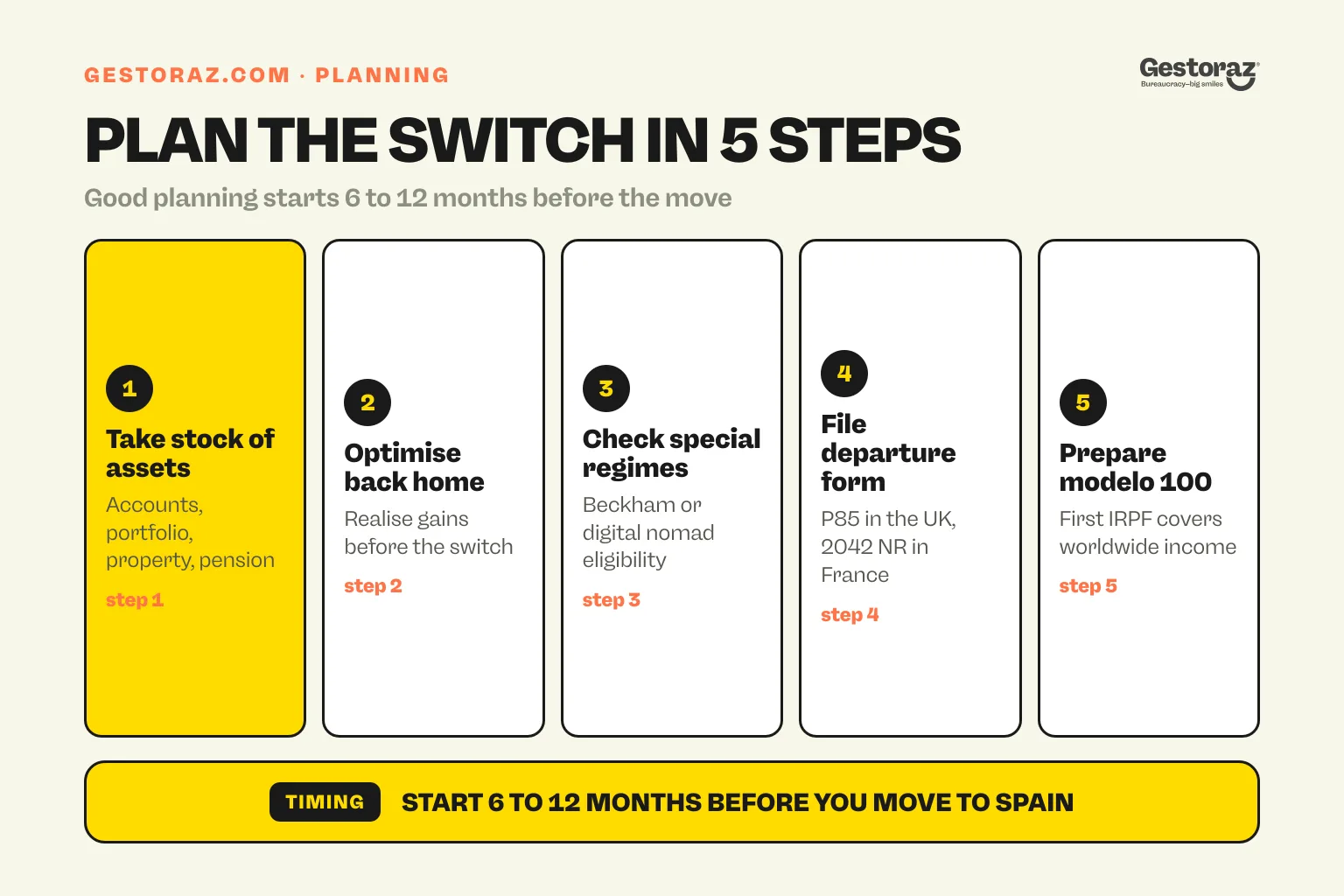
Step 1: take stock of your assets
List all your assets: bank accounts, investment portfolios, property, shares, pension, life insurance. Identify what is above the €50,000 threshold for the modelo 720, and what generates potentially taxable latent gains.
Step 2: optimise in the country of origin
Realise major capital gains, trigger pending dividends, restructure complex estates. The aim is to "cleanse" latent gains under the favourable regime of the country of origin before the switch to Spain.
Step 3: check applicable special regimes
If you are going to have professional income in Spain, check eligibility for the Beckham or digital nomad regime. A comparative IRPF / special regime simulation can show a gain of several thousand euros a year over 6 years.
Step 4: file the departure declaration in the country of origin
For UK citizens, file form P85 with HMRC; for French citizens, the declaration of departure (form 2042 NR). These steps formalise the change of tax residency and avoid future double taxation.
Step 5: prepare the first Spanish return
The year of the switch, your first IRPF return (modelo 100) must include all your worldwide income. For autónomos or directors, see how to become an autónomo in Spain and the step-by-step guide to setting up an SL. The full picture of residency types is in everything about residency in Spain.
Where to start your switch to Spanish tax residency
Becoming a tax resident in Spain is not an administrative decision but a status that flows from your physical presence and your interests. The practical rule is simple: above 183 days a year, you become a Spanish tax resident. But optimisation around this switch requires fine planning and often binational expertise.
The timing of the switch (mid-year vs start of year), the preparatory state of your assets, the choice of applicable Spanish tax regime (standard IRPF or Beckham), and coordination with the tax office of your country of origin are the four dimensions to master. Well planned, the switch can generate savings of several thousand euros a year over the first years.
Are you planning to move to Spain in the next 12 months? At gestoraz (ideally with a partner in your country of origin) we can quantify the fiscal impact of the switch, identify pre-move optimisations, and handle the first returns in Spain to avoid costly errors.
Official sources
- Agencia Tributaria, tax residency, sede.agenciatributaria.gob.es: tax residency criteria and applicable returns.
- Ley 35/2006 IRPF (BOE), boe.es/buscar/act.php?id=BOE-A-2006-20764: reference text on personal income tax.
- Modelo 720 (instructions), sede.agenciatributaria.gob.es: declaration of foreign assets for tax residents.
- Beckham regime (modelo 149), sede.agenciatributaria.gob.es: impatriate regime and forms.
- Spain-UK tax treaty, hacienda.gob.es: bilateral treaty to avoid double taxation.
- Spain-France tax treaty, hacienda.gob.es: equivalent for French expats.
- Ley de Startups (Ley 28/2022) (BOE), boe.es/buscar/act.php?id=BOE-A-2022-21739: digital nomad regime.


Obtain your Digital Certificate entirely remotely.
Request your Digital Certificate completely remotely.

