



Step-by-step guide to setting up a Sociedad Limitada (SL) in Spain
Setting up a Sociedad Limitada in Spain is the most common route to structure an economic activity beyond the autónomo status. The SL is the Spanish equivalent of an Ltd or LLC: modest minimum capital, limited liability of partners, corporate taxation. But the administrative path is longer than a simple self-employed registration, and it is worth preparing in the right order to avoid blockages.
This article offers a detailed roadmap, step by step, to go from idea to a fully operational SL. We cover the name, the capital, the articles, the notary, registration with the Registro Mercantil, obtaining the NIF, the alta with social security and registration with the Agencia Tributaria. We indicate lead times, realistic costs, the pitfalls specific to foreign entrepreneurs and the trade-offs between doing it yourself and delegating to a gestoría.
Why set up an SL rather than stay an autónomo?
Before the roadmap, you must clarify the decision. An SL costs more in start-up and maintenance than the autónomo status, but it brings real advantages above a certain activity threshold.
Personal asset protection
The autónomo answers for their professional debts on their personal assets. The SL, as a separate legal entity, limits liability to the contributed capital. If the company goes bankrupt, the partners' personal assets (home, accounts, cars) are protected except in cases of fraud or serious management default. For risk activities (e-commerce with large stock, advisory with exposed clients, restaurant, construction), it is a decisive argument.
Tax optimisation above €50,000
Above a certain profit level, the combination "corporate income tax at 23% + dividends at 19-23%" becomes significantly more advantageous than the progressive IRPF scale that hits the autónomo (up to 47%). For a detailed comparison of the switch threshold, see autónomo vs SL in Spain and taxes for a Sociedad Limitada.
Commercial credibility and hiring
An SL inspires more confidence to corporate clients (large accounts, public tenders, foreign partners) than an autónomo. It also makes it easier to hire, structure shareholding with partners or investors, and consider a future sale of the company or a succession.
What are the steps to incorporate an SL in Spain?
The standard path includes 8 main steps to chain in order. Total duration goes from 3 to 6 weeks depending on regions and notarial speed.
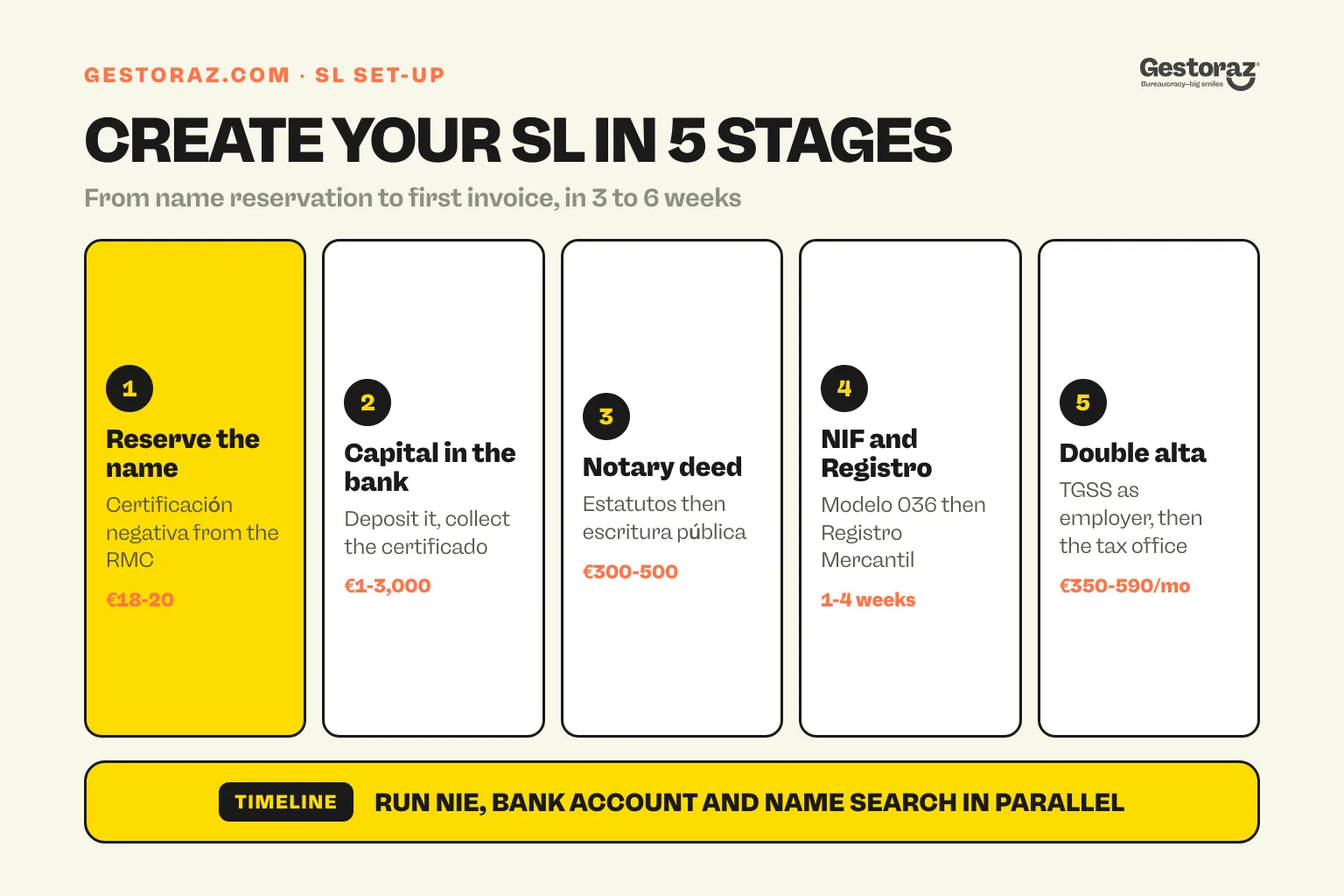
Step 1: choose and reserve the name (denominación social)
You must first choose the name of your future SL and check it is not already taken. The request is made online with the Registro Mercantil Central (RMC) by proposing five names in order of preference. The RMC issues a certificación negativa de denominación, proving the name is available. This certification is valid 3 months and costs around €18-€20. The name must end with "S.L." or "Sociedad Limitada". Without certification, the notary cannot sign the articles.
Step 2: open a bank account in the name of the SL in formation
You must open a special "company in formation" bank account in a Spanish bank and deposit the share capital (legal minimum of €3,000, but lowered in practice thanks to the new 2022 law allowing creation with only €1 of capital, provided you build a legal reserve). The bank issues a certificado bancario confirming the deposit, to present to the notary. Many banks require that the partners' NIE be already obtained: see the NIE in Spain and how long it takes to apply for an NIE.
Step 3: draft the articles (estatutos)
The articles define the corporate purpose (precise description of activities), capital, partners and their share, governing bodies (sole administrator, board, etc.), operating rules and rules for transferring shares. For a standard SL, model articles exist and a notary can provide them, but an SL with complex shareholding or specific exit clauses deserves bespoke drafting. It is a step where a gestoría or a tax lawyer adds real value.
Step 4: sign the incorporation deed at the notary
The notary (notario) receives the partners and signs the escritura pública de constitución, the official birth deed of the SL. The notary receives: the RMC certificación negativa, the bank certificado, the articles, the IDs (NIE for foreigners), and any partners' agreement. Notarial cost: around €300-€500 net depending on capital and complexity. Without this deed, the SL does not legally exist.
Step 5: obtain the provisional then definitive NIF
Once the escritura is signed, you request a provisional NIF from the Agencia Tributaria via the modelo 036. The SL then has a fiscal identifier to start its operations. After registration with the Registro Mercantil (step 6), the NIF becomes definitive. The NIF of an SL starts with the letter B. To understand the difference and use of company NIF vs personal NIE, read apply for NIF in Spain for foreign companies and what is a NIF number.
Step 6: register the SL at the Registro Mercantil Provincial
The escritura is then filed with the Registro Mercantil of the province where the SL has its registered office. Registration formalises the SL as a legal entity and gives it access to all commercial operations. Lead time: 1 to 4 weeks depending on the province. Cost: around €100-€200. Without registration, the SL cannot legally invoice third parties.
Step 7: alta with social security
If the SL hires employees, it must register as an employer with the TGSS and obtain a Código de Cuenta de Cotización (CCC). The SL director must register personally as an autónomo societario and pay their monthly cuota directly to the TGSS. To understand the social charges and director cuota, see how the Spanish social security system works for self-employed and businesses.
Step 8: alta with the Agencia Tributaria and start of activity
Last step: file the declaración censal (modelo 036) with the Agencia Tributaria to declare the start of activity, the applicable VAT regimes, registration with the intra-EU operators register (ROI) if you trade with the EU, and the IAE activity code. From there, the SL can invoice, deduct IVA, and start respecting its fiscal obligations: quarterly returns 303 (IVA), 111 (withholdings), 200 (annual IS) and 202 (IS instalments).
How much does it cost to set up an SL in Spain?
Costs vary with delegation and complexity, but here is a realistic range for a standard SL with one or two partners.
Unavoidable administrative fees
The RMC certificación negativa costs about €20, the notarial deed between €300 and €500 net, the Registro Mercantil Provincial registration between €100 and €200, and the bank set-up generally free but with the initial capital deposit (€3,000 minimum recommended in practice). Minimum total: about €600-€800 of pure fees.
Gestoría or lawyer fees
If you delegate the full path to a gestoría, count between €600 and €1,200 depending on complexity. For an SL with several partners, a partners' agreement or specific clauses, a tax lawyer adds value but charges more. For foreign entrepreneurs, this premium is largely justified by time saved and legal certainty.
Operating costs in year one
Beyond creation, plan for the director's monthly cuota (€350 to €590 depending on tramo, with no access to the Tarifa Plana), recurring accounting fees (€200 to €350 per month for a gestoría handling quarterly IVA, payroll, IS), and the filing of the Annual Accounts in year one (about €100-€150). Total year-one budget: €6,000 to €12,000 on top of the creation costs.
What obligations must be respected once the SL is incorporated?
An active SL in Spain must follow a strict calendar of fiscal and social filings throughout the year.
Quarterly fiscal returns
Every quarter, the SL files the modelo 303 (IVA collected and deductible), the modelo 111 (IRPF withholdings on salaries and professional invoices), and the modelo 202 (corporate income tax instalment). If it has intra-EU operations, it adds the modelo 349 (summary of EU purchases/sales). These returns are filed in April, July, October and January.
Annual returns
Every year, the SL files the modelo 200 (corporate income tax return) in July for the previous year, the modelo 390 (annual IVA summary) in January, and the modelo 190 (annual withholding summary). For the detail of rates and possible optimisations, read taxes for a Sociedad Limitada.
Social and accounting obligations
The SL must also file its Annual Accounts with the Registro Mercantil every year (in July generally), within strict deadlines under penalty of sanctions. If it employs staff, it must manage payslips, social contributions, and keep a contracts book monthly. A gestoría generally covers the whole for €200-€350 per month.
What pitfalls are specific to foreign entrepreneurs?
Setting up an SL from abroad or as a non-resident in Spain has subtleties to anticipate.

Partners' NIE and remote signature
All foreign partners must obtain an NIE before signing the notarial deed. NIE delays can postpone the SL creation by several weeks if poorly handled. The signature can be done remotely via a notarial power of attorney (apostille required to validate it in Spain), but that adds a month to the procedure. To anticipate, see what an NIE number costs and the NIE in Spain.
Bank account for foreign or non-resident company
Spanish banks become cautious with SLs whose partners are non-residents: they often demand a complete file (proof of source of funds, business plan, sometimes proof of personal income) before opening the account. Preparing a strong file in advance avoids weeks of blockage.
Fiscal representative: an SL does not need one
An SL is a Spanish company, established in Spain, so the fiscal representative rule, which targets taxpayers not established in Spain, does not apply to it, whoever owns the shares. That obligation is for foreign companies, see apply for NIF in Spain for foreign companies. What an SL does need is someone in Spain who reads and answers the Agencia Tributaria notifications, usually the gestoría. Non-resident partners keep their own IRNR obligations on what the SL pays them, and a non-resident administrador needs a Spanish NIF.
Status of the foreign director
A foreign director who does not reside in Spain but manages a Spanish SL ends up in a particular situation: they must contribute as an autónomo societario to the TGSS (cuota of €350-€590 per month), which can surprise entrepreneurs who think managing remotely exempts them. The rule is clear: the director is attached to the Spanish system, except in special posting cases with form A1.
Where to start with your SL project in Spain?
Setting up a Sociedad Limitada in Spain is a 4 to 8 week project depending on your preparation, your status (resident or not), and the degree of delegation chosen. The determining factor is almost always the partners' NIE and the bank account opening: if those two bricks are in place, the rest chains together without major difficulty.
Before launching, make a clear decision on the structure (partners, capital, corporate purpose), the registered office (province, which determines your Registro Mercantil and some local formalities), and the SL's fiscal profile (SME regime, intra-EU operations, etc.). Once these choices are made, launch the steps in parallel where possible (NIE + bank account + name search) rather than in strict sequence. The autónomo route comparison is in autónomo vs SL in Spain.
Are you considering setting up an SL and want to move from project to operational without errors? At gestoraz, we can pilot the full process, from drafting the articles to the fiscal alta, sparing you the classic delays linked to power of attorney or bank opening.
Official sources
- Registro Mercantil Central, rmc.es: SL name reservation, certificación negativa de denominación.
- Colegio de Registradores, registradores.org: registration with the Registro Mercantil Provincial.
- Agencia Tributaria, sede.agenciatributaria.gob.es: modelos 036, 200, 202, 303, 390, 111, 190, 349.
- Real Decreto Legislativo 1/2010 (Ley de Sociedades de Capital), boe.es/buscar/act.php?id=BOE-A-2010-10544: reference text on SLs in Spain.
- Ley 18/2022 de creación y crecimiento de empresas (BOE), boe.es/buscar/act.php?id=BOE-A-2022-15818: relaxation of the minimum capital to €1.
- Tesorería General de la Seguridad Social, sede.seg-social.gob.es: employer alta, CCC, autónomo societario.
- Consejo General del Notariado, notariado.org: information on the role of the notary in setting up an SL.


Obtain your Digital Certificate entirely remotely.
Request your Digital Certificate completely remotely.

