



Nine misconceptions about the NIE number in Spain
The misconceptions about the NIE in Spain are one of the leading causes of nasty surprises for expats and foreign property owners. The NIE is misunderstood because its name suggests more than it delivers, and because it is constantly mixed up with other documents (TIE, NIF, NUSS, padrón). The result: hundreds of expats believe they are in order when they still need essential steps, or conversely they pay for services they do not need.
This article dismantles the nine most common myths, explains what the NIE actually is, and tells you what else to do to live, work or invest in Spain with peace of mind. For each myth, we give the administrative truth and the practical consequences of believing it.
Myth 1: "With an NIE, I am a resident in Spain"
This is the most widespread and most costly misunderstanding.
The administrative reality
The NIE is an identifier, not a status. It grants you no residence right, no work permit, no social cover. For non-EU citizens, you need a specific residence visa later converted into a TIE to legally reside more than 90 days. For EU citizens, registration on the central foreigners' register (which produces the green A4 certificate) is the step that materialises administrative residence. To grasp the full residency picture, see everything about residency in Spain.
Consequences of believing it
A non-EU citizen who thinks the NIE is enough risks administrative expulsion if they exceed 90 days without a TIE. An EU citizen who does not register formally loses access to several local services and can run into trouble when renewing a driving licence or enrolling children in school.
Myth 2: "With an NIE, I am a Spanish tax resident"
The fiscal version of myth 1, and just as wrong.
The fiscal reality
Tax residency is defined by three criteria independent of the NIE: spending more than 183 days a year in Spain, having your centre of economic interests in Spain, or having your spouse and minor children habitually resident on the territory. The NIE enters none of those criteria. The exact mechanism is detailed in how to become a tax resident in Spain and the impact of your NIE on your tax status.
Consequences of believing it
Many expats who believe they have become tax residents simply by holding an NIE file a modelo 100 when they should have filed a modelo 210 (or vice versa). That can generate double taxation or, conversely, IRPF reassessments with penalties if tax residence was actually triggered without their knowing.
Myth 3: "The NIE gives me access to public healthcare"
Another confusion between administrative identifier and social right.
The reality
Access to Spanish public healthcare runs through the NUSS (social security number) and the TSI (health card), not through the NIE. You get a NUSS when you contribute to the Seguridad Social as an employee, autónomo, SL director, or via an S1 form as an EU pensioner. For details, see everything about the NUSS number and the Spanish healthcare system for expats.
Consequences of believing it
A newcomer who thinks the NIE is enough to walk into a health centre will be turned away. Without NUSS and TSI, access is limited to emergencies (for non-EU citizens) or EHIC cover (for EU citizens on short stays). To settle long-term, registration in the system is necessary.
Myth 4: "The NIE is mandatory to enter Spain as a tourist"
A classic that creates needless panic.
The reality
For a tourist stay of less than 90 days, no NIE is required. EU/EEA citizens enter with their passport or ID card. Citizens of countries subject to a Schengen visa follow the standard rules (short-stay visa). The NIE becomes necessary as soon as you open a bank account, sign a notarial deed, settle long-term, or start an economic activity.
Consequences of believing it
Some tourists go through NIE-by-power-of-attorney procedures when they do not need one for their annual holidays. That is an avoidable €200-€400 spend. If they later buy an apartment, they will need the NIE then, not before.
Myth 5: "The NIE expires and must be renewed"
A frequent confusion with the TIE or the passport.
The reality
The NIE is allocated for life. It never renews and never loses its validity, even if you leave Spain for 20 years. The number stays the same and will always be recognised. What can expire is the TIE (the plastic card for non-EU citizens), valid for 1, 2 or 5 years depending on the type of stay, and which must be renewed. But the NIE printed on the TIE does not change.
Consequences of believing it
Many expats file a fresh NIE request when they already have one from a previous stay. They pay the procedure again (€10 to €400 depending on the route) for nothing. Before any new request, check with the consulate or the Policía Nacional whether your old NIE can be retrieved. The detail of the cost sits in what an NIE number costs.
Myth 6: "The NIE and the NIF are two different things"
True for companies, false for individuals.
The reality
For a foreign individual, NIE and NIF are strictly the same number. The NIE serves automatically as your NIF for every fiscal step (tax filing, invoicing, account opening). You do not need to request a separate NIF. The distinction is contextual: we talk about NIE in administrative or migration steps, and NIF in fiscal ones, but the number to present is identical. For the nuance, see the difference between NIE and NIF and what is a NIF number and why you need it.
Consequences of believing it
Some expats embark on a procedure to "obtain their NIF" with the Agencia Tributaria when they already have an NIE. The procedure ends with... confirmation that their NIE is their NIF. Time wasted and confusion increased.
Myth 7: "The number on my card is my NIE"
A recurring source of error at digital certificate time.
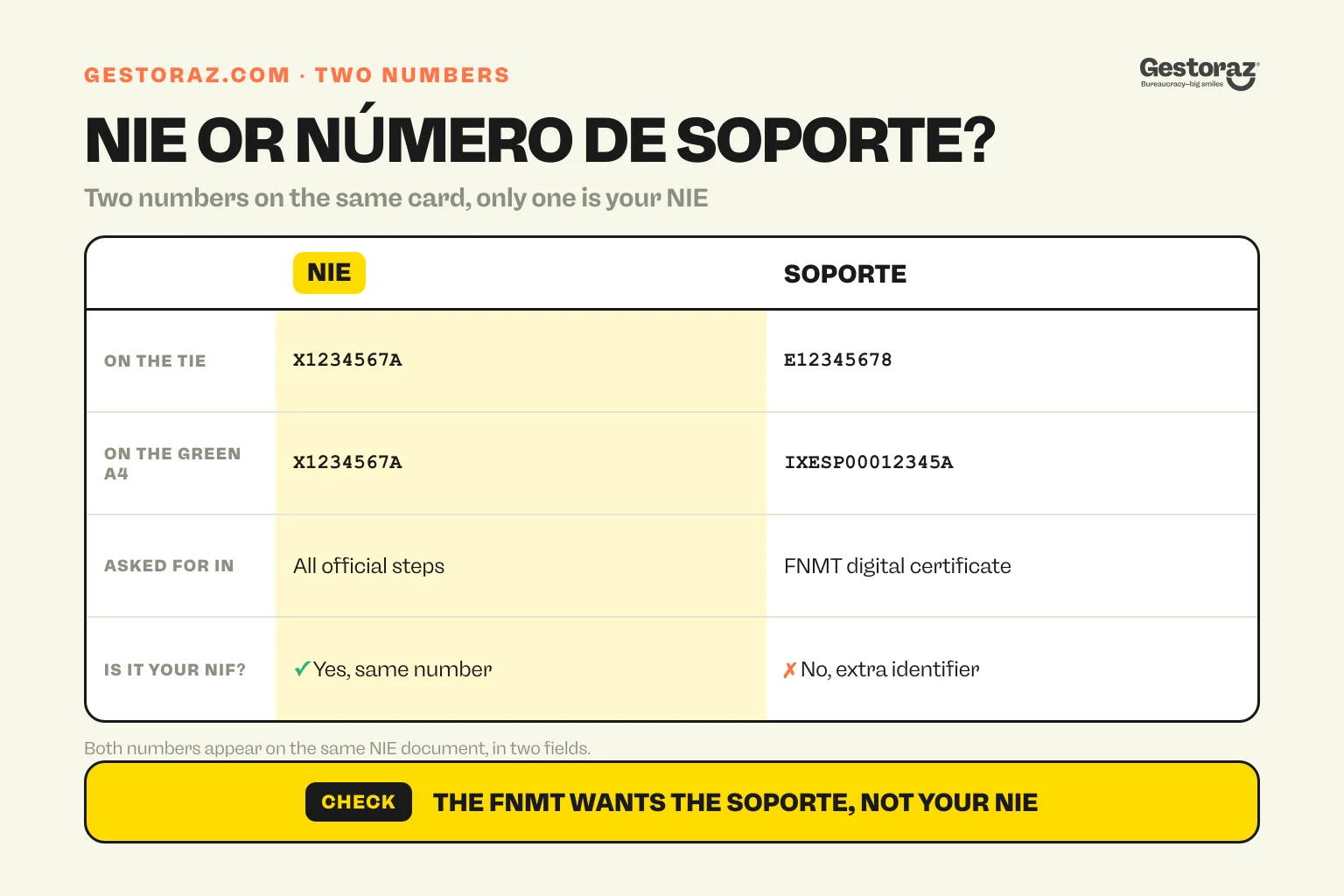
The reality
On your NIE document (green A4 or TIE), there are two distinct numbers: the NIE itself (X1234567A, Y1234567A or Z1234567A) and the número de soporte (E12345678 on the TIE, or IXESP00012345A on the green A4). They are not the same. For official steps, the NIE is asked for. For online steps with the FNMT (digital certificate especially), the número de soporte serves as a complementary identifier. The detail is in where to find the número de soporte and the digital certificate and Cl@ve.
Consequences of believing it
Trying to request a digital certificate by entering your NIE instead of the soporte triggers an error. Many give up at that point, when the fix is simply to look at the right field on the NIE document.
Myth 8: "The NIE exempts me from the padrón"
Two distinct steps confused as one.
The reality
The padrón municipal is registration with the town hall of your municipality of residence. It is entirely independent of the NIE and is not replaced by it. The padrón conditions access to many local services (municipal healthcare, public schooling, transport), and it is often required alongside the NIE to open a bank account or start a business activity.
Consequences of believing it
Without padrón, registration with a neighbourhood doctor is blocked, school enrolment for children gets complicated, and some banking steps run into refusal. Register as soon as you have a lease or housing certificate.
Myth 9: "Without an NIE, I cannot inherit in Spain"
To be qualified.
The reality
To finalise a succession in Spain, the notary requires an NIE from every foreign heir, that is correct. But "without NIE" you cannot informally renounce the inheritance either: you still have to handle the legal procedure. The good news is that the NIE can be obtained quickly by power of attorney via a gestoría (count 3-4 weeks). It is never blocking long-term, only short-term if you do not anticipate.
Consequences of believing it
Some heirs delay the procedure for months thinking the NIE will take years. In reality, the gestoría route via power of attorney solves the problem in less than a month. For details, see the NIE in Spain and how long it takes to apply for an NIE.
Recap: what the NIE is and is not
To settle once and for all what this number actually delivers.

What the NIE delivers
A unique fiscal and administrative identifier, for life, that lets you sign at the notary, open a bank account, pay your taxes, set up an activity or company, and appear in the databases of the Spanish administrations. It is the entry key to the system, but only a key.
What the NIE does not deliver
A residence permit, tax residency, access to public healthcare, the right to vote, padrón registration, work authorisation (for non-EU citizens), social status, or legal protection. All of those dimensions require separate additional steps.
For an overview of the context
The NIE fits into an ecosystem of identifiers and statuses that you have to grasp as a whole. For the picture, read the NIE in Spain. For residency and fiscal status, see how to become a tax resident and the difference between fiscal and social residence.
Where to start in Spain without falling into the traps
The misconceptions about the NIE in Spain all share one trait: overestimating what the NIE allows and underestimating the complementary steps required. Holding an NIE is just the first step, not the destination. What matters next is structuring correctly your administrative residency, your tax situation, your healthcare access and your economic activity.
The practical rule: never assume that a single identifier solves several problems at once. The NIE handles identification; the TIE or the EU certificate handles residence; the NUSS handles public healthcare; the 183-day criteria handle taxation; the padrón handles local registration. Tackle each dimension separately to forget nothing.
Preparing your move and want to avoid these pitfalls? At gestoraz, we can audit your situation and list exactly the steps to chain so your status is in order on every front (administrative, fiscal, social, healthcare).
Official sources
- Policía Nacional, sede.policia.gob.es: NIE, TIE and EU citizen certificate.
- Ministerio de Inclusión, Seguridad Social y Migraciones, Extranjería portal, extranjeros.inclusion.gob.es: foreigners' status in Spain.
- Agencia Tributaria, sede.agenciatributaria.gob.es: tax rules and NIF for foreign individuals.
- Tesorería General de la Seguridad Social, sede.seg-social.gob.es: NUSS and access to public healthcare.
- Federación Española de Municipios y Provincias, femp.es: information on the padrón municipal.
- Real Decreto 1155/2024 (BOE), boe.es/buscar/act.php?id=BOE-A-2024-24099: NIE implementing regulation.


Obtain your Digital Certificate entirely remotely.
Request your Digital Certificate completely remotely.

