



How to become an autónomo (self-employed) in Spain
Becoming an autónomo in Spain is the fastest way to start an economic activity: freelancer, consultant, e-commerce, liberal profession, craftsperson, content creator. No share capital, no notary, no Registro Mercantil registration. In a single day if everything is ready, you can issue your first invoice fully legally. But the administrative simplicity hides social costs and tax obligations that can surprise newcomers.
This article details step by step the procedure to register as an autónomo, the documents to prepare, the declarations to file with social security and the Agencia Tributaria, the realistic monthly cost, and the perks like the Tarifa Plana at €80/month in the first year. We also compare the autónomo status with the SL to help you decide when to switch, and we point out the most common pitfalls for expats.
What is an autónomo and who can become one?
The term autónomo in Spain refers to the self-employed worker: equivalent of the sole trader in English-speaking countries. It is an individual status covering a very wide palette of economic activities.
A broad activity category
Autónomos include freelancers (developers, designers, translators, consultants), sole-proprietor traders, craftspeople, liberal professions (lawyers, doctors, architects), farmers, individual e-commerce sellers, online content creators, and more generally any individual who carries out a habitual, personal and direct economic activity for profit. No legal structure needed: it is the individual who performs.
Conditions of access
To become an autónomo in Spain, you must have a valid NIE (see the NIE in Spain and how long it takes to apply for an NIE), be of age, and either be resident in Spain or (for non-EU citizens) have a work permit. EU/EEA citizens do not need specific authorisation. A Spanish bank account is not legally mandatory but becomes nearly indispensable to manage social security direct debits and client payments.
What it really means
Becoming an autónomo means contributing to Spanish social security (RETA), paying IRPF on profits via the progressive scale (up to 47%), collecting and declaring IVA quarterly, and keeping simplified accounts. It also means assuming civil and patrimonial responsibility for your activity: unlike the SL, personal assets are not separated. For tax details, see taxes and social security contributions for autónomos.
What are the steps to become an autónomo in Spain?
Registration runs in two parts: first with the Agencia Tributaria (fiscal side), then with the TGSS (social side). The order matters.
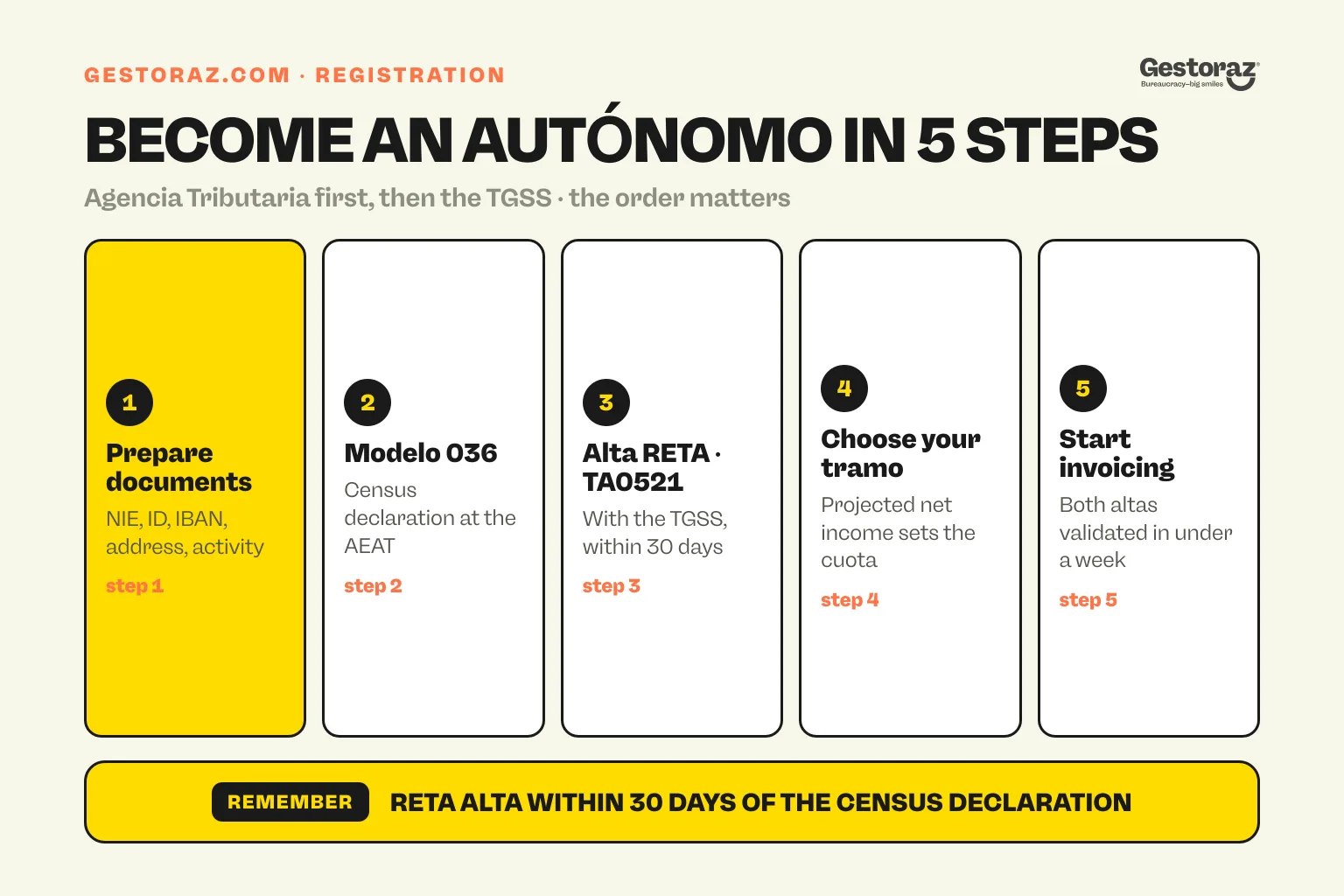
Step 1: prepare the documents
Before starting, gather: your NIE (valid), your ID, your Spanish bank account number (IBAN), your fiscal address in Spain, and the precise description of the activity you will carry out (which determines the applicable IAE code).
Step 2: census declaration with the Agencia Tributaria (modelo 036)
First official step: file the modelo 036 with the Agencia Tributaria. This form declares the start of your activity, the IAE code (epígrafe IAE), the applicable VAT regime (general or simplified), and the fiscal address. The declaration can be filed online with a digital certificate (see the digital certificate and Cl@ve) or in person at an AEAT office. Immediate effect: you are registered as an individual taxpayer for this activity.
Step 3: alta with social security (modelo TA0521)
Within 30 days of the census declaration, you must register with the Régimen Especial de Trabajadores Autónomos (RETA) at the TGSS via modelo TA0521. This registration generates your NUSS (social security number) if you do not already have one, and triggers the calculation of your monthly cuota. The NUSS can be obtained in parallel or in advance: see everything about the NUSS number.
Step 4: declare your projected income to set the cuota
Since 2023, the monthly cuota depends on your projected net income across 12 brackets (tramos). You choose your tramo at alta, and you can change it up to six times a year if your activity evolves. The declaration is made in good faith: if you under- or overestimate, a regularisation occurs in year N+1 based on actual income declared in IRPF.
Step 5: start invoicing
Once these two altas are validated (generally in less than a week), you can issue your first invoice fully legally. Your fiscal obligations begin: keeping a book of receipts and expenses, retaining supporting documents, preparing the quarterly modelos 303 (IVA) and 130 (estimated IRPF) if you are under direct estimation.
How much does the autónomo status cost in Spain?
This is the big question for anyone considering the leap. Costs vary widely with income and year of activity.
Monthly social security cuota by tramo (2023+)
Since the 2023 reform, the monthly cuota follows a 12-tramo grid based on projected net income:
| Net monthly income | Cuota |
|---|---|
| Up to €670 | €230 |
| €670-€1,166 | €230-€260 |
| €1,166-€1,700 | €291-€294 |
| €1,700-€2,030 | €350-€370 |
| €2,030-€2,760 | €390-€415 |
| Over €6,000 | €590 |
This cuota funds public healthcare, pension, sickness and unemployment benefits (since 2023). It is a fixed cost, paid even if you have not invoiced a single euro during the month.
The Tarifa Plana at €80/month in the first year
For new autónomos who have never registered or who have been more than two years out of RETA, the Tarifa Plana reduces the cuota to €80 per month for the first 12 months. If your income stays under €1,166/month, the Tarifa can be extended for 12 more months. It is a significant boost saving around €2,500 in the first year compared to the standard cuota.
Taxes (IRPF + IVA)
To the social cuota you add the IVA payable quarterly (modelo 303) and the IRPF on annual profit. The IRPF is progressive: 19% up to €12,450, 24% up to €20,200, 30% up to €35,200, 37% up to €60,000, 45% up to €300,000, 47% above. For details and the IRPF withholdings you can practise on your invoices, see when an autónomo uses IRPF withholding.
Worked example: autónomo in year one
Take a freelancer starting in 2026 invoicing €30,000 net on the year, with €5,000 of deductible expenses (equipment, gestoría, subscriptions). Her fiscal profit is €25,000. The Tarifa Plana cuota over 12 months represents €960. The estimated IRPF on €25,000 (with allowances) is around €4,800. Total social + fiscal: about €5,760, or 19% of gross turnover. That is significantly less than the same activity would cost after the Tarifa Plana.
What are the autónomo's tax and accounting obligations?
Once registered, you have a calendar of returns to respect quarterly and annually.
Quarterly returns
Four times a year (April, July, October, January), the autónomo files the modelo 303 (IVA collected minus IVA deductible) and the modelo 130 (IRPF instalment, anticipating annual tax based on quarter profit). If you invoice services to companies and you practise IRPF withholding (7% in the first year, 15% afterwards), you do not need to file the modelo 130 since your client withholds and declares via their own modelo 111.
Annual returns
Annually, you file the modelo 100 (IRPF return) between April and June for the previous year, the modelo 390 (annual IVA summary) in January, and possibly the modelo 190 (withholding summary if you practise them) and the modelo 349 (intra-EU summary if you invoice in the EU).
Keeping simplified accounts
The autónomo on direct estimation must keep three books: receipts book, expenses book, investment goods book. Accounting is simplified compared to an SL: no balance sheet, no formal P&L, no annual accounts filing. A gestoría typically charges €60-€150 per month to handle the whole.
When is autónomo better than setting up an SL?
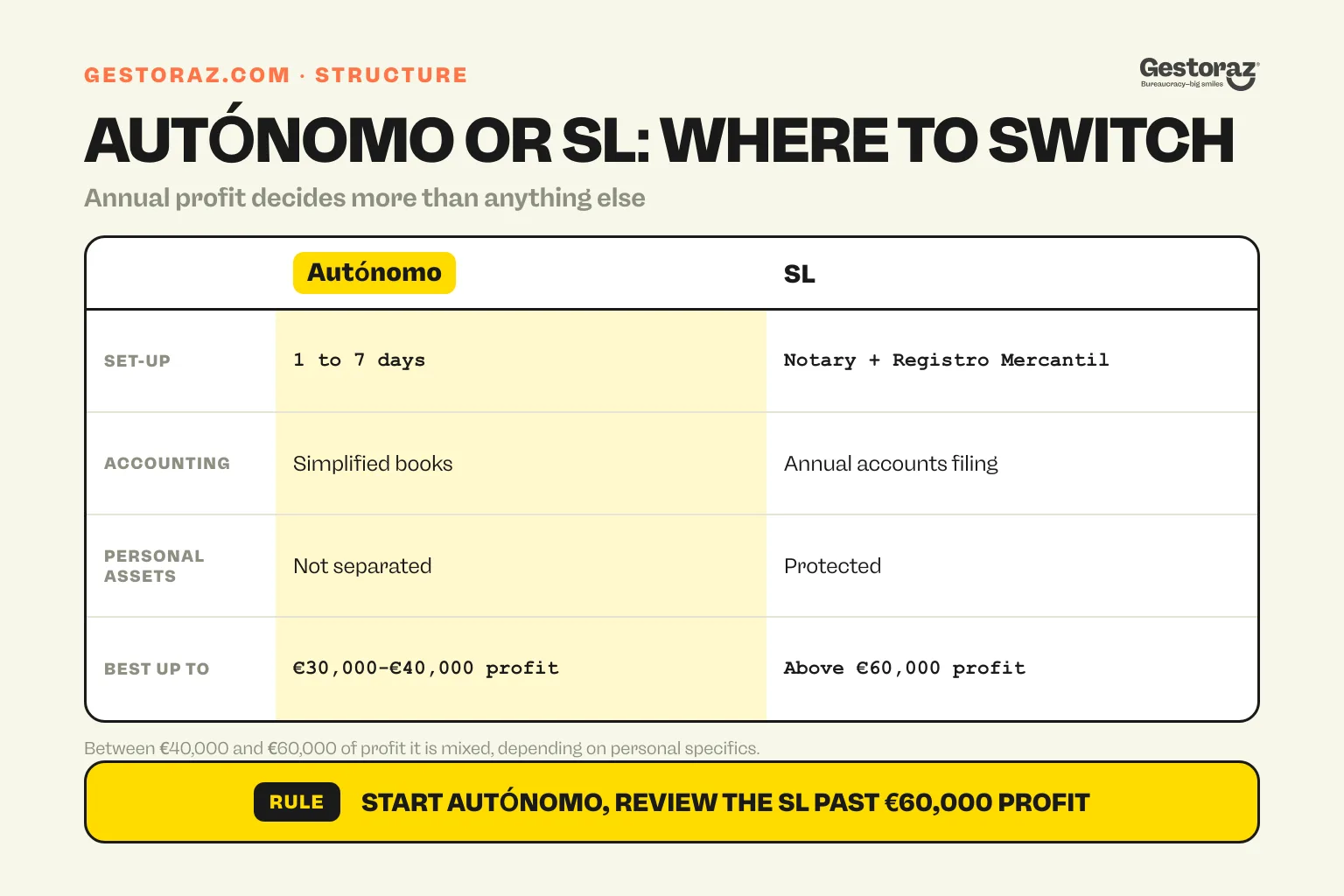
This is the classic trade-off for anyone structuring an activity in Spain. The choice depends on activity level, risk profile and long-term project.
Autónomo advantages
Fast start (1 to 7 days), no capital, no notary, simplified accounts, access to the Tarifa Plana in year one, broad expense deductibility if well documented. Ideal for starting, testing a project, or for low-volume activities where simplicity wins over fiscal optimisation.
SL advantages
Personal assets protected, more advantageous taxation above €50,000-€60,000 of profit, credibility with large clients, ability to have partners and investors, easier transmission. To understand the full set-up, see the step-by-step guide to setting up an SL and taxes for an SL.
The switch threshold
As a general rule, autónomo remains more advantageous up to about €30,000-€40,000 of annual profit. Between €40,000 and €60,000, it is mixed depending on personal specifics. Above €60,000, the SL becomes clearly winning thanks to the IS + dividends arbitrage vs marginal IRPF. The detailed comparison is in autónomo vs SL in Spain.
What pitfalls are specific to expat autónomos?
Several mistakes recur among foreigners settling as autónomos in Spain.
Underestimating the monthly cuota
Many British, French or Belgian expats coming from freelance status in their home country underestimate the weight of the Spanish monthly cuota. Even though the Tarifa Plana softens year one, the return to €290-€590/month can surprise. Build this charge into your cash flow forecasts from the start.
Confusing net income and turnover
The cuota tramos are based on net income (profit after deductible expenses), not gross turnover. Many new autónomos declare their gross turnover and pick a too-high tramo, paying too much for months until regularisation.
Forgetting IRPF withholdings on invoices
If you invoice Spanish companies, your invoice must show the IRPF withholding (15% generally, 7% in the first year and the two following for new autónomos). If you forget the withholding, your client will withhold anyway but the invoice error can complicate accounting. For the detail of rates and exemptions, see when an autónomo uses IRPF withholding.
Not registering with the ROI for EU operations
If you invoice clients in other EU countries, you must register with the Registro de Operadores Intracomunitarios (ROI) during the census declaration, which gives you an intra-EU NIF (NIF-IVA). Without that registration, you cannot apply the reverse charge mechanism and you wrongly invoice Spanish VAT on intra-EU services.
Miscalibrating personal tax status
Becoming an autónomo de facto makes you a social resident in Spain, but not automatically a tax resident. If you combine with an activity in your country of origin or if you live less than 183 days in Spain, your fiscal situation can become complex. To grasp this properly, see how to become a tax resident in Spain and the difference between fiscal and social residence.
Where to start if you want to launch as an autónomo?
Becoming an autónomo in Spain is the most accessible way to start an economic activity on the territory. The procedure is fast (a few days), inexpensive (the Tarifa Plana protects year one), and adapted to a wide range of trades. It is the ideal status to test a project, for international freelancers settling, and for small low-volume activities.
Before launching, check that your NIE is valid, that you have a Spanish bank account, and that you have a clear vision of your activity (IAE code, applicable VAT regime). Anticipate your cuota in your cash flow forecasts, and activate the Tarifa Plana from registration to save in year one. If you also operate as a director of an SL, see how the Spanish social security system works to understand the autónomo societario regime.
Want to launch without errors? At gestoraz, we can manage your full registration (modelos 036 and TA0521), activate the Tarifa Plana, configure invoicing and run your quarterly accounts for around €100 per month.
Official sources
- Tesorería General de la Seguridad Social (TGSS), sede.seg-social.gob.es: RETA alta, modelo TA0521, tramo choice and Tarifa Plana.
- Agencia Tributaria, sede.agenciatributaria.gob.es: modelos 036, 130, 303, 100, 390.
- Real Decreto-ley 13/2022 (BOE), boe.es/buscar/act.php?id=BOE-A-2022-12482: new contribution system by tramos for autónomos.
- Ley 20/2007 del Estatuto del Trabajo Autónomo (BOE), boe.es/buscar/act.php?id=BOE-A-2007-13409: legal status of the autónomo in Spain.
- INSS, sede.seg-social.gob.es: unemployment and sickness benefits for autónomos.
- ATA, Federación Nacional de Trabajadores Autónomos, ata.es: practical information and statistics on the status.


Obtain your Digital Certificate entirely remotely.
Request your Digital Certificate completely remotely.

