



Checklist for students studying in Spain
Studying in Spain attracts thousands of foreign students every year (Erasmus, Master, PhD, private schools). But before enjoying student life in Madrid, Barcelona, Valencia or Salamanca, you need a complete and chronological student checklist for Spain. Visa, NIE, padrón, accommodation, healthcare, banking, transport: forgetting a step or doing it in the wrong order can block university enrolment or delay your arrival by several weeks.
This article offers a checklist organised by phase (before departure, on arrival, first weeks), distinguishes the steps depending on whether you are EU/EEA or non-EU, and gives realistic lead times for each step. We also detail student-specific aids and benefits (public transport, cultural access, healthcare) and the pitfalls to avoid wasting time.
What documents to prepare before your departure?
A few weeks before arrival, several preparations are essential.
For EU/EEA citizens
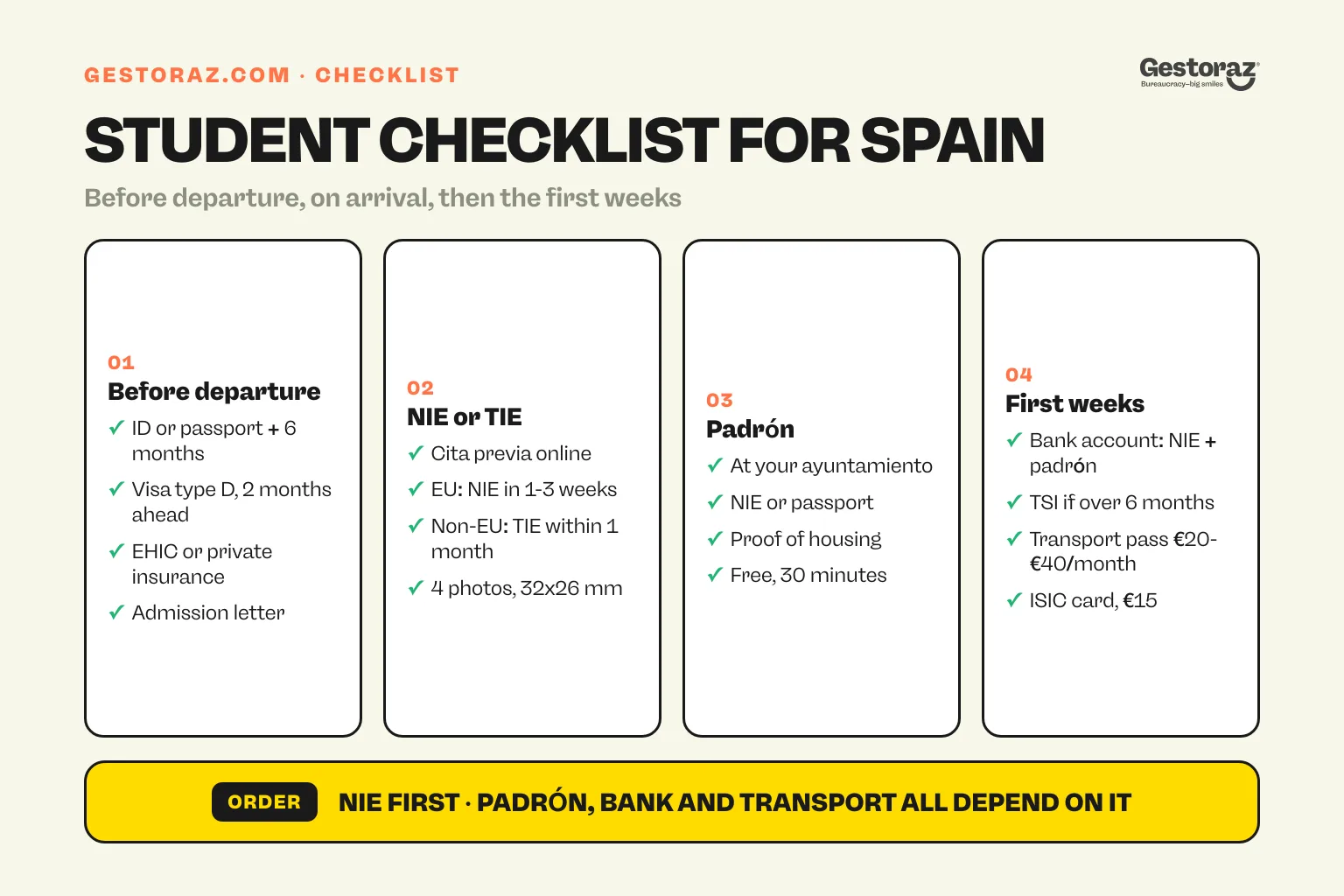
- Valid ID (national ID card or passport) covering the duration of your studies + 6 months of margin.
- European Health Insurance Card (EHIC) for health cover during the first months.
- Enrolment certificate or admission letter from the Spanish university.
- Erasmus agreement signed if you are on Erasmus+ mobility.
- Proof of grant or income (sometimes required for a long-stay visa).
For non-EU citizens
- Type D student visa obtained from the Spanish consulate in your country of origin. Apply for the visa at least 2 months before departure.
- Passport valid covering the entire study duration.
- University admission letter for enrolment.
- Financial proof (€700-€900/month depending on consulates) to prove your resources.
- Private health insurance covering Spain (often mandatory for the visa).
- Clean criminal record recent (less than 3 months) from your country of origin, apostilled.
Universal documents
- Diplomas and transcripts possibly translated into Spanish by a sworn translator.
- Spanish format ID photos (32x26 mm).
- International bank card for first payments.
- Accommodation booked for at least the first month (hostel, Airbnb, university residence).
How do you obtain your NIE as a student?
The NIE is your entry key for most procedures. For the full procedure, see the NIE in Spain and how long it takes to apply for an NIE.
For EU/EEA citizens
You can request your NIE in Spain (at the Policía Nacional station) with your university enrolment certificate as motive. Cita previa via sede.administracionespublicas.gob.es. The cita is typically available within 1-3 weeks depending on the city. The NIE is issued the same day or within 1-2 weeks. You also receive your Certificado de Registro de Ciudadano de la Unión (the large green A4).
For non-EU citizens with student visa
On arrival, within the following month, you must request a TIE (foreigner ID card) at the police station. The TIE materialises your legal residence and contains your NIE. Bring your visa, admission letter, accommodation proof, and 4 photos.
For Erasmus students of short duration (< 90 days)
If your Erasmus stay lasts less than 90 days, the NIE is not mandatory. You can manage with your ID/passport. But many steps (bank account, resident transport pass) are simpler with an NIE.
What is the mandatory step after arrival: the padrón?
The padrón is registration with the town hall of the municipality where you live. It is mandatory for everyone living in Spain, with no minimum length of stay.
Why the padrón is essential
The padrón gives you access to: municipal healthcare, free language courses in some cities, resident transport tariff (often 30-50% cheaper), municipal libraries, and more generally to all local services. To grasp the full administrative residency, see everything about residency in Spain.
How to register
You go to the town hall (ayuntamiento) of your municipality with:
- Your NIE or passport.
- Proof of housing (lease, owner's certificate, university residence contract).
Registration is free, generally takes 30 minutes, and you receive your certificado de empadronamiento the same day or within a few days.
Particularity: padrón without lease
If you live with someone (rented room, informal flatshare), you can register with a certificate signed by the owner. Some cities (Madrid, Barcelona) are strict on supporting documents.
How do you access healthcare as a student?
Health cover depends on your nationality and status.
EU/EEA: EHIC then possibly TSI
With your EHIC (European Health Insurance Card), you are covered for urgent care during your stay. If you will stay more than 6-12 months, request a NUSS and activate your TSI at the centro de salud (see everything about the NUSS number and the Spanish healthcare system for expats).
Non-EU: private health insurance
Private health insurance is generally mandatory for your student visa. It must cover all care in Spain (consultations, hospitalisations, emergencies) for the entire duration of studies. Cost: €400-€1,000/year for a young adult, depending on cover.
Special case: students working in parallel
If you work part-time during your studies (student job, paid internship), you contribute to social security via your employer and access the public system via TSI. It is one of the routes for non-EU students who want to avoid paying private insurance for 3-5 years.
How do you open a bank account in Spain?
Indispensable for daily life.
Resident vs non-resident bank account
With your NIE and your padrón, you can open a resident account in most Spanish banks (BBVA, Santander, CaixaBank, Banco Sabadell). Without an NIE, some banks offer a non-resident account but with higher fees.
Online banks
Several online banks (N26, Revolut, BBVA Online) allow fast account opening for foreigners, sometimes without NIE to start. It is the most practical option for short-term Erasmus students.
Required documents
- NIE.
- ID.
- Padrón (often requested).
- Proof of enrolment or income.
- Address in Spain.
Fees to anticipate
Many traditional banks charge account-keeping fees (€60-€180/year) if you do not have a domiciled salary. Online banks are generally free but with limited functionality.
What are the housing procedures?
Housing is one of the most delicate steps for a foreign student.
University residences
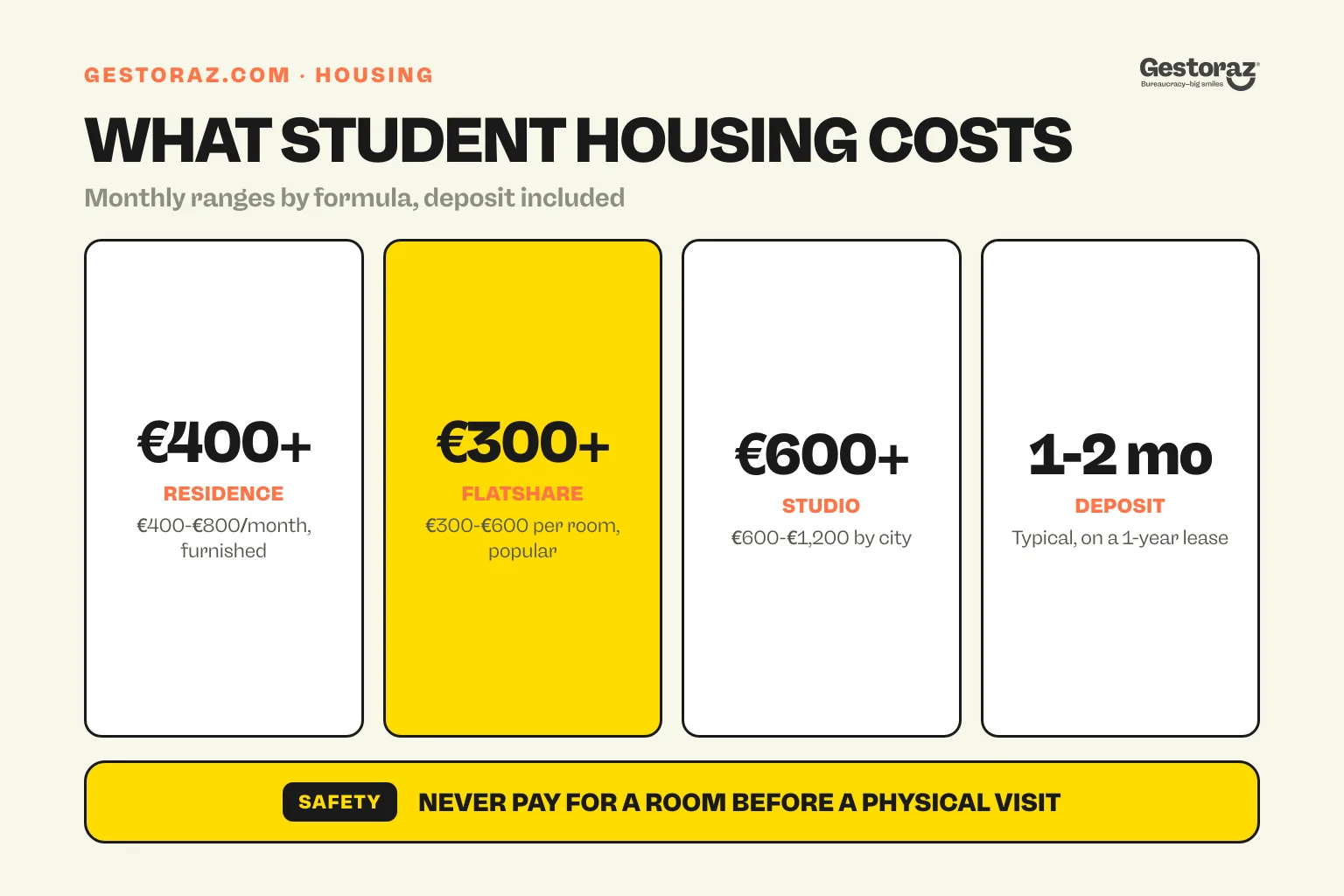
University residences are the simplest solution: €400-€800/month depending on the city, already furnished, lighter formalities (no long-term lease), often communal. Apply early (sometimes 6 months before arrival for sought-after cities).
Flatshare (compartir piso)
Flatshare is very popular in Spain: €300-€600/month per room depending on the city. Platforms: Idealista, Fotocasa, Badi. Beware of scams (never pay before a physical visit).
Studio or apartment
For an individual studio, count €600-€1,200/month depending on the city. Typical deposit: 1-2 months of rent. Lease (contrato de arrendamiento) often signed for 1 year minimum, renewable.
The lease and registration
The lease must be in Spanish and signed by both parties. Keep a copy for the padrón and your procedures. Some owners require a guarantor or a rent default insurance.
How do you optimise your transport costs?
Spanish student cities offer very advantageous tariffs.
Monthly student passes
Madrid, Barcelona, Valencia, Seville and most major cities offer a reduced monthly abono transporte for students: €20-€40/month for unlimited access to metro, bus, regional train. Request the student card with your enrolment certificate.
Renfe long-distance train
For frequent returns to your country of origin or to visit Spain, the Renfe youth card (up to 25 or 30 years depending on regions) offers 30-50% reduction on all trains.
Bike and scooter
Madrid, Barcelona and Valencia have public bike systems (BiciMad, Bicing, Valenbisi) with student subscriptions at €20-€40/year. Electric scooters (Bird, Lime) are also widespread.
What are the other useful steps?
A few additions for a successful integration.
International student card (ISIC)
The ISIC (International Student Identity Card) costs €15 and gives access to international reductions (museums, transport, cinemas). Useful also outside Spain.
Municipal library registration
Often free with your padrón, gives access to thousands of physical and digital books, and often to a student coworking space.
Free or low-cost Spanish courses
Official language schools (EOI - Escuelas Oficiales de Idiomas) offer Spanish courses for foreigners at very accessible rates (€200-€400/year). Very useful to pass the DELE (official Spanish diploma).
University fee and SEPA
Check with your university whether the fee is paid by SEPA direct debit. If so, your Spanish bank account is useful. Otherwise, international transfer suffices.
What pitfalls are specific to foreign students?
Several mistakes recur and complicate arrival.
Underestimating consular delays (student visa)
For non-EU citizens, the student visa can take 4-12 weeks depending on the consulate. Anticipate at least 3 months before the start of term.
Forgetting the apostilled criminal record (non-EU)
The clean criminal record is almost always required for the student visa. Apostille it well before departure: the procedure takes 2-4 weeks depending on the country.
Delaying the padrón
Without padrón, you do not access full reduced tariff to municipal services. File the request from the first month.
Bank account without NIE
If you want to avoid the fees of non-resident accounts, do your NIE as a priority after arrival. See what an NIE number costs.
Confusing TIE and NIE for non-EU citizens
For non-EU citizens, the TIE (plastic card) is the object to request, not just the NIE. The TIE contains your NIE and constitutes your residence card. The wider misconceptions are explained in nine misconceptions about the NIE number.
Not declaring your fiscal status correctly
If you are a student and you exceed 183 days in Spain, you potentially become a tax resident. Depending on your situation (income, grant), this can generate declaration obligations. To understand, see how to become a tax resident in Spain and the impact of the NIE on your tax status.
Where to start your studies in Spain
The student checklist for Spain boils down to a structured sequence: before departure (visa, admission letter, EHIC or insurance), on arrival (NIE/TIE, padrón), then in the first weeks (bank account, possible TSI, transport pass, definitive accommodation). Planning this sequence well avoids blockages and avoidable fees.
The initial time investment (4-6 weeks to set everything up) is largely compensated by the benefits: student-rate public transport, free public healthcare (EU), reduced access to cultural and sporting services. Anticipate administrative steps at least 2 months before the start of term to depart with peace of mind.
Are you preparing a study stay in Spain and want to centralise all the steps without wasting time? At gestoraz, we can manage NIE, padrón, bank account opening, TIE for non-EU citizens, and even housing search with local partners, for a moderate package.
Official sources
- Ministerio de Inclusión, Seguridad Social y Migraciones, Extranjería portal, extranjeros.inclusion.gob.es: student visa and residence rules.
- Ministerio de Universidades, universidades.gob.es: enrolment in Spanish universities.
- Erasmus+, erasmus-plus.ec.europa.eu: European student mobility programme.
- Servicio Nacional de Salud, sanidad.gob.es: EHIC and healthcare access for EU students.
- Catastro Inmobiliario, catastro.minhap.gob.es: cadastral references for the padrón.
- Renfe Carné Joven, renfe.com: Renfe youth card for train reductions.


Obtain your Digital Certificate entirely remotely.
Request your Digital Certificate completely remotely.

