



How does the Spanish social security system work for self-employed and companies?
The Spanish social security system for self-employed and companies rests on a contributory framework that funds public healthcare, pensions, sickness benefits, unemployment and parental leave. Understanding how it works is essential for expats settling as autónomos, for SL directors who must contribute as autónomo societario, and for businesses hiring local staff. The system is generous but costly, and the rules have changed substantially since 2023.
This article explains exactly the structure of Spanish social security (TGSS, INSS, SEPE), the different regimes (Régimen General for employees, RETA for autónomos), the monthly costs depending on your status, the benefits you access in return, the steps to register yourself or your company, and the pitfalls to avoid. We also detail international coordination via the S1, A1 and U1 forms.
What is the structure of the Spanish social security system?
Before the procedures, understand the institutional organisation.
Three main bodies
The Spanish system is managed by three complementary bodies:
- TGSS (Tesorería General de la Seguridad Social): the "treasury", in charge of collecting contributions and managing contributor accounts. It withholds your monthly cuota.
- INSS (Instituto Nacional de la Seguridad Social): manages social benefits (pension, sickness benefits, disability, maternity/paternity leave, survivor pension).
- SEPE (Servicio Público de Empleo Estatal): manages unemployment benefits and public employment.
The NUSS, unique identifier
Every contributor receives a NUSS (social security number) that follows them for life. For details, see everything about the NUSS number in Spain. It is the number that appears on your payslips, your social returns and that lets you accumulate your entitlements.
The two main regimes
Spain distinguishes:
- Régimen General: for employees. Contributions split between employer (~30-35%) and employee (~6.35%).
- RETA (Régimen Especial de Trabajadores Autónomos): for self-employed. Contribution entirely borne by the autónomo via the monthly cuota.
How does RETA work for autónomos?
RETA is the regime for Spanish self-employed workers.
Registration with RETA
You register with RETA via the modelo TA0521 when registering as an autónomo (see how to become an autónomo in Spain). Registration generates your NUSS if you do not have one, and triggers the calculation of your monthly cuota according to the chosen tramo.
The monthly cuota by tramos (since 2023)
Since the 2023 reform, the cuota depends on your projected net income, across 12 tramos ranging from €230/month (for income < €670/month) to €590/month (for income > €6,000/month). For details, see taxes and contributions for autónomos.
The Tarifa Plana
New autónomos benefit from the Tarifa Plana at €80/month for 12 months (24 months if income < €1,166). It is a major advantage in year one.
Associated benefits
By contributing to RETA, the autónomo accesses: public healthcare via TSI, pension calculated on contribution years, sickness benefits (from day 4 of leave at 60% of reference salary), maternity/paternity leave (16 weeks at 100%), and unemployment benefit since the recent improvement of the regime.
How does Régimen General work for employees?
For employees on permanent or fixed-term contracts, the system is different.
Contributions split employer/employee
On a Spanish gross salary, the employer pays around 30-35% of employer contributions (health, pension, unemployment, professional training, work accidents). The employee sees about 6.35% withheld on their gross for their own contributions. The employee's take-home pay is therefore the gross minus 6.35% minus the IRPF withheld at source.
Worked example
For a Spanish employee with €2,500 gross/month:
- Employer contribution: ~€800/month (employer's burden).
- Employee contribution: ~€159/month (withheld on gross).
- IRPF withholding: ~€250-€400/month depending on personal situation.
- Employee take-home pay: ~€1,950-€2,100/month.
- Total employer cost: €2,500 + €800 = €3,300/month.
Régimen General benefits
Employees access: public healthcare via TSI, pension calculated on 25 career years, unemployment benefit (up to 24 months depending on seniority), sickness benefits (employer pays 60% from day 4 to 21, then 75% from day 21), maternity/paternity leave (16 weeks at 100%), and professional training.
How does a company register as an employer?
If you will hire in Spain, your company must register with the TGSS.
Registration as employer
The company (SL or other form) requests its registration via the TGSS sede electrónica. It receives a CCC (Código de Cuenta de Cotización) which is its employer identifier. The CCC is distinct from the company NIF and the personal NUSS of the director.
The Sistema RED
The Sistema RED is the electronic platform through which companies manage their social returns: employee altas and bajas, monthly contribution returns, payroll file transmissions. Any company with staff must be connected to it.
SL director case: autónomo societario
The director of an SL must register personally as an autónomo societario with the TGSS. They pay their own monthly cuota (€350-€590/month, without Tarifa Plana for SL directors). To understand SL set-up, see the step-by-step guide to setting up an SL.
Recurring costs for the employer
To handle payslips and social returns, the employer generally goes through a gestoría charging €50-€80/month per employee managed. For an SL with 5 employees, count €250-€400/month of social management.
What social benefits do you get for contributing?
The counterparts are numerous and structured.
Public healthcare via TSI
All contributors (and their dependants) access public healthcare via their TSI (health card). Basic care is free or with very low copayment (consultations, hospitalisations, medication with discount by income). For the operating detail, see the Spanish healthcare system for expats.
Pension
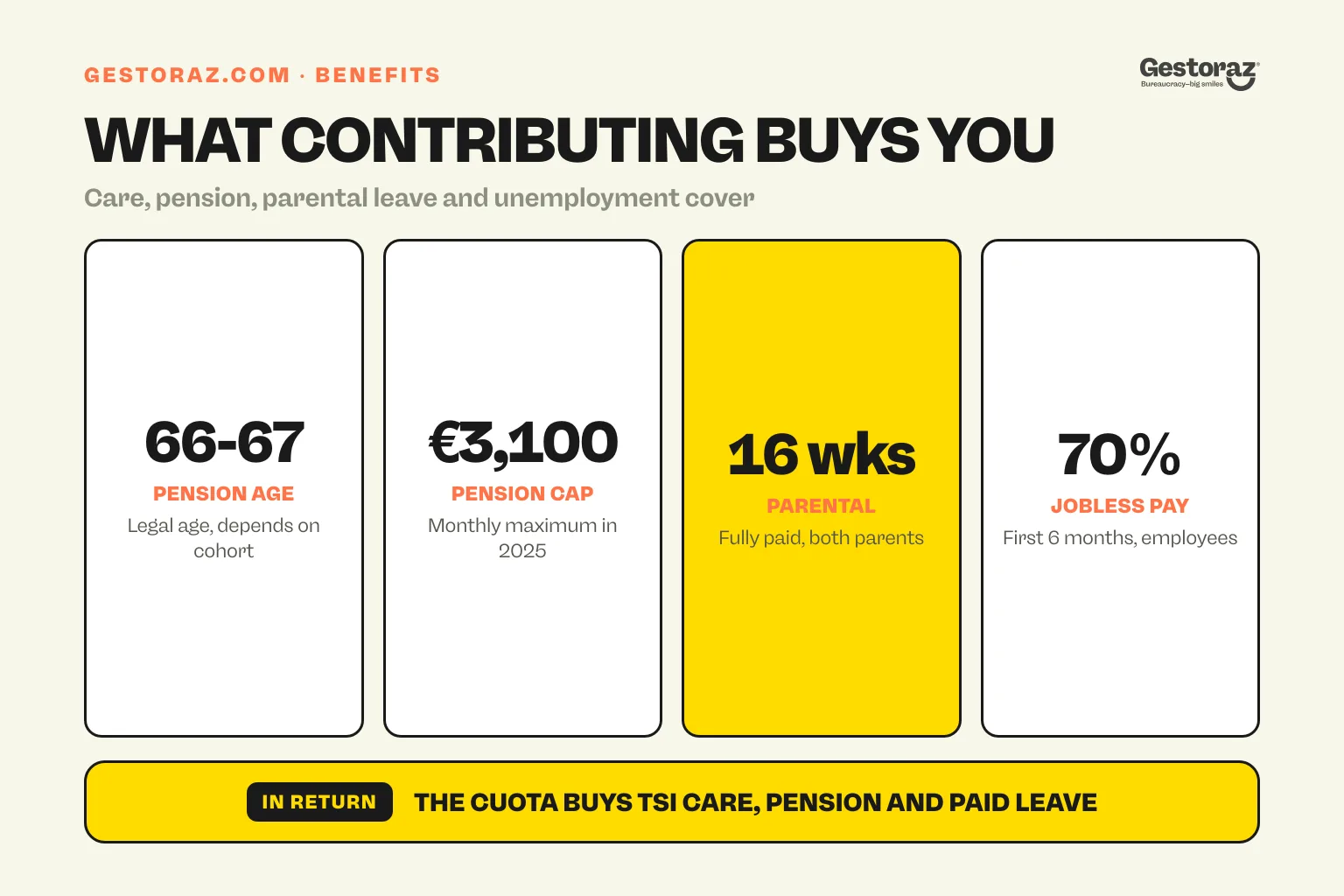
Contributions feed your pension account. Spanish legal age is 66-67 depending on cohorts. The calculation is based on the last 25 contribution years (gradual extension). Maximum pension is capped (~€3,100/month in 2025).
Sickness benefits
In case of sickness, the autónomo receives a benefit from day 4 (60% of reference salary) rising to 75% from day 21. For employees, the employer pays the first days then the INSS takes over.
Maternity/paternity leave
Since 2021, both parents benefit from 16 weeks of fully paid leave (100% of reference salary). It is one of the most generous benefits in Europe.
Unemployment benefit
For employees: 70% of reference salary for the first 6 months, then 50%, up to 24 months depending on seniority. For autónomos: since 2023, access to unemployment benefits under conditions (justified cessation of activity, minimum 12 months of dedicated contributions).
Survivor pension
In case of contributor's death, their spouse and dependent children can receive a survivor pension calculated on the contributions paid.
How does international coordination work (S1, A1, U1)?
For EU expats, specific mechanisms avoid double contributions or loss of rights.
The S1 form for retirees
An EU/EEA retiree settling in Spain requests an S1 from their original pension fund. With this form, they access Spanish public healthcare without contributing locally. Spain bills the care to their country of origin. It is the typical status of French, German, Belgian, Dutch retirees settling in Spain.
The A1 form for posted workers
An employee sent temporarily by their foreign employer to Spain (mission of a few months) can obtain an A1 keeping them attached to the social security of their country of origin during the mission. They do not contribute in Spain. It is the classic mechanism for consultants on mission or temporary expat managers.
The U1 form for contribution history
If you have worked in several EU countries, the U1 certifies your contribution periods in each country's social security. It is used to calculate your unemployment rights in Spain (by aggregating European contribution periods) and later your pension (totalisation of periods).
Coordination of benefits
European Regulation 883/2004 guarantees that you are subject to only one social security at a time (that of the country where you work mainly) and that your acquired rights in one country are not lost in case of mobility. To grasp the fiscal and social implications of a residency change, see everything about residency in Spain and the difference between fiscal and social residence.
What pitfalls are common with Spanish social security?
Several mistakes recur and prove costly.
Underestimating the monthly cuota
UK and French expats are often surprised by the high level of the monthly cuota. The UK has a system where a freelancer can pay very little at activity start. In Spain, the minimum cuota (€230/month after Tarifa Plana) applies even without invoicing. Provision from the start.
Believing the NIE gives access to healthcare
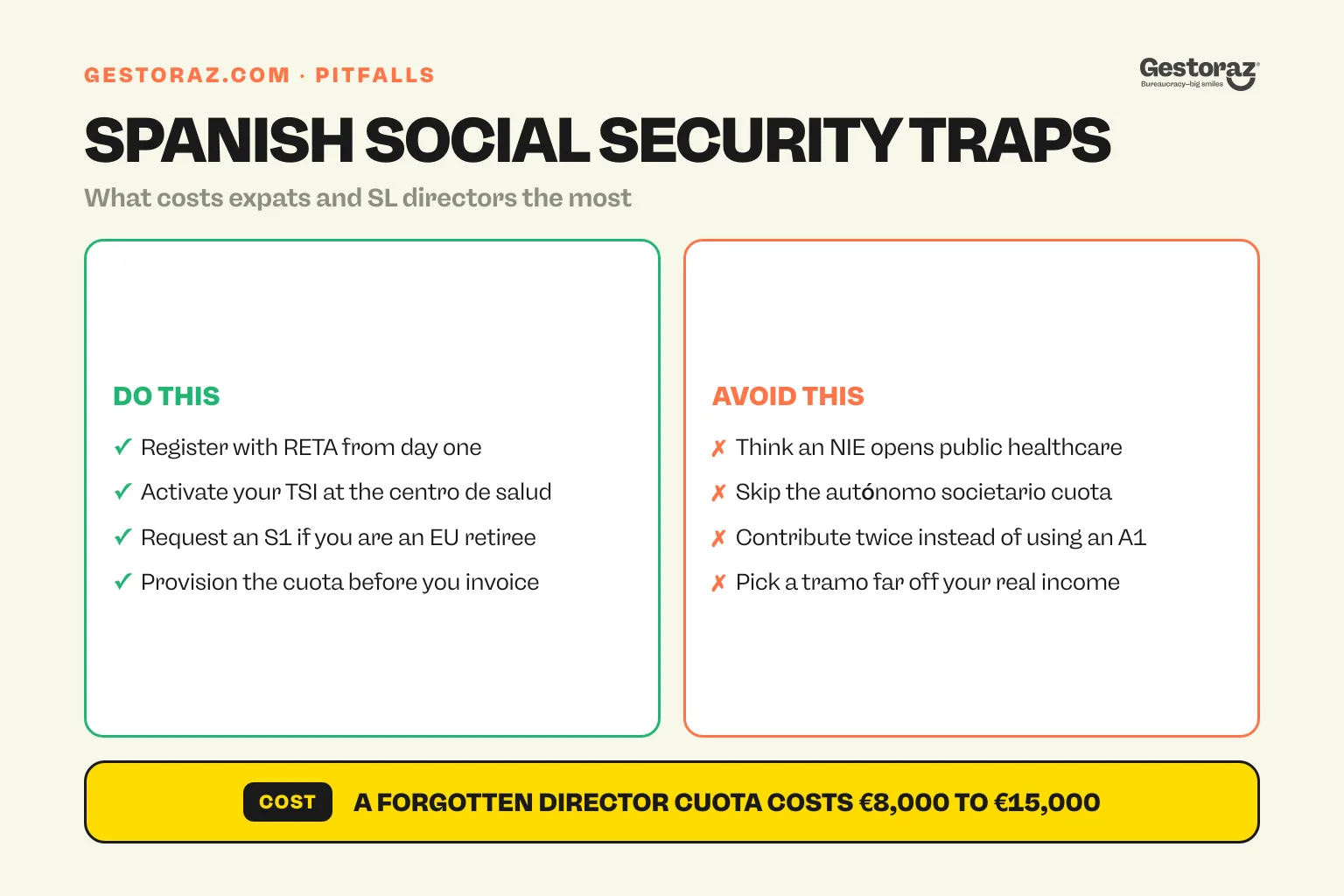
Holding an NIE does not give you access to public healthcare. You need a NUSS and a TSI. Many non-resident owners wrongly think their NIE opens care, and end up paying privately. The myth is also dismantled in nine misconceptions about the NIE number.
Forgetting the TSI after obtaining the NUSS
Holding a NUSS without having activated your TSI at the centro de salud does not concretely allow you to see a doctor. The TSI is the practical step not to neglect.
For directors: forgetting your societaria cuota
The SL director who does not register as an autónomo societario accumulates a TGSS debt. The reassessment over 2-4 years can reach €8,000-€15,000. Register from the SL creation.
Failing to request the S1 as an EU retiree
Many EU retirees take out private health insurance (€1,200-€2,400/year) when they were eligible for an S1. The procedure takes 4-8 weeks with the original pension fund and saves several hundred euros a year.
Miscalibrating the tramo at start of year
For autónomos, choosing too low a tramo generates a regularisation to pay in N+1; too high a tramo blocks cash flow needlessly. Estimate your projected income realistically and adjust the tramo during the year if you see a significant gap.
Where to start to manage Spanish social security
The Spanish social security system for self-employed and companies is a structured and globally generous system, but it requires precise understanding of the regimes and applicable contributions. For autónomos, the monthly cuota is the main issue; for companies, it is employer charges on salaries; for EU expats, it is the S1/A1/U1 forms.
The practical rule: register correctly from the start (RETA for autónomo, employer + autónomo societario for SL), provision the cuota in your cash flow forecasts, activate your TSI quickly after the NUSS, and use European mechanisms (S1, A1) if eligible. Bad management can generate a social debt taking years to regularise.
Are you preparing a move, a company set-up, or a hire in Spain? At gestoraz, we can manage all social steps (RETA or employer alta, tramo choice, S1 request) and keep the monthly calendar to spare you penalties and arrears.
Official sources
- Tesorería General de la Seguridad Social (TGSS), sede.seg-social.gob.es: RETA alta, employer alta, contributor account management.
- Instituto Nacional de la Seguridad Social (INSS), sede.seg-social.gob.es: pension, sickness, leave benefits.
- SEPE, Servicio Público de Empleo Estatal, sepe.es: unemployment benefits and employment.
- Real Decreto Legislativo 8/2015 (Ley General de la Seguridad Social) (BOE), boe.es/buscar/act.php?id=BOE-A-2015-11724: reference text.
- Real Decreto-ley 13/2022 (BOE), boe.es/buscar/act.php?id=BOE-A-2022-12482: new autónomo contribution system by tramos.
- Regulation (EC) 883/2004, eur-lex.europa.eu/legal-content/EN/TXT/?uri=CELEX:32004R0883: coordination of EU social systems.


Obtain your Digital Certificate entirely remotely.
Request your Digital Certificate completely remotely.

