



What is an NIE number in Spain?
The NIE number in Spain is the identifier the Spanish state assigns to every foreigner who interacts with the administration: opening a bank account, signing a notarial deed, paying taxes, setting up a company, or receiving an inheritance. Without an NIE, many doors stay shut. The NIE is also the source of countless misunderstandings, especially around what it does (and does not) make of you in Spain on the tax and social side.
This article explains what the NIE is, how it fits within the constellation of Spanish identifiers (NIF, TIE, NUSS, número de soporte), what it concretely lets you do, who needs one and on what timeline, and which traps to avoid when applying. We also explain why the NIE is neither a residence permit, nor proof of residency, nor a fiscal free pass.
What is the NIE and where does it come from?
Before talking procedure, you need to grasp the legal nature of the NIE. It is an administrative identifier, not a status. That distinction is the source of half the confusion in the expat community.
An identifier assigned for life
The NIE (Número de Identidad de Extranjero) is a unique 9-character number in the format X1234567A or Y1234567A, issued by the Dirección General de la Policía. Once allocated, it is valid for life. You cannot have two of them and it does not expire, even if you change nationality or migration status. The NIE follows a foreigner throughout their life in Spain, and beyond, since it stays active even if you leave.
Different from the NIF, TIE, NUSS and número de soporte
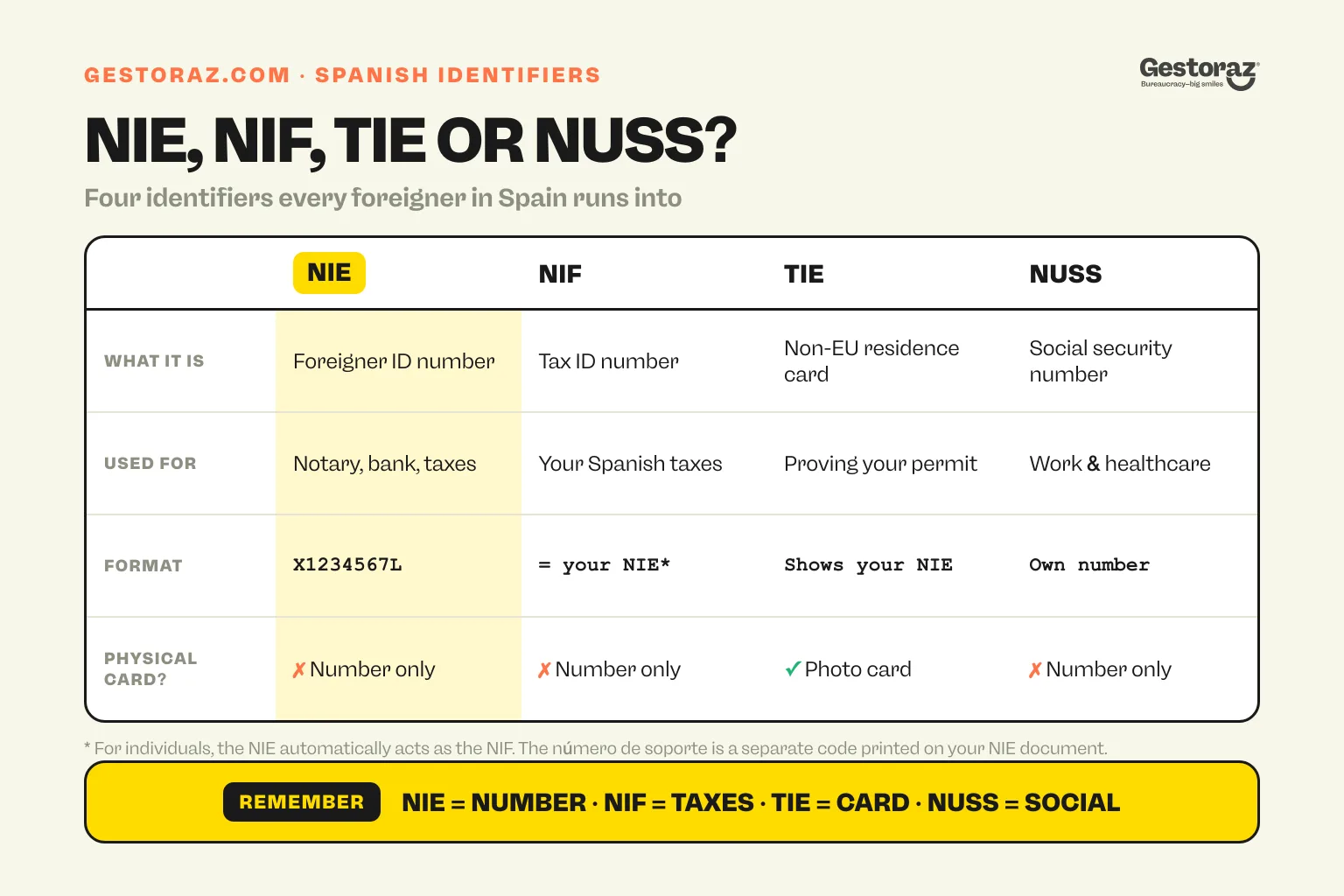
The Spanish identifier landscape contains several distinct concepts that are easily confused. The NIF (Número de Identificación Fiscal) is the tax identifier: for individuals, the NIE and NIF are the same number, the NIE acting automatically as your NIF. For the full picture, see the difference between NIE and NIF. The TIE (Tarjeta de Identidad de Extranjero) is the plastic card issued to non-EU citizens with a residence permit, and it carries their NIE. The NUSS is the social security number, used to contribute and access public healthcare; we explain it in detail in everything you need to know about the NUSS number in Spain. Finally, the número de soporte, often confused with the NIE itself, is a security code printed on the NIE document and required to activate a digital certificate. If you are wondering where to find it on your card or green A4, see what is the número de soporte and where to find it.
What is an NIE number actually used for?
The NIE is required as soon as a foreigner performs a legal, fiscal or financial act in Spain. The list of uses is broader than most people imagine.
Legal and notarial transactions
Any operation before a Spanish notary requires a valid NIE: buying real estate, signing a commercial lease, gifts, inheritances, incorporating a company. The notary will not sign without an NIE and verifies its authenticity with the police register. For property transactions in particular, the NIE is what allows you to appear in the Registro de la Propiedad and therefore to be the recognised owner.
Banking and tax operations
A Spanish bank requires an NIE to open a resident account, and in most cases for a non-resident account too. The NIE is also how you identify yourself with the Agencia Tributaria, how you pay your taxes (IBI, IRNR, IRPF, IVA depending on your situation), and how you appear in the cross-referenced databases shared between administrations. If you own property without living in it, the NIE is what lets you file the modelo 210: we walk through the mechanics in how much tax you must pay as a non-resident in Spain.
Professional registrations
Any employee, autónomo or company director in Spain needs an NIE for their contract or registration. If you are thinking of becoming an autónomo in Spain or setting up a Sociedad Limitada, the NIE is the first brick: without it, the alta with the TGSS and the IAE registration are impossible.
Who needs an NIE number in Spain?
Many foreigners wonder whether their situation justifies a request. The rule is simple: any administrative interaction triggers the need for an NIE.
Expats settling in Spain
EU and EEA citizens settling in Spain typically receive an NIE printed on a green A4 document. Non-EU citizens with a residence permit receive a TIE (a plastic card) bearing their NIE. In both cases, the NIE is obtained as part of the residency procedure, and it is a prerequisite for registering with the padrón municipal.
Investors and non-resident owners
You can have an NIE without living in Spain. This is the typical situation of the foreign investor buying an apartment on the Costa Blanca for holidays or rental, or of the entrepreneur who wants to hold shares in a Spanish SL without relocating. Having an NIE as a non-resident does not change your tax status: you remain non-resident as long as you do not exceed 183 days in Spain and your centre of economic interests stays abroad. To understand what your NIE actually implies, read the impact of your NIE on your tax status in Spain.
Heirs, spouses and beneficiaries
Many foreigners discover the NIE when they inherit from a relative in Spain. The notary handling the succession requires an NIE from every foreign heir before assets can be distributed. The same applies to a foreign spouse who becomes the beneficiary of a Spanish property or bank account: without an NIE, the transfer cannot proceed.
How does an NIE look and how do you tell it apart from other identifiers?
The format of the NIE is codified and easy to recognise once you know it.
The 9-character format
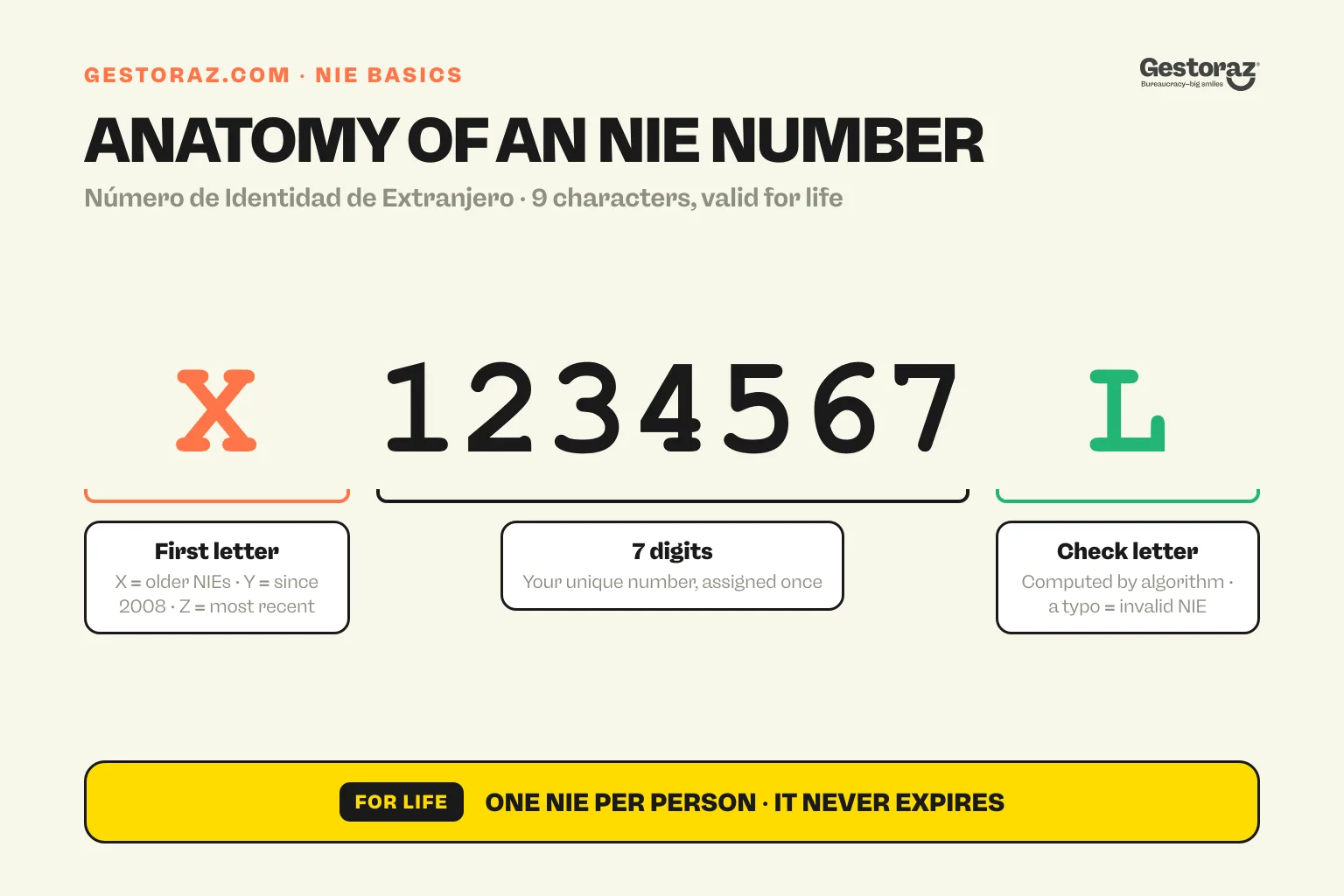
An NIE starts with the letter X (older NIEs), Y (NIEs issued since 2008) or Z (the most recent ones), followed by 7 digits and a final check letter. Examples: X1234567L, Y8765432P. The check letter is calculated by an algorithm: if it does not match, the NIE is invalid. Many input errors on banking or tax forms come from a mistyped NIE.
NIE on a green A4 or on a TIE card
Depending on your nationality, the NIE is printed on two different supports. EU/EEA citizens receive a green A4 certificate titled Certificado de Registro de Ciudadano de la Unión, which contains the NIE and confirms the entry in the central foreigners' register. Non-EU citizens with a residence permit receive a TIE, a plastic card the size of an ID card with photo. An alternative plastic card for EU citizens also exists: the NIE Easy Card, a convenient but optional format.
Do not confuse the NIE with the número de soporte
The number that appears next to the NIE on these documents (often starting with IXESP on green A4s or with E on TIEs) is the número de soporte, not the NIE. That code is what the FNMT will ask for when you request a digital certificate. To see the difference and where to look, consult the guide to the número de soporte and the role of the digital certificate and Cl@ve.
How do you obtain an NIE in practice?
The procedure is well known but it varies depending on whether you are in Spain or abroad, and on your reason for applying.
Three main routes
You can request an NIE in three ways. First, present yourself at a Policía Nacional station in Spain with a cita previa and a complete file (modelo EX-15, modelo 790-012, proof of motive, passport). Second, go to a Spanish consulate in your country of residence: useful for British, Irish or Dutch applicants who are not yet in Spain. Third, delegate to a gestoría through a notarial power of attorney, the most practical route when you are not on site and cannot wait weeks for a consular appointment.
Documents and timing
The file includes a modelo EX-15 form, proof of payment of the fee (modelo 790 código 012, around €10) and proof of motive (sale agreement, employment contract, university enrolment letter, etc.). Timing varies: same-day to a few days at a Spanish police station, 4 to 12 weeks at a consulate, around 2 to 4 weeks with a gestoría. For full planning details, see how long it takes to apply for an NIE and for the budget what an NIE number costs.
Worked example: a Dutch buyer in Valencia
Take the case of a Dutch buyer negotiating an apartment in Valencia. He signs a sale agreement conditional on obtaining the NIE within six weeks. Rather than waiting for the consulate in The Hague (where the queue is 8 to 10 weeks), he signs a power of attorney with his Dutch notary (€80) and instructs a gestoría in Valencia. The gestoría secures an appointment, files the request and receives the NIE within three weeks. Total cost: €80 + €250 of gestoría fees + €10 of tasa = €340. The power of attorney is well worth the money saved on a delayed signing.
What can you (and can you not) do with an NIE?
Many foreigners overestimate what an NIE gives them, or conversely underestimate it. Here is the reality.
What the NIE allows
With a valid NIE, you can sign before a notary, open a bank account, buy or sell real estate, file a tax return (modelo 210, modelo 100), set up an SL or register as autónomo, inherit, open an investment account, buy a vehicle. The NIE is also the number that appears on your employment contract if you are an employee in Spain, and on your NUSS when you start contributing to social security.
What the NIE does not give you automatically
Having an NIE does not make you a Spanish tax resident, does not grant access to public healthcare, does not give you the right to vote and does not give you a residence permit. For tax status, the physical criteria (183 days, economic interests, family) apply regardless of the NIE: we detail the mechanism in how to become a tax resident in Spain and the difference between fiscal and social residence. For healthcare you need a NUSS (social security) or a private insurance. For stays beyond three months, non-EU citizens need a visa and then a TIE, distinct from the simple allocation of the NIE.
The nine most frequent misconceptions
Having an NIE does not mean being a resident, paying tax in Spain, losing social security in your home country, or having to declare your foreign assets. To clear up the confusion once and for all, read nine misconceptions about the NIE number. It is the article that resolves the most doubts among new owners and expats.
What mistakes should you absolutely avoid?
A few errors keep coming back and can delay your project by months or cost you significant money.
Confusing NIE and residency
The classic error is to think that an NIE is enough to live legally in Spain. For non-EU citizens this is false: you need a residence permit, materialised through a TIE. The NIE alone is a fiscal identifier, not a residence title. For EU citizens, the NIE goes hand in hand with the registration certificate, but it does not replace the padrón municipal that many local services require. For the full picture of your status, see everything about residency in Spain.
Applying without a clear reason
The police can refuse a request that does not state a clear motive. Preparing your file with a sale agreement, employment contract or university enrolment certificate saves you weeks. A simple "maybe I will buy one day" is generally not enough.
Confusing NIE and número de soporte at certificate time
This is the most frequent mistake when trying to request a digital certificate online via the FNMT. The form asks for the número de soporte, not the NIE, and many applicants enter their NIE and receive a cryptic error. Always check on your NIE document which field corresponds to the soporte.
Forgetting that the NIE is for life
If you already had an NIE in the past (for instance during a student stay) and you return to Spain ten years later, your old NIE is still valid. You do not need a new one; you simply need to retrieve the reference. Many foreigners file a fresh request unnecessarily.
Where to start if you do not yet have an NIE?
The NIE number in Spain is the first brick in any personal or professional project on Spanish soil. Without it, nothing is possible on the tax, banking or real estate side; with it, almost everything becomes feasible, provided you understand its limits.
If you do not yet have an NIE and you are preparing a project in Spain, the first question to ask yourself is: do you have a deadline? For a notarial signing scheduled in two months, going through a power of attorney and a gestoría is safer than a consulate. For a move planned in six months, the consular route is workable. And if you are already in Spain, book a cita previa now: lead times vary widely between regions.
Want to delegate the procedure and focus on your project? At gestoraz, we handle the full file remotely, from the power of attorney to the delivery of the NIE, and we coordinate the related steps (bank account, digital certificate, padrón registration).
Official sources
- Policía Nacional, sede electrónica, sede.policia.gob.es: cita previa, EX-15 form and download of the modelo 790-012.
- Ministerio de Inclusión, Seguridad Social y Migraciones, Extranjería portal, extranjeros.inclusion.gob.es: official information on NIE allocation and foreigners' status.
- Agencia Tributaria, sede.agenciatributaria.gob.es: recognition of the NIE as NIF for tax purposes.
- Real Decreto 1155/2024 (BOE), boe.es/buscar/act.php?id=BOE-A-2024-24099: regulation implementing the Foreigners' Act, legal basis of the NIE.
- Spanish consular network, exteriores.gob.es: directory of consulates where to apply for an NIE from abroad.


Obtain your Digital Certificate entirely remotely.
Request your Digital Certificate completely remotely.

