



Mandatory rental registration in Spain from July 2025 (Airbnb, Booking.com)
Since 1 July 2025, every property rented short-term in Spain (less than 30 consecutive days) must hold a mandatory registration number issued by the Colegio de Registradores. This new regulation concerns all owners advertising on Airbnb, Booking, Vrbo, Rentalia or directly, whether Spanish residents or foreigners, individuals or companies. Without this number, platforms now refuse listings and sanctions for offenders can reach several thousand euros.
This article explains exactly this new obligation, who must request the number, how to follow the procedure step by step, how much it costs, and how it fits with existing obligations (SES Hospedajes, regional tourist licence, fiscal returns). We also detail the sanctions and frequent pitfalls for foreign owners.
Why has this new obligation been introduced?
The context is important to grasp the regulatory logic.
A response to tourist pressure
Spanish cities under heavy tourist tension (Barcelona, Madrid, Seville, Palma, Ibiza, Valencia, Málaga) have known for 10 years explosive growth in short-term rentals via Airbnb-type platforms. This growth has generated: pressure on residential rents, gentrification of historic centres, degradation of local experience, and tax loss for the state (undeclared rentals).
European-level harmonisation
The EU has been pushing since 2023 for a European regulation on short-term rentals (Short-Term Rental Regulation) requiring Member States to put a national registration system in place. Spain has anticipated this European obligation with its own system in force since July 2025.
A complement to existing systems
The mandatory registration number complements already in-place systems:
- SES Hospedajes: traveller declaration to the Ministry of the Interior (since December 2024). See register at SES Hospedajes.
- Regional tourist licence: local authorisation issued by each CCAA (already existed).
- Fiscal returns: modelo 210 for non-residents (see how much tax a non-resident pays) or IRPF for residents.
Who must request the registration number?
The obligation is broad and concerns almost every short-term landlord.
Individuals renting occasionally
If you rent your second home in Spain during holidays, or even your main residence occasionally, you are concerned. The threshold is very low: a single week a year is enough to trigger the obligation.
Rental companies
Any company (SL, SA, or other) operating apartments in short-term rental must have a registration number per property.
Platform hosts
Airbnb, Booking, Vrbo, Rentalia hosts and any other short-term rental platform must have the number before being able to keep their listing active. Platforms verify automatically.
Individuals renting to relatives for payment
Even rentals to relatives with financial counterpart are concerned if the duration is under 30 days.
Exceptions
You are not concerned if:
- You only rent long-term (≥ 30 days).
- It is your main residence and you do not leave during the rental (cohabitation type room with the inhabitant: specific rules).
- You do a non-commercial home swap.
What do you need to request the number?
A few essential prerequisites before launching.
The cadastral reference of the property
The cadastral reference is the national identifier of your property. It appears on your annual IBI notice and you can also find it on the Catastro portal (catastro.minhap.gob.es) by entering the address. Without the exact cadastral reference, the request is rejected.
Title deed or nota simple
You must prove you are the owner of the property. Attach the escritura pública (notarial deed of property) or the recent nota simple from the Registro de la Propiedad. For tenants who sublet (rarer case), an owner's agreement with explicit short-term rental authorisation is needed.
The regional tourist licence (if required)
Depending on your CCAA, a local tourist licence may be necessary before the national request. Catalonia, Valencian Community, Andalusia, Balearics have strict rules. The regional licence must be obtained before the national registration number request.
The digital certificate or Cl@ve
Access to the Colegio de Registradores portal is via a digital certificate or Cl@ve. If you do not have one, request it upstream. See the digital certificate and Cl@ve in Spain.
How does the procedure unfold step by step?
Here is the detailed path.
Step 1: fill the online form
You connect to the Colegio de Registradores portal (sede.registradores.org) with your digital certificate. You fill the modelo SEDE-RP-31 with the following information:
- Personal data: full name, NIF/NIE.
- Cadastral reference of the property.
- Type of offer (whole home, room, etc.).
- Maximum number of travellers.
- Listing URL on Airbnb / Booking / other platform.
Step 2: attach documents in PDF
You upload supporting documents:
- Signed SEDE-RP-31 form.
- Property deed or recent nota simple.
- Local licences if required by your CCAA.
- Proof of payment of the tasa.
Step 3: digital signature
You electronically sign the request with your digital certificate. The signature commits your responsibility for the accuracy of the information provided.
Step 4: wait for the number allocation
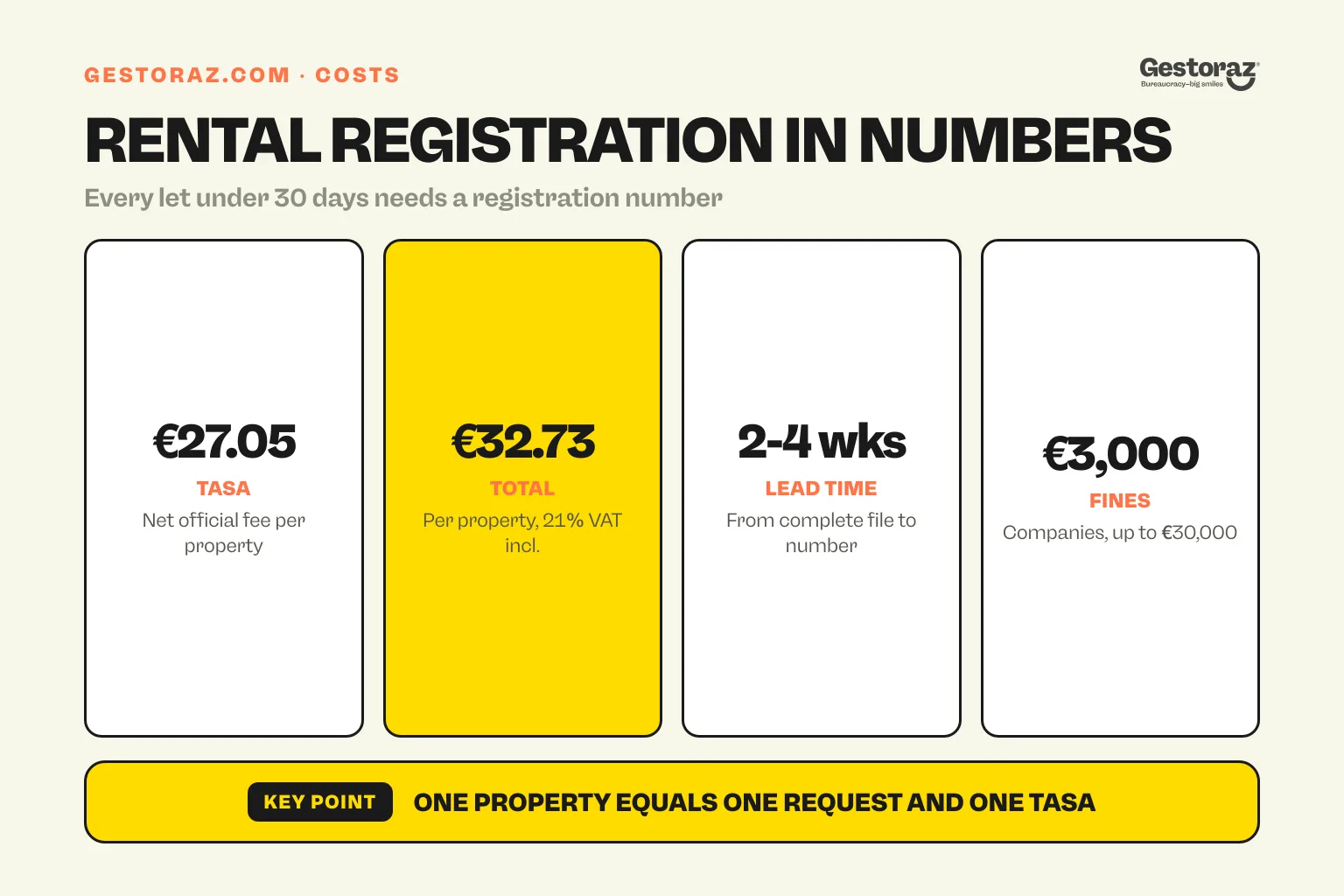
The registration number is allocated within 2 to 4 weeks of the complete file submission. You receive the notification by email with the number to keep and to include in all your listings.
Step 5: integrate the number into your listings
Since July 2025, all platforms (Airbnb, Booking, Vrbo, Rentalia) refuse listings without a national registration number. You must add it manually in the profile of each listing. If you have several properties, do it for each.
Step 6: keep the registration active
The number remains valid as long as you file the annual report required by the Colegio de Registradores. It is a simple but mandatory formality to keep the number.
How much does the request cost?
The cost is moderate for a one-off step.
Official tasa
The official tasa is €27.05 net per request (each property = one request). To this is added VAT of 21%, so a total cost of €32.73 inc. per property.
Example for an owner with several properties
For an owner operating 3 apartments in Valencia in tourist rental:
- 3 × €27.05 net = €81.15 net.
- VAT 21%: €17.04.
- Total: €98.19 inc.
Add the annual report (minimal fees, ~€5-€10 per property per year) to keep the registration active.
If you delegate to a gestoría
A gestoría will typically charge €100-€200 for the first request (including the tasa and checks). For owners with several properties, reduced packages are often offered.
How does it fit with other obligations?
National registration is just one brick in a wider system.
Three parallel systems
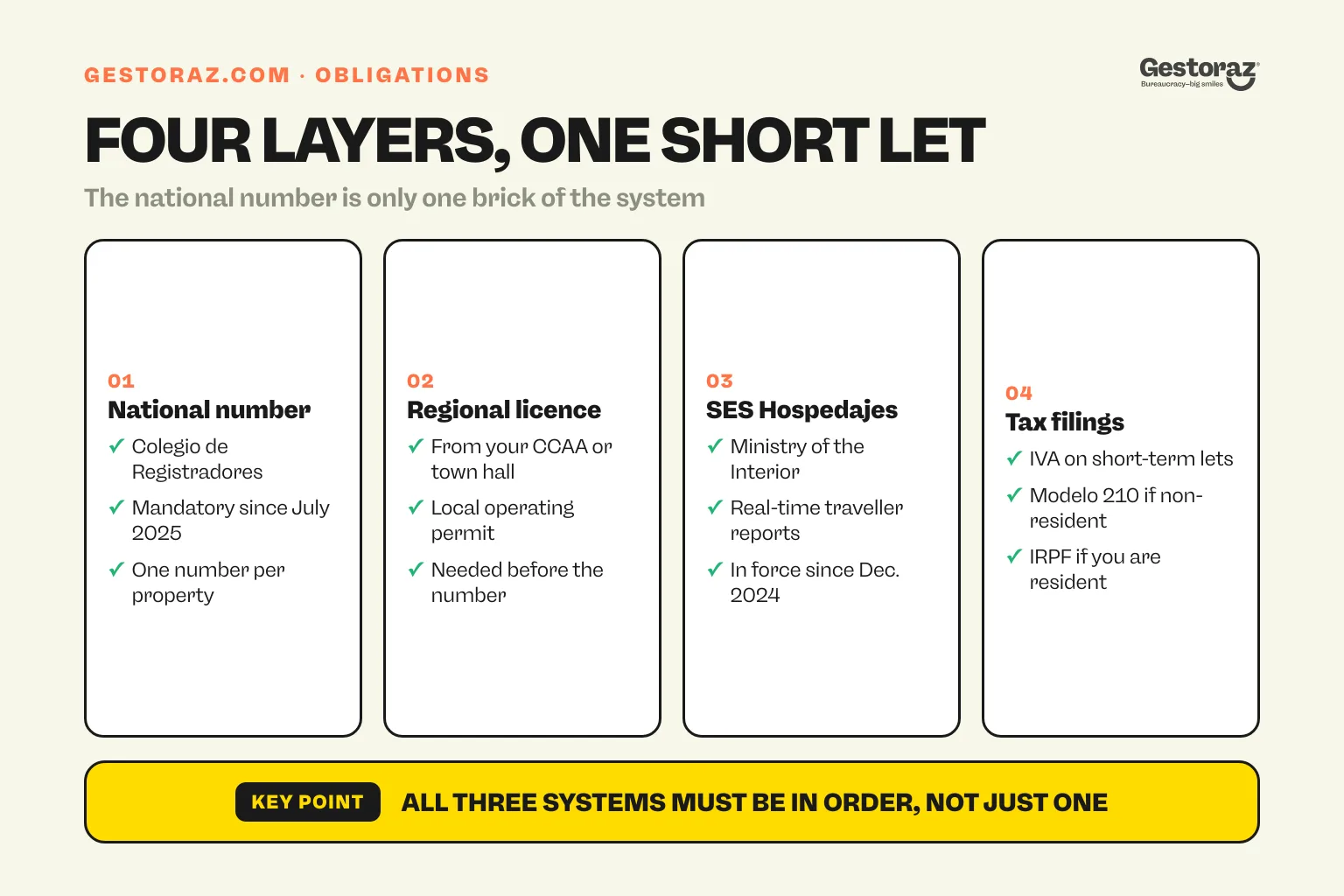
- National registration number (Colegio de Registradores): new obligation since July 2025.
- Regional tourist licence (CCAA, town hall): local operating authorisation.
- SES Hospedajes (Ministry of the Interior): real-time traveller declaration. See register at SES Hospedajes.
You must have all three in order to legally operate your property as a short-term rental.
Plus fiscal obligations
Beyond administrative obligations, do not forget the fiscal ones:
- IVA on short-term rentals (except some residential exceptions). For details see check which VAT rate applies in 2025.
- Modelo 210 quarterly if you are a non-resident owner (see how much tax a non-resident pays).
- IRPF annually if you are a tax resident (see how to become a tax resident).
- NIF if you rent via an SL (see apply for NIF in Spain for foreign companies).
Plus local constraints
Depending on your municipality, additional rules apply: zoning (some cities ban tourist rentals in certain districts), quotas per building, co-owners' authorisation, noise and use constraints.
What are the sanctions for non-compliance?
Sanctions are structured and dissuasive.
For individuals
- Light infringement (occasional forgetting, delay): fine from €300.
- Serious infringement (rental without number, false declarations): fine from €300 to several thousand.
For companies
- Infringements: fine of €3,000 to €30,000 depending on severity and number of properties concerned.
Platform blocking
Since July 2025, platforms are required to refuse listings without a valid registration number. If you do not have the number, your listings are automatically suspended, cutting you off from main distribution channels.
Automatic fiscal audit
The absence of a registration number is a signal alerting the Agencia Tributaria. Many owners then find themselves audited over 4 years with undeclared IRNR or IRPF reassessment, plus penalties. The total cost can largely exceed €10,000.
What pitfalls are common for foreign owners?
Several mistakes recur and cost time and money.
Incorrect cadastral reference
The most frequent error: indicating a wrong or imprecise cadastral reference. The reference must correspond exactly to that of the IBI notice. Check twice.
No digital certificate
Without a digital certificate or Cl@ve, access to the portal is impossible. Non-resident owners often have to go through a power of attorney and a gestoría to obtain their certificate. Anticipate at least 3-4 weeks.
Forgetting the number in listings
Once the number is obtained, do not forget to add it manually in all your listings (Airbnb, Booking, Vrbo, etc.). Without a displayed number, the listing is suspended.
Skipping the regional local licence
The national number does not exempt from the regional licence. If your CCAA requires a licence (Catalonia, Valencian Community, Andalusia, Balearics), you must obtain it before or in parallel.
Forgetting the annual report
The registration remains valid as long as you file the annual report. Many owners forget it and see their number revoked the following year.
Underestimating associated tax obligations
Holding the registration number does not exempt from declaring your rental income to the Agencia Tributaria. The two obligations are distinct and the tax office cross-references the bases.
Confusing registration number and cadastral reference
The registration number is a new unique code issued by the Colegio de Registradores. It is different from the cadastral reference of the property. Do not confuse the two in your listings.
Where to start with your tourist rental registration
The mandatory rental registration in Spain from July 2025 is a new unavoidable reality for those who want to continue operating their property short-term. The practical rule: launch the request as soon as you consider the rental, anticipate the digital certificate or Cl@ve, check your regional tourist licence, and keep written track of all steps to be able to justify in case of audit.
The cost is moderate (~€30 per property) and the procedure takes 2-4 weeks. Combined with SES Hospedajes and the regional licence, it now structures the short-term rental activity in Spain. Better to be in order from the start than to suffer a listing suspension or a fine that will largely exceed the registration fees.
Are you preparing a tourist rental or want to regularise an already rented property? At gestoraz, we can manage all steps in parallel (digital certificate, regional licence, national number, SES Hospedajes registration) and advise you on the associated tax obligations (quarterly modelo 210, rent declaration).
Official sources
- Sede del Colegio de Registradores, sede.registradores.org: official portal for the national registration number.
- Real Decreto 1312/2024 (BOE), boe.es: decree instituting the mandatory short-term rental registration number.
- Sede del Ministerio del Interior, SES Hospedajes, sede.mir.gob.es: traveller declaration.
- Catastro Inmobiliario, catastro.minhap.gob.es: cadastral reference consultation.
- Regulation (EU) 2024/1028 on short-term rentals, eur-lex.europa.eu: European registration framework.
- FNMT, sede.fnmt.gob.es: digital certificate request.
- Cl@ve, clave.gob.es: alternative to the digital certificate.


Obtain your Digital Certificate entirely remotely.
Request your Digital Certificate completely remotely.

