



The Spanish healthcare system: what you need to know as an expat
The Spanish healthcare system for expats is one of the best in Europe according to WHO rankings, with broad public coverage, modern hospitals and near-free access to basic care. But concretely accessing it when you settle requires understanding the procedures: NUSS, TSI, centro de salud, choice between public and private healthcare, S1 form for EU retirees. Misjudging these steps can leave you without effective cover for several months, even with your NIE in hand.
This article explains exactly how Spanish public healthcare works, how to access it depending on your status (employee, autónomo, EU retiree, student), how to activate your TSI, how to position yourself relative to private health insurance, and which pitfalls to avoid so you are not blocked when you have an urgent need. We also detail regional specificities, because healthcare in Spain is managed by each autonomous community.
How is the Spanish healthcare system organised?
Before the procedures, understand the system architecture.
A national system run by regions
Spain has a Sistema Nacional de Salud (SNS) that guarantees universal and free access to basic care. But its concrete management is decentralised: each autonomous community (17 regions + Ceuta/Melilla) manages its own network of centros de salud, hospitals, emergency services. Catalonia, Madrid, Andalusia, Valencia, Basque Country each have their SERVASA, SERMAS, SAS, etc., with slightly different modalities.
Three care levels
- Atención primaria (family doctor at the centro de salud): entry door for most care. Consultations, prevention, chronic disease follow-up.
- Atención especializada (specialists at hospitals or specialty centres): on family doctor referral for most specialties.
- Urgencias (hospital emergencies): 24/7 for critical cases. You can go without an appointment.
Medication copayment
For medication, a copayment varies by income: actives with income < €18,000/year pay 40%, > €18,000 pay 50%, > €100,000 pay 60%. Retirees pay 10%. Some medications (chronic, hospital) are free.
How do you access public healthcare as an expat?
Access depends on your social status, not just your administrative status.
For employees and autónomos who contribute
You automatically access public healthcare as soon as you contribute to Spanish social security (RETA for autónomo, Régimen General for employee). You receive a NUSS (see everything about the NUSS number) then you activate your TSI at the centro de salud.
For SL directors
The director of a Spanish SL contributes as autónomo societario and therefore accesses public healthcare in the same way as a standard autónomo. For SL set-up, see the step-by-step guide to setting up an SL and the wider social context in how the Spanish social security system works.
For EU/EEA retirees with S1
EU retirees settling in Spain request an S1 form from their original pension fund. The S1 transfers health cover: they obtain a NUSS and a TSI without contributing locally. Their country of origin pays for care consumed in Spain. It is the classic mechanism for French, German, Belgian, Dutch, British (with post-Brexit agreement) retirees.
For non-EU on student or digital nomad visa
Holders of student or digital nomad visa generally must take out private health insurance as a visa condition. Without contribution to Spanish social security, they cannot activate the TSI. Private insurance then covers care, or they can pay cash in public hospitals (at accessible rates).
For non-residents with EHIC
EU citizens on short stays (holidays, business trips) are covered by their EHIC (European Health Insurance Card) for urgent care. But the EHIC does not replace resident cover: to settle long-term, you need NUSS+TSI or private insurance.
How do you activate your TSI at the centro de salud?
It is the concrete step giving you access to care. Many expats neglect this step and remain without operational access for months.
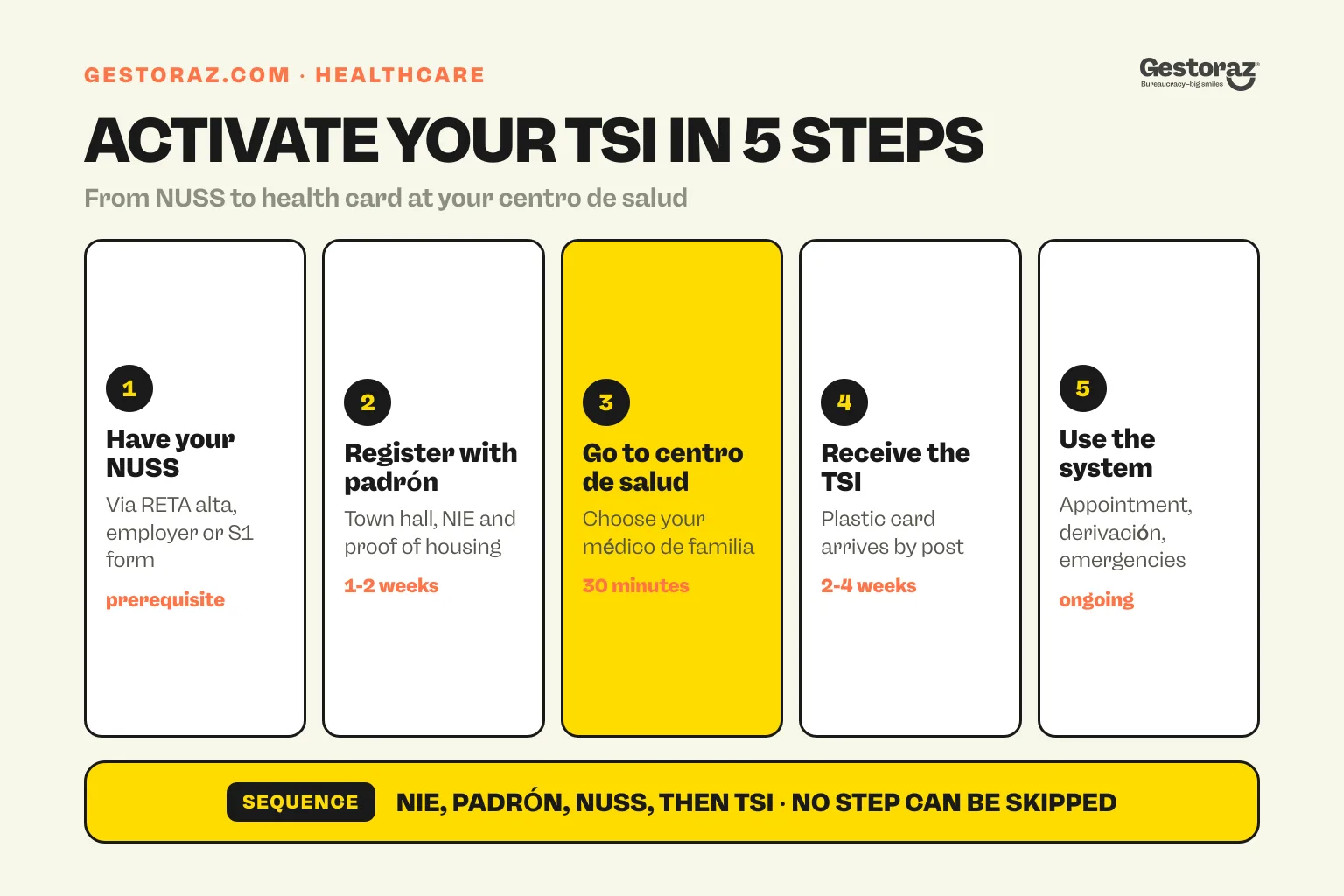
Step 1: have your NUSS
You must first have obtained your NUSS. If you are an employee, your employer requested it for you. If you are an autónomo, you obtained it during the RETA alta. If you are an EU retiree, your S1 triggered the allocation. For NUSS request details, see everything about the NUSS number.
Step 2: register with the padrón
Before the centro de salud, you must be empadronado in the town where you live. Padrón registration is done at the town hall with your NIE and proof of housing (lease, certificate, deed). The padrón is free and generally takes 1-2 weeks. To grasp the full administrative residency, see everything about residency in Spain.
Step 3: present yourself at the centro de salud
With your NUSS, your NIE document (and the S1 form if EU retiree), your ID and your empadronamiento certificate, you go to the centro de salud closest to your home. You choose your médico de familia (family doctor) and a paediatrician if you have children. Registration is free and takes 30 minutes.
Step 4: receive the TSI by post
The TSI (physical health card) arrives by post within 2-4 weeks. It is the plastic card you present at every consultation and at the pharmacy for reimbursed medication. Without a physical TSI, you can still be treated with your NUSS in the first weeks, but it is less smooth.
Step 5: use the system
For a consultation with your family doctor, you book an appointment (online, by phone, or by going to the centro). For a specialist, the family doctor gives you a derivación (prescription) directing you to the right service. For emergencies, you go directly to the hospital without an appointment.
How do you choose between public and private healthcare in Spain?
It is a strategic question for mid- to high-income expats.
Public healthcare advantages
Spanish public healthcare is almost free (consultations, hospitalisations, emergencies), of high medical quality, with an excellent hospital network. It is enough for 90% of health needs. For urgent and hospital care, it is unbeatable.
Public healthcare limits
Waiting times for specialists can be long (3-6 months for a dermatologist, 6-12 months for some non-urgent operations). The family doctor is geographically assigned. Dental care, optics and psychology are little covered. Hospital comfort is decent but without extras.
Private insurance advantages
Spanish private insurance (Sanitas, Adeslas, DKV, Mapfre, etc.) costs between €40 and €150/month per person depending on age and cover. It offers specialists accessible within 24-72 hours, choice of doctor and hospital, partial dental care, and superior comfort. Widely used by expats and Spanish urban middle classes.
Both together: the common solution
Many expats combine public healthcare (for emergencies and heavy needs) and private insurance (for comfort and specialist accessibility). It is also the strategy of many urban Spaniards.
For retirees
For EU retirees with S1, public healthcare is free and largely sufficient. Private insurance is not essential, unless you want dental care or fast access to specific specialists.
What are the regional specificities of the system?
As healthcare is managed by autonomous communities, some rules vary.
The main regional services
- Catalonia: CatSalut, ICS (Institut Català de la Salut). Well-organised network but under tension in Barcelona.
- Madrid: SERMAS (Servicio Madrileño de Salud). Very dense network, fairly broad choice of hospitals and centros.
- Andalusia: SAS (Servicio Andaluz de Salud). Largest network in Spain with local disparities.
- Valencian Community: SERVASA. Good quality, with modernisation projects.
- Basque Country: Osakidetza. Often considered one of the best networks in Spain.
Local specificities
Depending on the region, some benefits vary slightly (dental cover, prevention programmes, accessibility of certain treatments). If you move from one region to another, your TSI must be renewed locally (simple procedure via the new centro de salud).
The SIP card in the Valencian Community
Valencian particularity: the health card is called SIP (Sistema de Información Poblacional) instead of TSI. The mechanism is identical but the name changes.
What pitfalls are common for expats?
Several mistakes recur and complicate access to care.
Believing the NIE is enough
Mistake number one: thinking that holding an NIE opens access to public healthcare. The NIE is just an administrative identifier. You need a NUSS (so contribute or have an S1) and an activated TSI. To understand, see nine misconceptions about the NIE number.
Forgetting to activate the TSI after obtaining the NUSS
Holding the NUSS without the TSI is a frequent situation: expats register with social security (RETA alta, employment contract) but forget the centro de salud step. Without active TSI, access to care is complicated.
Underestimating specialist lead times
Public healthcare is excellent for urgent and hospital care, but lead times for specialists can be long. If you have a regular medical follow-up (cardiology, endocrinology, dermatology), plan either a top-up private insurance, or much patience.
Failing to request the S1 as an EU retiree
Many EU retirees take out private insurance through unfamiliarity with the S1. The S1 is free, requested from your original pension fund, and gives access to all Spanish public healthcare without contributing. Check your eligibility before paying for insurance.
Confusing EHIC and residency
The EHIC (European card) covers urgent care on short stays. To settle long-term, it is insufficient: you need resident NUSS+TSI.
Neglecting the regional dimension
If you move from one region to another (Madrid → Valencia for example), you must renew your TSI locally. No automatic transfer. Register at the new centro de salud as soon as you arrive.
How do you handle an emergency without an active TSI?
If you do not yet have your TSI at the moment of a medical need, several options exist.
Emergencies are always accessible
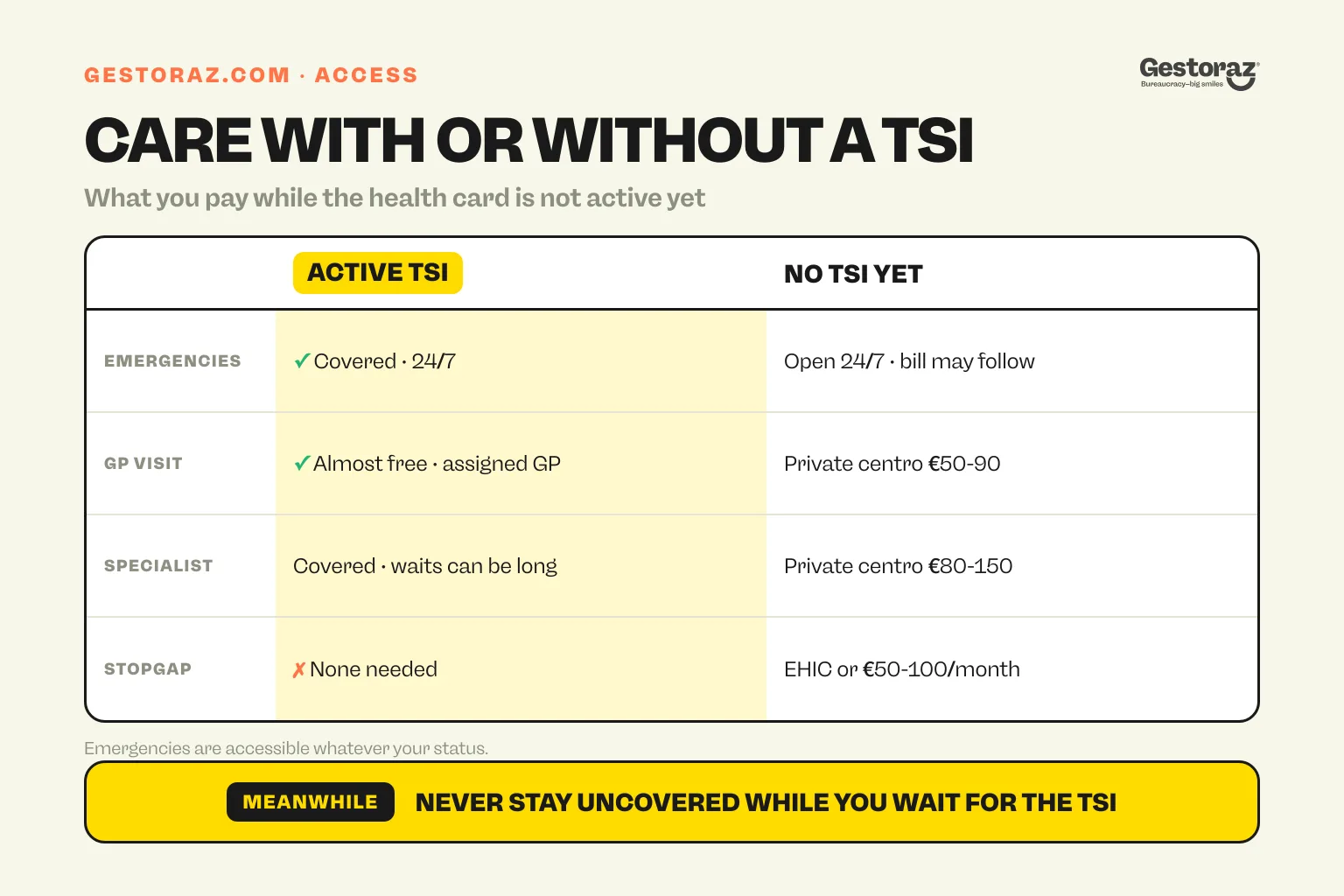
Whatever your status (tourist, expat without TSI, undocumented), hospital emergencies are accessible 24/7. You will be treated even without documentation. A bill may be issued afterwards if you do not have cover, but it is generally modest for basic care.
EHIC for EU citizens
If you are EU/EEA and you do not yet have the Spanish NUSS, your EHIC (European card) covers urgent care. Present it at emergencies or in consultation.
Temporary private insurance
Many expats take out temporary private insurance for the first months (€50-€100/month) while waiting for TSI activation. It is a good practice not to be without cover.
Private centros at moderate cost
For a non-urgent consultation without active TSI, private centros typically charge €50-€90 for a GP, €80-€150 for a specialist. It is an acceptable one-off option.
Where to start to manage your health as an expat in Spain
The Spanish healthcare system for expats is one of the strengths of settling in Spain, but it requires precise procedures to access concretely. The practical rule: NIE → padrón → social security contribution (or S1 for retirees) → NUSS → TSI at the centro de salud. Without this complete sequence, you can have all the papers without operational access to care.
Anticipate the steps from arrival: register with the padrón quickly, do your social alta (RETA if autónomo, S1 if retiree), and present yourself at the centro de salud with all supporting documents. During the first weeks, keep top-up private insurance or your EHIC if you are EU.
Are you preparing a move and want to structure your health cover correctly from arrival? At gestoraz, we can coordinate the NUSS, padrón, and TSI steps, and advise you on the relevance of complementary private insurance based on your profile and health needs.
Official sources
- Ministerio de Sanidad, sanidad.gob.es: Sistema Nacional de Salud, covered benefits.
- Tesorería General de la Seguridad Social, sede.seg-social.gob.es: NUSS and social alta.
- Real Decreto-ley 7/2018 (BOE), boe.es/buscar/act.php?id=BOE-A-2018-10752: universalisation of access to healthcare in Spain.
- Regulation (EC) 883/2004, eur-lex.europa.eu/legal-content/EN/TXT/?uri=CELEX:32004R0883: coordination of EU healthcare and S1 form.
- INSS, health benefits, sede.seg-social.gob.es: sickness benefits and associated steps.
- Catastro de los servicios autonómicos de salud, sanidad.gob.es: directory of SERVASA, SERMAS, SAS and other regional services.


Obtain your Digital Certificate entirely remotely.
Request your Digital Certificate completely remotely.

