



Register at SES Hospedajes in Spain: a step-by-step guide
Since 2 December 2024, every tourist host in Spain must register their travellers on the SES Hospedajes platform of the Ministry of the Interior. This obligation replaces the old Hospederías system of the Guardia Civil and concerns absolutely everyone: hotels, hostels, Airbnb rentals, B&Bs, campsites, individuals occasionally renting their second home. Failing to register or to declare your travellers exposes you to heavy administrative sanctions.
This article explains exactly what SES Hospedajes is, who must register, which documents to prepare, how to complete registration step by step via the Ministry of the Interior sede, how to automate traveller registration with specialised platforms, and the sanctions for non-compliance. We also detail the pitfalls specific to foreign hosts and the related steps (regional tourist register, digital certificate).
What is SES Hospedajes and why was it created?
Before the procedures, understand the stakes and the context.
A Ministry of the Interior platform
SES Hospedajes is the official platform of the Spanish Ministry of the Interior on which all tourist hosts must register each traveller within 24 hours of check-in. It replaces the old Hospederías system of the Guardia Civil used until 2024.
Government objectives
The Spanish state has several reasons to put this platform in place:
- Control tourist rentals in cities under heavy tourist pressure (Barcelona, Madrid, Seville, Palma, Ibiza).
- Facilitate tax collection: the Agencia Tributaria can cross-reference SES Hospedajes declarations with revenue declared by hosts.
- Enable local enforcement of co-ownership and zoning rules by municipalities.
- Public security: traveller tracking in case of investigation or emergency.
Link with the mandatory rental registration
Since July 2025, short-term rentals under 30 days must additionally have a registration number specifically issued by the Colegio de Registradores. SES Hospedajes and this new register are complementary. For details, see mandatory rental registration in Spain from July 2025.
Who must register with SES Hospedajes?
The obligation is broad and concerns all types of tourist hosts.
Professional accommodation
Concerned: all hotels, hostels, B&Bs, paradores, but also campsites and glampings, aparthotels and tourist apartments, rural houses and casas rurales, and short-term rental homes (Airbnb, Booking, Vrbo, Rentalia).
Individuals renting occasionally
If you rent your second home or even your main residence occasionally (holidays, weekends), you are required to register with SES Hospedajes for your rentals under 30 days. Even one week a year triggers the obligation.
Exceptions
You are not concerned if:
- You only rent long-term (≥ 30 days).
- You host relatives without financial counterpart.
- You do a non-commercial home swap (without monetary transaction).
Platform special case
Platforms (Airbnb, Booking) do not register with SES Hospedajes for you: it is the host who is responsible. Even if Airbnb starts integrating declaration aid tools, the legal obligation stays on the host.
What documents and preparation before registration?
A few prerequisites to organise before launching.
The digital certificate
Access to SES Hospedajes is via the Ministry of the Interior's sede electrónica, requiring a digital certificate or Cl@ve. If you do not yet have either, that is the first step. For the procedure, see the digital certificate and Cl@ve in Spain and where to find the número de soporte which is essential for the FNMT request.
Property data
- Full address (street, number, floor, postcode, municipality).
- Cadastral reference (visible on your IBI notice or on catastro.minhap.gob.es).
- Type of accommodation (apartamento, casa, hotel, etc.).
- Maximum number of travellers (legal capacity of the property).
- Local tourist licence if your CCAA requires it (Catalonia, Balearics, Valencian Community, Andalusia).
Host NIF
If you are a foreign individual, your NIF is your NIE (see the difference between NIE and NIF). If you rent via an SL, it is the company NIF (starting with B). To understand company NIFs, see apply for NIF in Spain for foreign companies.
An up-to-date email address
SES Hospedajes sends notifications by email. Check your address is up to date in your profile before starting.
How do you register with SES Hospedajes step by step?
Here is the detailed path.
Step 1: access the portal
Go to sede.mir.gob.es (Ministry of the Interior sede electrónica) and navigate to the "SES Hospedajes" section. Click on the @ symbol next to the option "Acceso al registro de establecimientos y entidades".
Step 2: authentication
Choose your authentication method: digital certificate (most reliable) or Cl@ve PIN/Permanente. The system then loads your user profile.
Step 3: configure your profile
Top right, click on "Perfil". Check that all your data is correct: name, NIF, postal address, email (essential for notifications), phone. Click "Aceptar" to validate.
Step 4: start establishment registration
Return to the home page and click on "Inicio" then on the option to create a new establishment. Indicate the type of accommodation (hotel, tourist apartment, individual rental, etc.).
Step 5: fill the establishment data
Enter:
- Commercial name of the establishment (can be your personal name for an individual rental).
- NIF/CIF of the responsible entity.
- Full address (with cadastral reference).
- Important: tick "Envío de comunicaciones por servicio web" to be able to transmit travellers automatically via API if you use a specialised platform.
Step 6: add accommodation units
For each managed property (useful if you have several apartments), enter:
- Full address.
- Cadastral reference.
- Type of accommodation.
- Maximum capacity.
- Regional tourist licence number if required in your CCAA.
Step 7: verify and sign
Carefully reread all data. Once validated, sign electronically with your digital certificate. Registration is effective immediately.
Step 8: configure traveller declaration
For each check-in, you must declare the traveller within 24 hours. Two options:
- Manual declaration on SES Hospedajes: tedious for those with regular rentals.
- Integration via specialised platform like Hola Huésped, Civitfun, Check-in Scan, Avantio, Smily, Lodgify: these solutions automate the declaration by connecting to SES Hospedajes via API.
What data must be declared per traveller?
For each check-in, you transmit within 24 hours:
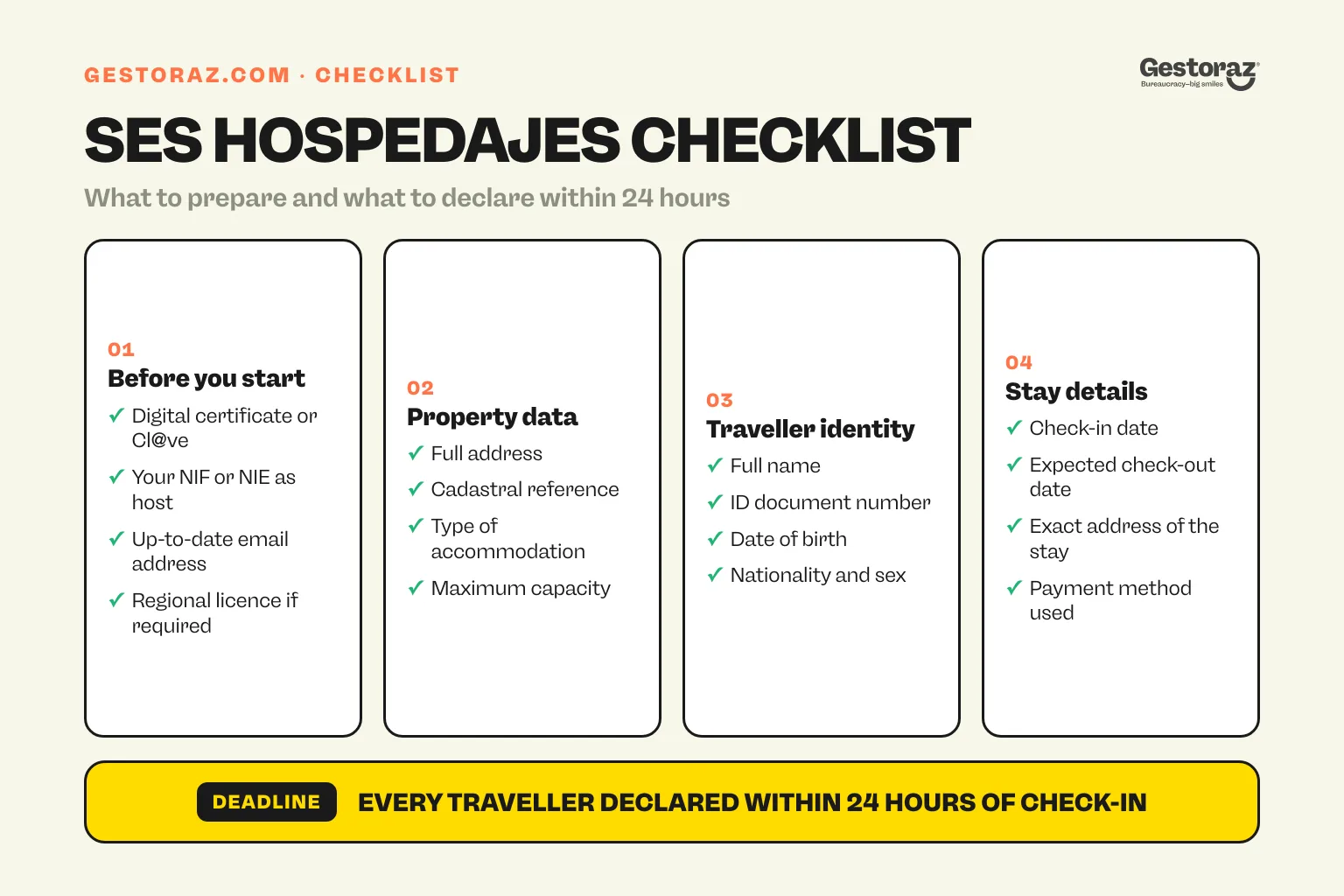
Traveller identity
- Full name.
- ID document number (passport, DNI, NIE).
- Date of birth.
- Nationality.
- Sex.
Stay details
- Arrival date (check-in).
- Expected departure date (check-out).
- Exact address of the accommodation.
- Payment method used.
For children
Children under 14 do not need to be declared individually, but they must appear in the traveller count.
Data security
SES Hospedajes is GDPR compliant. Data is kept by the Ministry of the Interior in a secure environment. You can consult past declarations and correct them in case of error.
What are the sanctions for non-compliance?
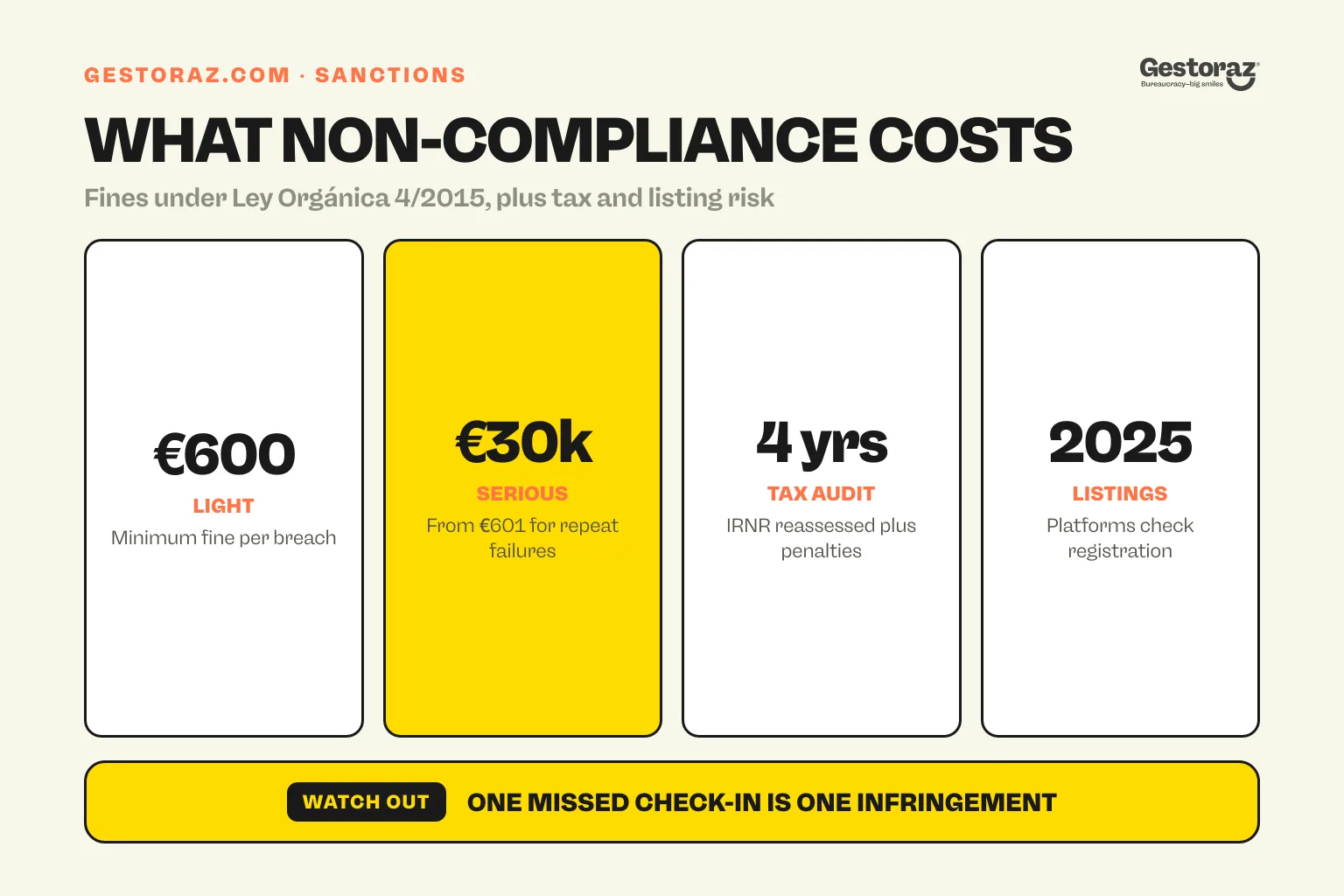
Sanctions are structured by Ley Orgánica 4/2015 on citizen security.
Administrative sanctions
- Light infringement (occasional forgetting, minor delay): fine starting at €600 per infringement.
- Serious infringement (repeated non-declaration, false declarations): fine of €601 to €30,000.
- Very serious infringement (systematic refusal, falsification, organisation): fines that can exceed €30,000.
Fiscal consequences
Failing to declare on SES Hospedajes can trigger an Agencia Tributaria audit of your rental income. Many hosts have been reassessed over 4 years with quarterly IRNR (modelo 210) reassessment plus penalties. To grasp non-resident owner tax obligations, see how much tax a non-resident pays.
Platform blocking
Airbnb, Booking and other platforms have applied since 2025 the verification of the national registration number (linked to the July 2025 mandatory registration). Without complete registration, your listings can be suspended or removed.
What pitfalls are most common?
Several mistakes recur with new hosts.
Starting too late
Many private hosts wait for the first traveller to arrive before registering and become aware of the obligation late. Registration takes 1-3 days and obtaining the digital certificate 1-2 weeks. Anticipate at least a month before the first rental.
No digital certificate
Without a digital certificate or Cl@ve, access to SES Hospedajes is impossible. Request your digital certificate in parallel with registration with the tourist register.
Wrong cadastral reference
The cadastral reference is mandatory and must correspond exactly to that on your IBI notice. An error generates an automatic rejection. Check on catastro.minhap.gob.es if in doubt.
Forgetting to tick "Envío de comunicaciones por servicio web"
This option lets you connect a third-party platform (Hola Huésped, Civitfun, Avantio) to SES Hospedajes automatically. Without this box ticked, you must manually declare every traveller, which quickly becomes unmanageable.
Not automating for several properties
If you have 2 or more properties, automation via a specialised platform is almost essential. Count €10-€20/month per property for a solution like Hola Huésped, saving hours of manual declarations.
Forgetting the registration number from the new obligation
SES Hospedajes does not replace the mandatory registration number introduced in July 2025. They are two complementary registers. For the new register procedure, see mandatory rental registration.
Confusing regional tourist licence and SES Hospedajes
Your CCAA (Catalonia, Valencian Community, Andalusia, Balearics) requires a specific tourist licence for short-term rentals. This licence is distinct from SES Hospedajes. Without regional licence + SES Hospedajes registration + national registration number, you are not in order.
Where to start with SES Hospedajes
Registration with SES Hospedajes in Spain is mandatory for any tourist host since December 2024 and is part of a regulatory set that has tightened since 2025. The practical rule: start registration in parallel with the regional tourist licence request and the national registration number, automate traveller declaration if you have several properties or frequent rentals, and keep an internal log of your rentals to facilitate annual fiscal returns.
For hosts starting or regularising a situation, the sequence to respect is: digital certificate → SES Hospedajes registration → Colegio de Registradores registration number → automation activation. Count 4-8 weeks for full set-up.
Are you starting a tourist rental or want to regularise your existing activity? At gestoraz, we can manage all the steps (digital certificate, SES Hospedajes registration, regional licence, national registration number) and configure automation so you only need to transmit check-ins.
Official sources
- Sede del Ministerio del Interior, SES Hospedajes, sede.mir.gob.es: official portal for registration and traveller declaration.
- Real Decreto 933/2021 (BOE), boe.es/buscar/act.php?id=BOE-A-2021-17630: founding text of SES Hospedajes.
- Ley Orgánica 4/2015 sobre seguridad ciudadana (BOE), boe.es/buscar/act.php?id=BOE-A-2015-3442: sanctions applicable in case of non-declaration.
- Catastro Inmobiliario, catastro.minhap.gob.es: cadastral reference consultation.
- FNMT, sede.fnmt.gob.es: digital certificate request to access SES Hospedajes.
- Cl@ve, clave.gob.es: alternative to the digital certificate for authentication.


Obtain your Digital Certificate entirely remotely.
Request your Digital Certificate completely remotely.

