



Modelo 030 in Spain: what it is and how to file it
The modelo 030 is the form almost nobody hears about until something goes wrong. It is the census declaration that individuals file with the Agencia Tributaria to register in the taxpayer census, to change their tax address, to update personal data, or to request a NIF when they do not have one.
It matters more than its low profile suggests. If you move and do not file it, the Agencia Tributaria keeps writing to the old address, and Spanish law treats those letters as validly delivered. This guide covers what the form actually does, when it becomes mandatory, how to file it, and how it differs from the modelo 036 that everyone confuses it with.
What the modelo 030 is actually for
Its full name is Declaración censal de alta en el Censo de obligados tributarios, cambio de domicilio y/o variación de datos personales. In plain terms: it is how a private individual tells the Spanish tax office who they are and where to find them.
The form covers eight distinct purposes:
- Registration (alta) in the census of taxpayers.
- Change of domicilio fiscal, your tax address.
- Setting, changing or removing a separate domicilio a efectos de notificaciones, the address where the administration sends letters.
- Modification of identifying data (name, surnames, document number).
- Request for a NIF for individuals who hold neither a DNI nor an NIE.
- Change of civil status.
- Request for a new NIF identification card.
- Adding or updating a phone number and email address for AEAT alerts.
It is designed for people who do not carry on a business or professional activity and do not pay out income subject to withholding. If you are already registered in the Censo de Empresarios, Profesionales y Retenedores, you may only use the 030 for two narrow things: a change of civil status and a change of identifying data. Everything else goes on the modelo 036.
The situations that make it mandatory
You moved house
This is the common case. Individuals who are not in the business census must communicate a change of tax address within three months of the move, under article 17 of Real Decreto 1065/2007. There is one exception worth knowing: if the filing window for your personal income tax return opens and closes inside those three months, you communicate the new address in that return instead.
Your personal data changed
A marriage, a divorce, a change of surname, a renewed identity document with a new number. Each of these creates a mismatch between what the AEAT holds and what appears on the documents you sign, and mismatches are what block returns from validating.
You need a NIF and do not have one
The Agencia Tributaria assigns tax numbers to individuals who have no DNI and no NIE. There are three cases, identified by the first letter of the number:
- K: Spanish minors under 14 who are resident in Spain.
- L: Spanish nationals resident abroad who are not required to hold a DNI.
- M: foreign nationals who do not have an NIE.
Two caveats. This AEAT number is transitional: it stands until the person obtains a DNI or an NIE, both issued by the Ministerio del Interior, not by the tax office. And if you are a foreigner who is going to need an NIE anyway, the 030 is not your route: the NIE is applied for with the modelo EX-15, as set out in how to obtain an NIE number.
You are appointing a representative
The form has a section for a representante. Non-residents and people who spend long periods outside Spain use it so that someone in Spain receives and acts on tax correspondence.
Why a stale address gets expensive quietly
Article 48 of the Ley General Tributaria contains a sentence that catches people out: a change of tax address does not take effect as regards the tax administration until you have communicated it. Until the 030 is filed, the old address is legally still yours, however long ago you left it.
What follows from that is the real risk. If a letter cannot be delivered, the administration can move to notification by comparecencia under article 112 of the same law: an announcement is published in the Boletín Oficial del Estado, you have 15 natural days to appear, and if you do not, the notification is treated as made for all legal purposes. Nobody expects a private individual to read the BOE. The law does not require that you did.
The consequences stack up in silence. Deadlines to pay run and expire. The window to lodge an appeal, normally counted from the notification date, closes without you knowing it opened. A file that could have been fixed with one email becomes an enforcement procedure with surcharges attached. None of this requires bad faith on anyone's part, only an address that is three years out of date.
modelo 030 vs modelo 036: who files what
This is the confusion worth clearing up, and it is simpler than the internet makes it look.

- Modelo 030: individuals with no business or professional activity. Census registration, address, personal data, civil status, NIF request, representative.
- Modelo 036: the census declaration for economic activity. Anyone starting, modifying or ceasing an activity uses it: autónomos, Spanish companies, and foreign companies operating in Spain through a fiscal representative.
- Modelo 037: the simplified version of the 036, now withdrawn. Orden HAC/1526/2024 suppressed it with effect from 3 February 2025, and its simplifications were folded into the 036 itself, which now only displays the sections a given taxpayer needs.
The working rule: if there is an economic activity behind the change, it is a 036. If you are simply a private individual with a Spanish tax number, it is a 030. If you own property in Spain and rent it out as a private landlord without a registered activity, you are still on the 030 side for census purposes. For the identity numbers underneath all of this, see what a NIF number is and why you need it.
What to have ready before you start
The form is short, but two fields stop people mid way. Gather this first:
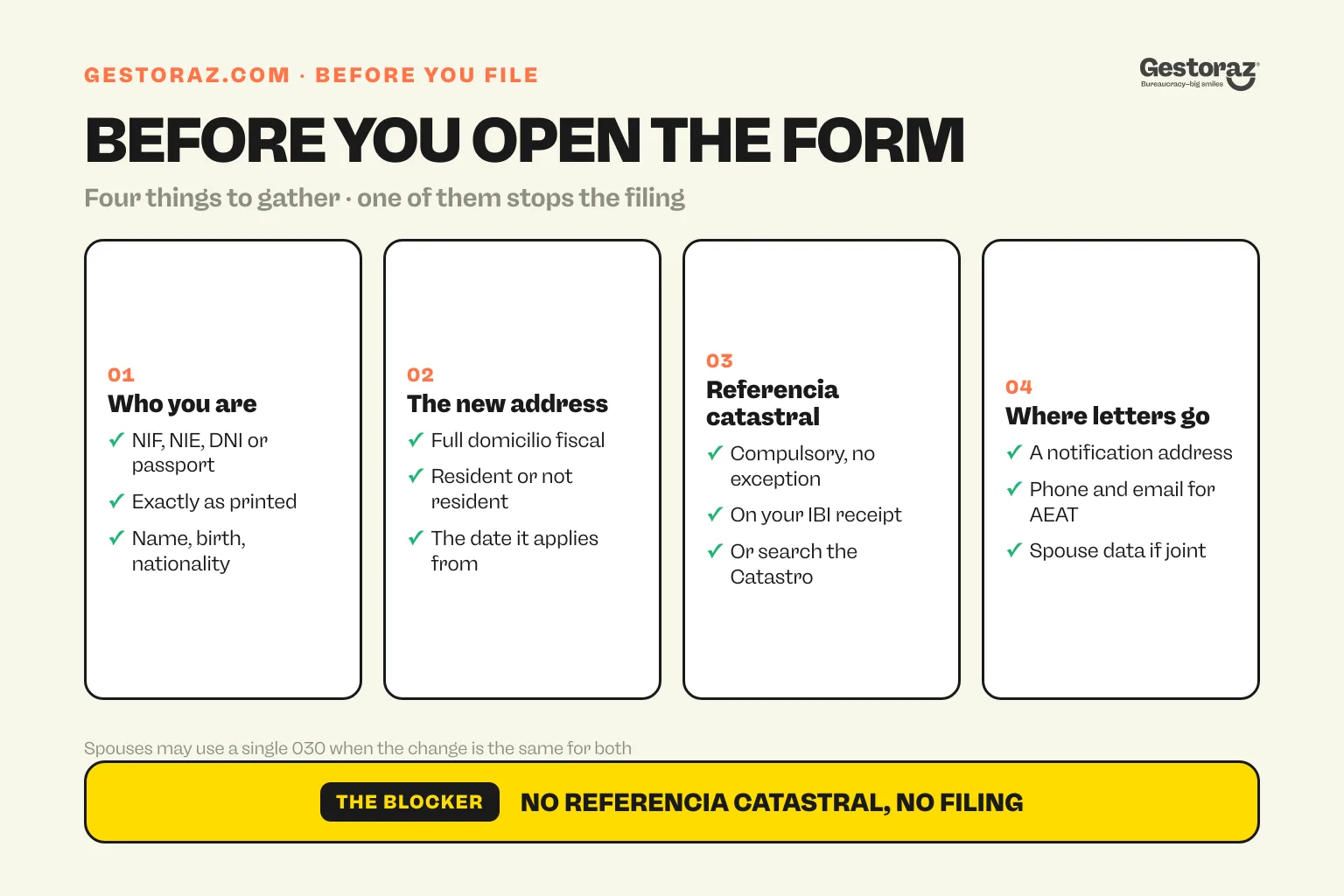
- Your NIF, NIE, DNI or passport number, exactly as printed on the document.
- Full name and surnames, date and place of birth, nationality.
- Your condición de residente o no residente and the date from which it applies.
- The full new domicilio fiscal, including the referencia catastral of the property. This is compulsory and it is the field that halts most filings. It appears on your IBI receipt and can be looked up on the Catastro site from the address.
- A separate notification address if you want letters sent somewhere other than your tax address.
- Your spouse's details if you are filing a joint change. Spouses may use a single 030 when the change is the same for both, signed by each of them.
- A phone number and an email address, so the AEAT can flag that something is waiting for you.
Filing it: digital certificate, Cl@ve, or on paper
Online, if you can already identify yourself
The fastest route is the sede electrónica of the Agencia Tributaria, with a digital certificate or Cl@ve. It is immediate and you get a filing receipt straight away, which is the proof you want if a notification dispute ever arises. If you have neither system yet, the digital certificate and Cl@ve guide explains how each is obtained.
On paper, at an office or by post
The 030 can be completed as a printed form and delivered to the AEAT office corresponding to your tax address, or sent by certified post. For counter service, book a cita previa through the sede electrónica, the AEAT app, or by phone.
The case where online is not an option
If you are filing the 030 precisely because you have no Spanish tax number, you cannot log in with credentials tied to a number you do not have. The AEAT provides a non face to face route for K, L and M requests, where the completed 030 is uploaded as a PDF together with the supporting identity documents. The alternative is the counter, in person or through a representative.
Non-residents: the specific case, and the modelo 210
For a non-resident owner, the 030 is the quiet piece of infrastructure that makes everything else work. Your tax address is abroad, but the letters need to reach someone. The form lets you record a notification address in Spain, typically that of your representative, and to register the representative themselves.
That matters because non-resident obligations are recurring and unforgiving. The modelo 210 on renta imputada is filed every year, even if you never set foot in the property, and failing to file generates back tax over four years plus penalties. Every one of those letters goes to the address the census holds. The detail is in how much tax you pay as a non-resident.
The census entry is also where your residence status is recorded. Note that being in the census says nothing about being a tax resident: those are separate questions, covered in the impact of your NIE on your tax status.
Common mistakes
- Assuming the padrón is enough. Registering with the town hall updates the municipal register. It does not update the Agencia Tributaria. They are separate systems and the 030 is still required.
- Assuming the bank told them. Telling your bank, your utility company or your gestor your new address does not communicate it to the AEAT.
- Filing a 036 as a private individual, or a 030 when you have an active autónomo registration. Both get rejected or, worse, accepted and half applied.
- Leaving the referencia catastral blank. The filing does not go through without it.
- Setting a notification address nobody actually monitors. An empty holiday flat as your notification address is functionally the same as no address at all.
- Waiting past the three months and only mentioning the move in next year's return, when a notification has already been issued in the meantime.
- Not keeping the receipt. The filing acknowledgement is your evidence that the address was communicated on a given date.
Where to start
If you have moved in the last three months and hold a digital certificate or Cl@ve, file the 030 online today: it takes minutes once you have the cadastral reference to hand. If you moved longer ago, file it anyway and then check your AEAT notification inbox for anything issued in the meantime, because that is where an old surprise would be sitting.
If you are a non-resident, the more useful step is structural rather than administrative: set a notification address in Spain that a real person reads, and appoint a representative on the same form.
At Gestoraz we handle Spanish administrative filings remotely, including census updates, and we coordinate what usually surrounds them: NIE and NIF, digital certificate, padrón registration and the non-resident tax calendar.
Official sources
- Agencia Tributaria, modelo 030, sede.agenciatributaria.gob.es: purposes of the form, instructions, required data and filing channels.
- Ley 58/2003, General Tributaria, boe.es: article 48 on the duty to communicate the tax address, article 112 on notification by comparecencia.
- Real Decreto 1065/2007, boe.es: article 17, three month deadline for individuals outside the business census.
- Orden HAC/1526/2024, boe.es: suppression of the modelo 037 with effect from 3 February 2025 and consolidation into the modelo 036.


Obtain your Digital Certificate entirely remotely.
Request your Digital Certificate completely remotely.

