



NIE vs TIE in Spain: what is the difference?
Two documents, one number, and a confusion that costs people appointments. The NIE and the TIE are constantly used as if they were the same thing, including by staff at banks and utility companies who should know better.
They are not the same kind of object at all. One is a number, the other is a card. A number cannot expire and a card always does. Almost every practical misunderstanding follows from that single distinction.
The difference in one sentence
The NIE is your identification number as a foreign national in Spain. The TIE is a physical card issued to non-EU nationals that proves you hold a residence permit, and your NIE is printed on it.
Put differently: the TIE is one of several supports your NIE can be printed on. It is not a different number, and getting a TIE does not give you a new NIE. If you want the full definition of the number itself, it lives in what is an NIE number, and the neighbouring confusion with the tax number is covered in NIE vs NIF.
The NIE is a number, and it never expires
The NIE is assigned once and stays with you. It does not lapse because you left Spain, because you stopped paying taxes there, or because the paper it was printed on is ten years old. This is the single most useful thing to know about it, and the reason a whole category of searches about "renewing your NIE" rests on a false premise, as set out in renewing your NIE.
What can expire is the document carrying it. That is a different question, and it is the one that actually affects you at a counter.
The TIE is a card, and it does expire
The TIE, Tarjeta de Identidad de Extranjero, is a plastic card the size of an ID card, with your photograph. It is issued to non-EU nationals who hold a residence authorisation, and it materialises that specific authorisation: student, employee, family member, digital nomad, and so on.
Because it represents a permit, it inherits that permit's validity. When the permit ends, the card ends. This is why the card is the thing you diary, not the number.
What triggers the obligation is duration, not permit type: anyone granted a visa or an authorisation to stay longer than six months has both the right and the duty to obtain the card, and one month from entry or from the grant to do it. That rule now sits in article 209 of Real Decreto 1155/2024, the regulation that replaced Real Decreto 557/2011 on 20 May 2025. Any guide still citing the 2011 text, and there are many, is quoting repealed law.
One practical consequence: a non-EU national who has an NIE but no valid TIE does not thereby have the right to stay. The number identifies you, it does not authorise you.
What EU citizens get instead: the green certificate
EU, EEA and Swiss citizens do not receive a TIE. Staying beyond three months, they register in the Registro Central de Extranjeros and receive the certificado de registro de ciudadano de la Unión, a green A4 sheet, sometimes issued in a smaller card-sized format. It carries the NIE and confirms the entry in the register.

It is paper, it has no photograph, and it is not an identity document: an EU citizen still identifies themselves with a passport or national ID card. The procedure and the form behind it are covered in the modelo EX-18.
There is also an optional plastic format sold to EU citizens for convenience. It is not an official replacement for the green certificate, and offices will still ask for the original.
Which document you actually end up with
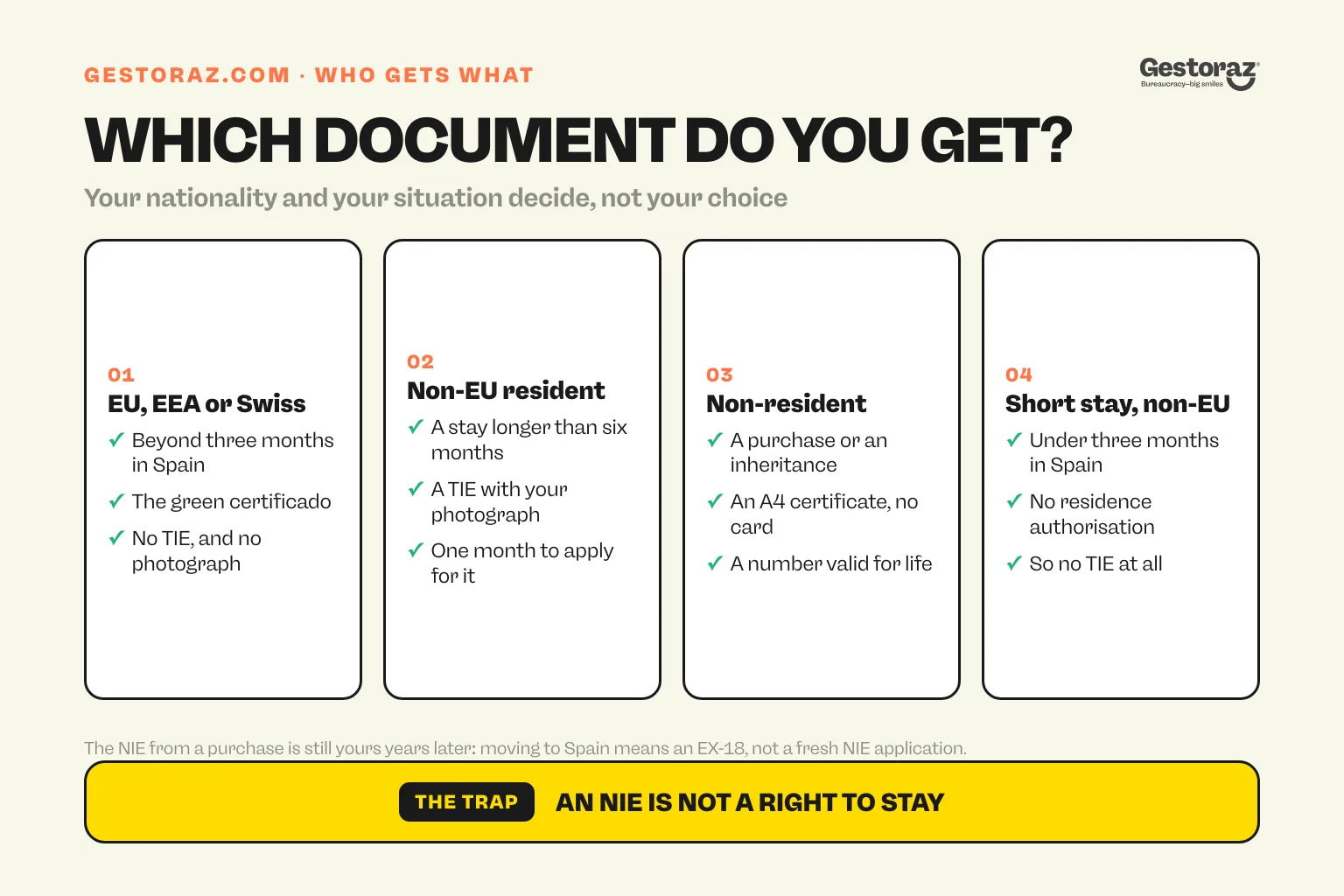
Your nationality and your situation decide the support, not your preference.
- Non-EU national with a residence permit: a TIE. The card is the proof of the permit.
- EU, EEA or Swiss citizen staying beyond three months: the green certificado de registro, with the NIE on it.
- Non-EU family member of an EU citizen: the tarjeta de familiar de ciudadano de la Unión, form EX-19, not a TIE. Confusing the two is how this file most often goes wrong.
- Non-resident with an interest in Spain, typically a property purchase, an inheritance or a company stake: an A4 certificate assigning the NIE, and nothing else. No card, because there is no residence permit to prove.
- Non-EU national staying under three months: no TIE at all, since there is no residence authorisation behind it.
The non-resident case is the one people underestimate. A buyer who obtained an NIE for a purchase holds a valid number for life on a sheet of paper, and no card will ever be issued to them unless their situation changes.
When your situation changes, the number does not
People move between these categories all the time, and the reflex is to apply for a new NIE. That reflex is wrong, and it is expensive: it means booking the wrong procedure, paying the wrong heading of the tasa, and losing the appointment.
Three transitions account for most of it.
- The EU citizen who bought a property years ago and now moves to Spain. They already hold an NIE from that purchase. What they need is the registration certificate, so the procedure is an EX-18, not a fresh NIE application. Applying again for a number you already have gets the file stopped.
- The non-EU national who arrives as a student and later works. A new permit means a new card, with a new número de soporte and a new expiry date. The NIE printed on it stays the same one they were given as a student.
- The person who left Spain for a decade and comes back. Nothing was cancelled in their absence. The number is still theirs, and the task is to locate it rather than request it, which is what finding your NIE number is about.
The useful habit is to treat the number as a fact about you that was settled once, and the document as a service that has to be renewed. Only the second one has a deadline.
Where the NIE appears on each document
The number has the same shape everywhere: a letter, seven digits, a check letter. What changes is where to look, and what else is printed next to it.
- On the green A4 certificate: the NIE appears with your name and the date of entry in the register.
- On the TIE: the NIE is printed on the card, alongside a second number that catches people out.
- On the assignment certificate for non-residents: the NIE with the reason the number was granted.
That second number on the TIE is the número de soporte, which starts with the letter E followed by eight digits. It identifies the physical card, not you, and it changes every time a new card is issued. It is the number the FNMT asks for, and confusing the two is one of the more common reasons a digital certificate request fails. It has its own article: what is the número de soporte.
Three consequences of mixing them up
The distinction is not academic. Three situations come up repeatedly.
- Booking the wrong appointment. The cita previa portal lists assignment of an NIE and issuance of a residence card as separate procedures. Booking one and turning up for the other wastes the slot, and slots are the scarce resource.
- Assuming a number grants a right. A non-EU national holding only an NIE, with no valid card behind it, is not authorised to reside. The number is administrative, the authorisation is not.
- Treating an expired card as an expired number. When a card lapses, the NIE underneath is untouched. What has to be restored is the document, not the identity.
The wider picture of what residency actually means in Spain, administrative, fiscal and social, is untangled in everything you need to know about residency.
The short version
The NIE is who you are in the eyes of Spanish administration, and it is permanent. The TIE is what you are currently allowed to do there, and it is temporary. EU citizens prove the same thing with a green sheet of paper instead of a card.
At gestoraz we handle the NIE application itself, for EU and non-EU nationals, and the padrón registration that most of these procedures depend on. If you are unsure which document your situation calls for, that is the question to settle before booking anything.
Official sources
- Policía Nacional, sede.policia.gob.es: the competent body for the NIE, the TIE and the EU citizen certificate.
- Real Decreto 1155/2024, boe.es/buscar/act.php?id=BOE-A-2024-24099: the Reglamento de Extranjería in force since 20 May 2025, articles 205 and 209 for the NIE and the TIE.
- Real Decreto 240/2007, boe.es/buscar/act.php?id=BOE-A-2007-4184: the regime for EU citizens and their family members.
- Ministerio de Política Territorial, administracionespublicas.gob.es: the extranjería application forms and the cita previa portal.
- FNMT, sede.fnmt.gob.es: the digital certificate procedure that requires the número de soporte.


Obtain your Digital Certificate entirely remotely.
Request your Digital Certificate completely remotely.

