



Modelo EX-18: the EU registration certificate in Spain
Most guides about moving to Spain stop at the NIE. If you are Dutch, German, French or from any other EU or EEA country and you intend to stay beyond three months, the NIE is only half the job. The form that actually registers you as a resident is the modelo EX-18, and what it produces is the green A4 certificate everyone mentions without naming it correctly.
This guide is procedural: what the EX-18 is for, how it differs from the EX-15, who files it, what you must prove, and what the certificate does and does not give you. If you are still at the number itself, start with what an NIE number is.
What the EX-18 is, and what the green A4 actually is
The modelo EX-18 is the application for registration in the Registro Central de Extranjeros as a citizen of the Union residing in Spain. Its Spanish name is Solicitud de inscripción en el Registro Central de Extranjeros, and the document it produces is the certificado de registro de ciudadano de la Unión.
That certificate is not a card. It is a green sheet, usually A4, stating your name, nationality, address in Spain, NIE and date of entry in the register.
It is the form administrative residency takes for EU and EEA citizens, where non-EU citizens get a TIE. The wider picture, administrative versus fiscal versus social residency, is in everything you need to know about residency in Spain.
It also carries the número de soporte, the code starting with IXESP or AXESP that the FNMT asks for when you request a digital certificate. It is not your NIE, and confusing the two blocks the request: see what the número de soporte is and where to find it.
EX-15 or EX-18: which one you need
These two forms are constantly mixed up. They do different things.
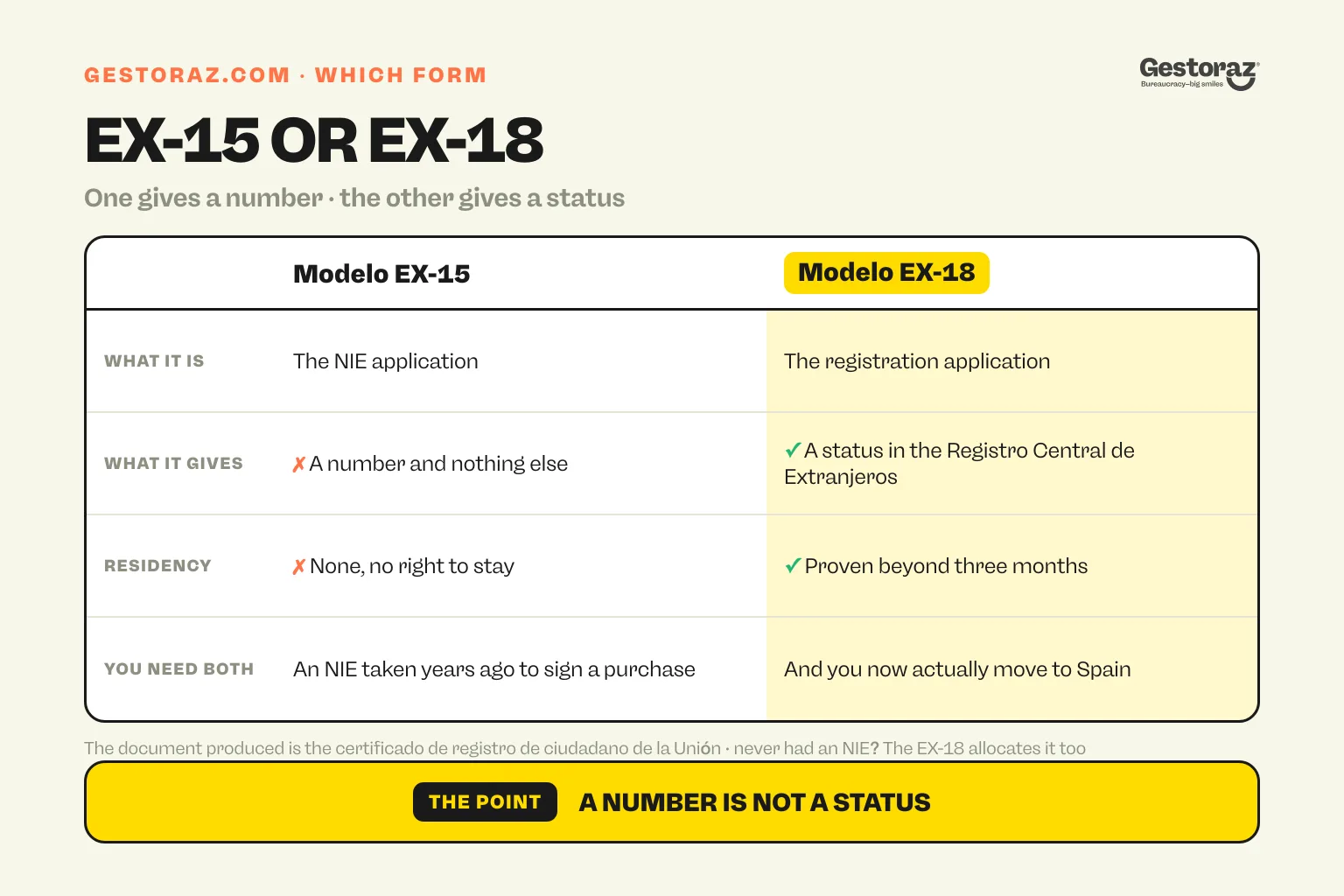
- Modelo EX-15 is the application for allocation of an NIE, or for a certificate proving you already hold one. It gives you a number and nothing else: no status, no residency, no right to stay.
- Modelo EX-18 is the application for registration as an EU citizen resident in Spain. It gives you a status, an entry in the Registro Central de Extranjeros, and the green certificate as proof of it.
The case where you need both is common among buyers. You obtained an NIE years ago through an EX-15 to sign a purchase, and you now actually move to Spain. The number never expires, so it is still valid, but it says nothing about your residency: you file an EX-18 on top of it.
The reverse case does not. If you have never had an NIE and arrive as a new EU resident, the EX-18 allocates your NIE at the same time; filing an EX-15 first only adds an appointment and a tasa.
One more form worth knowing: your non-EU spouse or family member does not use the EX-18 but the modelo EX-19, which leads to a residence card for the family member of a Union citizen, not to a green certificate.
Who must register, and by when
The obligation comes from EU free movement rules, transposed in Spain by Real Decreto 240/2007. Any national of an EU or EEA member state, and of Switzerland, who intends to reside in Spain for more than three months must register in person at the Registro Central de Extranjeros.
- Stays under three months. No registration; your passport or national identity card is enough. You may still need an NIE to buy property or sign before a notary, which is an EX-15 matter.
- Stays over three months. Registration is compulsory, and the application is filed within the three months following your entry into Spain.
- Minors and dependants. They are registered too, through the parent or the EU citizen on whom they depend.
The obligation is personal, not per household. Each adult files their own EX-18 at the Oficina de Extranjería or Policía Nacional station of their province. A couple files two forms and pays two tasas.
What you have to prove
Registration is not automatic. You hold the right to reside, but you must show you fall into one of the categories set by the free movement rules. The office asks which box you fit and wants the paperwork that matches.

- Employee. An employment contract, a declaración de contratación signed by the employer, or proof that you are registered with Spanish social security. If you already contribute, your alta is the cleanest proof there is: see everything you need to know about the NUSS number.
- Self-employed. Your alta as autónomo, meaning the census registration with the Agencia Tributaria and the alta in the RETA with social security.
- Sufficient resources plus health cover. The route for people not working in Spain: retirees, people living off savings or foreign income. You prove resources for yourself and for anyone depending on you, and full health cover in Spain.
- Student. Enrolment in a public or private establishment, health cover, and a declaration of sufficient resources for the stay.
On the resources route, do not rely on a figure read on a forum. The threshold references Spanish social assistance levels and is revised periodically: trust the current hoja informativa of the Extranjería portal.
Health cover means your own contributions, an S1 form if you are a pensioner from another member state, or a convenio especial. Private policies are accepted, but offices commonly ask for cover equivalent to the public system, without copayments. Travel insurance is generally refused.
The documents that go with the form
- Modelo EX-18, completed in Spanish and signed, downloaded from the Extranjería portal. One form per applicant.
- Your passport or national identity card, valid, original plus a photocopy. An expired document blocks the file on the spot.
- Proof of the category you claim, from the four above. This is the part that gets files sent away.
- Proof of payment of the tasa, modelo 790 código 012, paid before the appointment.
- Proof of your address in Spain. The certificate states an address, so bring the rental contract, the deed, or your certificado de empadronamiento.
Documents issued abroad and not written in Spanish generally need a sworn translation, and foreign public documents may need an apostille. That typically hits marriage and birth certificates and some proofs of income. Start both before booking.
The appointment is single use. If a document is missing on the day, the slot is lost and you queue again for a new cita previa.
The tasa and how it is paid
The fee is paid through the modelo 790 código 012, the same form used for the NIE. What changes is the line you tick: the one for the certificado de registro de residente comunitario, not the one for NIE allocation. Tick the NIE line and you pay the wrong amount for the wrong procedure, which is a wasted appointment.
You generate the form on the Policía Nacional electronic office, which prints the amount for the procedure you selected. Pay at a Spanish bank or online with a Spanish card, then keep the validated proof. Without it the file is not processed.
What the certificate gives you, and what it does not
What it does:
- It proves you are legally residing in Spain beyond three months, which is what employers, schools and administrations ask to see.
- It carries your NIE, so it doubles as your NIE document if you did not already have one.
- It unlocks the rest of the sequence: banks routinely ask for it before switching you from a non-resident to a resident account, and it supports healthcare and vehicle registration.
What it does not:
- It is not a tax status. Holding the green certificate does not make you a Spanish tax resident, and not holding it does not protect you from becoming one. The Agencia Tributaria applies its own criteria: more than 183 days in Spain, centre of economic interests, family. See the impact of your NIE on your tax status.
- It is not a TIE. The TIE is the plastic residence card for non-EU citizens. A French or German national asking for a TIE is asking for the wrong document.
- It is not an identity document. There is no photograph on it, so you still carry your national identity card or passport alongside. The optional NIE Easy Card is a convenience format with no legal value of its own.
- It is not the padrón. The padrón is the town hall inhabitants register: separate procedure, separate document, and what conditions a neighbourhood doctor, a school place or a transport pass.
- It is not the end of the road. The NIE number on it never expires, but the certificate is a document: address and nationality changes must be notified, and after five continuous years of residence you apply for the permanent registration certificate under Real Decreto 240/2007.
The mistakes that cost an appointment
- Filing an EX-15 when the situation called for an EX-18, or booking the NIE procedure on the cita previa portal instead of the certificado de registro one.
- Ticking the NIE line on the modelo 790 código 012 and arriving with the wrong tasa paid.
- Bringing travel insurance instead of real health cover on the sufficient resources route.
- Letting the three months after arrival run out before filing.
- Turning up with foreign documents that are neither translated nor apostilled.
- Assuming the appointment will be conducted in English. The form is in Spanish and so is the interview.
Where to start
A working order of operations: settle your housing and register on the padrón, assemble the proof for whichever category applies to you, get any translation or apostille moving, pay the modelo 790 código 012 for the certificado de registro, then book the cita previa.
The appointment is the bottleneck, exactly as for the NIE. Waits run roughly 1 to 4 weeks in mid-size provinces and 4 to 6 weeks in Madrid, Barcelona, Málaga and Marbella, and July, August and September are the worst months. The portal lets you check several offices within the same province, the simplest way to find an earlier slot.
At Gestoraz we handle Spanish administrative files remotely, from the NIE to the EU registration certificate, and we coordinate what usually comes with it: padrón, NUSS, bank account and digital certificate.
Official sources
- Ministerio de Inclusión, Seguridad Social y Migraciones, Extranjería portal, extranjeros.inclusion.gob.es: download of the modelo EX-18 and the hoja informativa on registration of EU citizens.
- Real Decreto 240/2007 (BOE), boe.es: entry, free movement and residence of EU and EEA citizens in Spain, legal basis of the certificate and its conditions.
- Policía Nacional, sede electrónica, sede.policia.gob.es: cita previa for extranjería procedures and generation of the modelo 790 código 012.
- Agencia Tributaria, sede.agenciatributaria.gob.es: tax residency criteria, independent of your administrative registration.


Obtain your Digital Certificate entirely remotely.
Request your Digital Certificate completely remotely.

