



How to renew your TIE card in Spain
Look up how to renew a TIE and you meet the same renewal window on page after page, including on sites with serious traffic. Those figures come from Real Decreto 557/2011, a regulation that no longer exists. It was repealed on 20 May 2025, when Real Decreto 1155/2024 came into force.
The rule that applies now is article 80.1 of the new regulation. You file within the two months before your card expires, and the application is still receivable within the three months after it expires, without prejudice to the sanction that lateness attracts.
The gap between the repealed 2011 figures and the current ones is a handful of days. What matters more is what it tells you about the page you are reading: a guide still working from the 2011 text is very likely also printing the fee schedule replaced in June 2025, and those amounts moved.
The window: two months before, three months after
The date that counts is the expiry printed on your card. A TIE is valid for exactly as long as the authorisation it documents (article 209.7), so card and permit lapse on the same day. There is no separate card calendar.
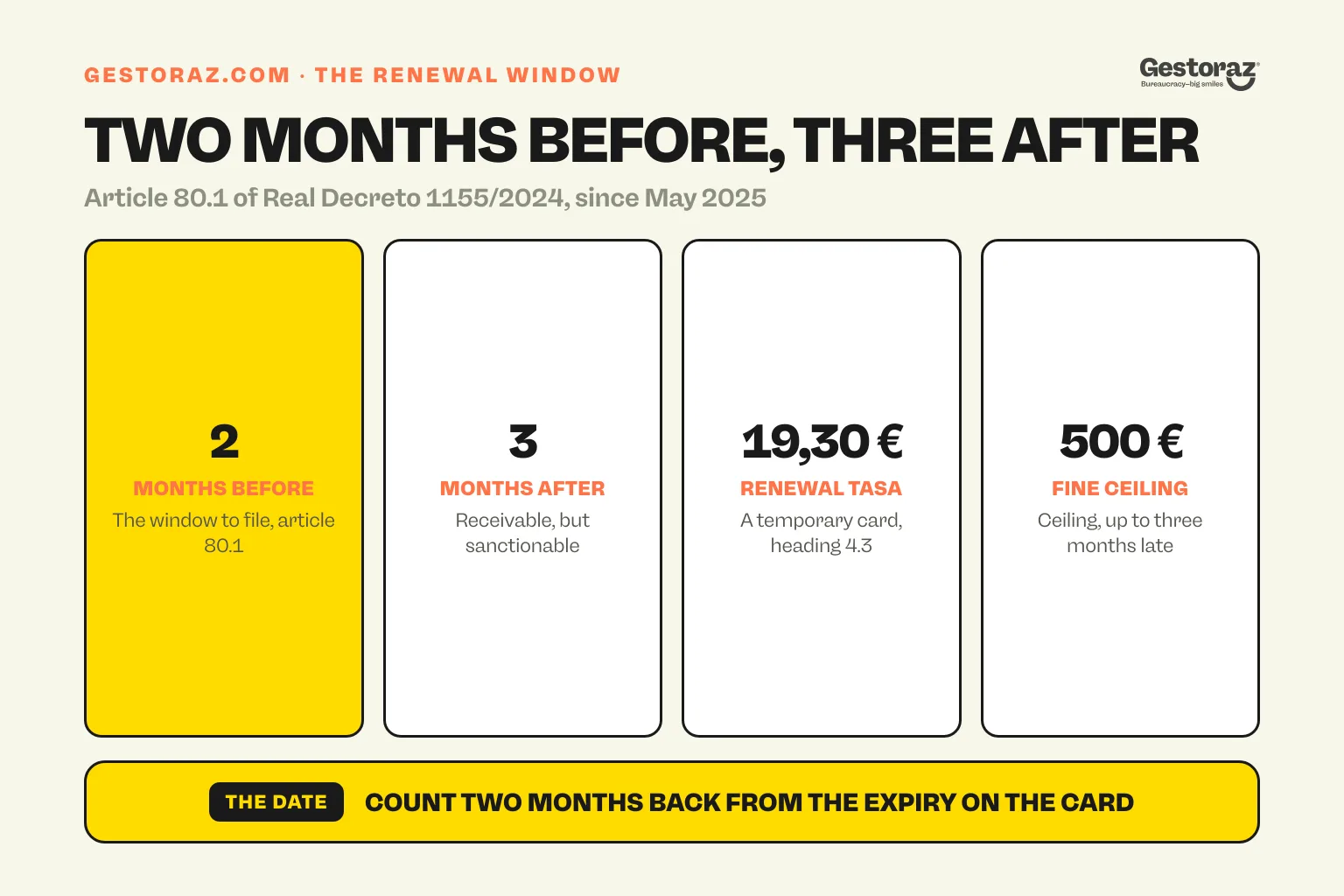
From that date, article 80.1 gives you two periods, and they are not equivalent.
- The two months before expiry. The intended window, and filing inside it is what triggers the protection described below.
- The three months after expiry. The application is still receivable. Not a second normal window: a late filing the administration accepts, while the law expressly reserves the right to sanction it.
What is gone is the pair of figures in article 71.1 of the 2011 regulation. Any guide still quoting them is quoting repealed law, including pages updated in the last year that never rechecked the source.
Filing in the window keeps you legal while you wait
This is the part worth internalising, because it takes the panic out of the exercise. Article 80.1 provides that filing the renewal extends the previous authorisation until the application is resolved, and article 178.2 does the same for the larga duración card. You do not become irregular the morning your card expires because the office has not answered yet.
- An expired card is not automatically an expired right, provided the renewal was filed in time. The authorisation behind it is still running.
- A counter is not a court. A bank, an employer or a landlord reading a lapsed date off the plastic knows none of this. Keep the filing receipt with the card and produce them together.
What we will not tell you is what that receipt, the resguardo, is worth outside Spain. Its legal nature and its value for travel are not set out on any official page we could source, so do not plan a trip around it. Ask the office handling your file first.
Ordinary temporary permits renew in two steps, not one
This is where most renewals go wrong, and it is a sequencing problem rather than a paperwork problem. For an ordinary temporary residence permit, the card is not the thing you renew. The authorisation is, and the card follows it.
- Step one, the authorisation. You renew the permit itself at the Oficina de Extranjería, inside the window above.
- Step two, the card. Once the renewal is granted, articles 209.1 and 209.10 give you one month to apply in person for the new TIE at the police.
Two files, two bodies, two deadlines, and the second clock only starts when the first one stops. Booking a police appointment before your authorisation is resolved books the wrong step, and appointments are the scarce resource here.
One exception: applicants under Ley 14/2013, meaning investors, entrepreneurs, researchers and intra-company transfers, use a separate form, the MI-TIE.
The cards that renew on their own
A second family of cards works differently, because the authorisation behind them has no end date. Only the plastic expires, so there is no Oficina de Extranjería step.
- Larga duración and larga duración-UE (articles 178 and 185). The authorisation is indefinite. The card is renewed at five years, then every five years, and from the age of 30 every ten years.
- The card of a family member of an EU citizen (article 8.5 of Real Decreto 240/2007). Five years, and ten years for the permanent card.
Article 178.3 adds something holders rarely know: failing to renew a larga duración card never extinguishes the underlying authorisation. You remain a long term resident. That is not a licence to let it lapse, since the sanctions below still apply and you lose the ability to prove anything at a counter, but the status survives the oversight.
EU, EEA and Swiss citizens sit outside all of this. They hold the certificado de registro rather than a TIE, a procedure with its own logic, covered in the modelo EX-18.
The EX-17, the right box, and the tasa
The card is requested on the modelo EX-17, on the extranjería portal of the Ministerio de Inclusión. Check the header first: version 03 cites LO 4/2000 y RD 1155/2024. A PDF still headed with the 2011 regulation is an old copy someone left online.
The form offers three mutually exclusive boxes: TARJETA INICIAL, RENOVACIÓN, DUPLICADO. A renewal is the middle one. The form also states its own filing rule: in person only, no telematic route, no filing through a public registry.
The fee is the modelo 790 código 012, generated on the sede electrónica of the Policía Nacional. The amounts come from Orden PJC/617/2025, in force since 16 June 2025, which repealed the 2011 fee order outright.
- 19,30 € for the renewal of a temporary residence card or a prórroga (heading 4.3).
- 21,87 € for a larga duración or larga duración-UE card (heading 4.5).
- 12,00 € for the card of a family member of an EU citizen, and for the Brexit withdrawal agreement TIE (heading 4.6).
A first issue is 16,08 € (heading 4.2), so a renewal costs more than the original card.
Two mechanical points. The código, 012 or 052, depends on which body processes your file, police or Oficina de Extranjería, not on the procedure, and the amount is identical either way. And there is a clock: ten working days of voluntary payment from filing, with the proof reaching the office within fifteen days. Generating, paying and validating the form is covered in the modelo 790 código 012.
What you bring, and what you give back
Article 178.4 sets a short list for the card appointment.
- Your passport, valid, and a copy of it in full. Not the photo page on its own.
- Proof that the tasa is paid. The validated form or the online receipt, never the blank PDF.
- One photograph, to the specification in article 5.1.b of Real Decreto 1553/2005: 32 x 26 mm, plain white background, facing forward, head uncovered, no tinted glasses.
On the photograph there is an honest inconsistency: the police information sheet says one, the page for the EU family member card says three. Bring three, it costs almost nothing.
The obligation nobody reads is article 209.8: you must hand in the old card. On expiry, on renewal, or when the right behind it ends. It is not a souvenir, and the new card is issued against it.
Expect the número de soporte to change, because it identifies the card and not you. Anything bound to the old one breaks the same day, usually a digital certificate. See what the número de soporte is and digital certificates and Cl@ve.
How long the finished card takes to arrive, we will not guess. No .gob.es page publishes a collection time, it varies between commissariats, and the numbers circulating on blogs are sourced to nothing official.
Filing late: the two brackets
The three month grace period is real, and it is not free. The law splits lateness in two.
- Up to three months late. Article 52.b of Ley Orgánica 4/2000 makes it a minor infringement, with a fine of up to 500 € under article 55.1.a. Your application remains receivable.
- Beyond three months with nothing filed. It moves to article 53.1.a, a serious infringement, with a bracket of 501 € to 10.000 €.
Two things that does not say. It does not say a fine is issued automatically, and no official page we can cite describes the practice, so read 500 € as the ceiling of the first bracket rather than a prediction. And it does not say a sanction invalidates the renewal: article 80.1 accepts the late application expressly, without prejudice to that sanction. What residence status actually means in Spain is untangled in everything you need to know about residency.
A duplicado is not a renewal
If your card is lost, stolen, destroyed or unreadable, what you request is a duplicado, and article 209.9 is blunt: it is not a renewal. It runs only for the validity remaining on the card it replaces. Issued seven weeks before your expiry date, it gives you seven weeks. Nothing is reset.
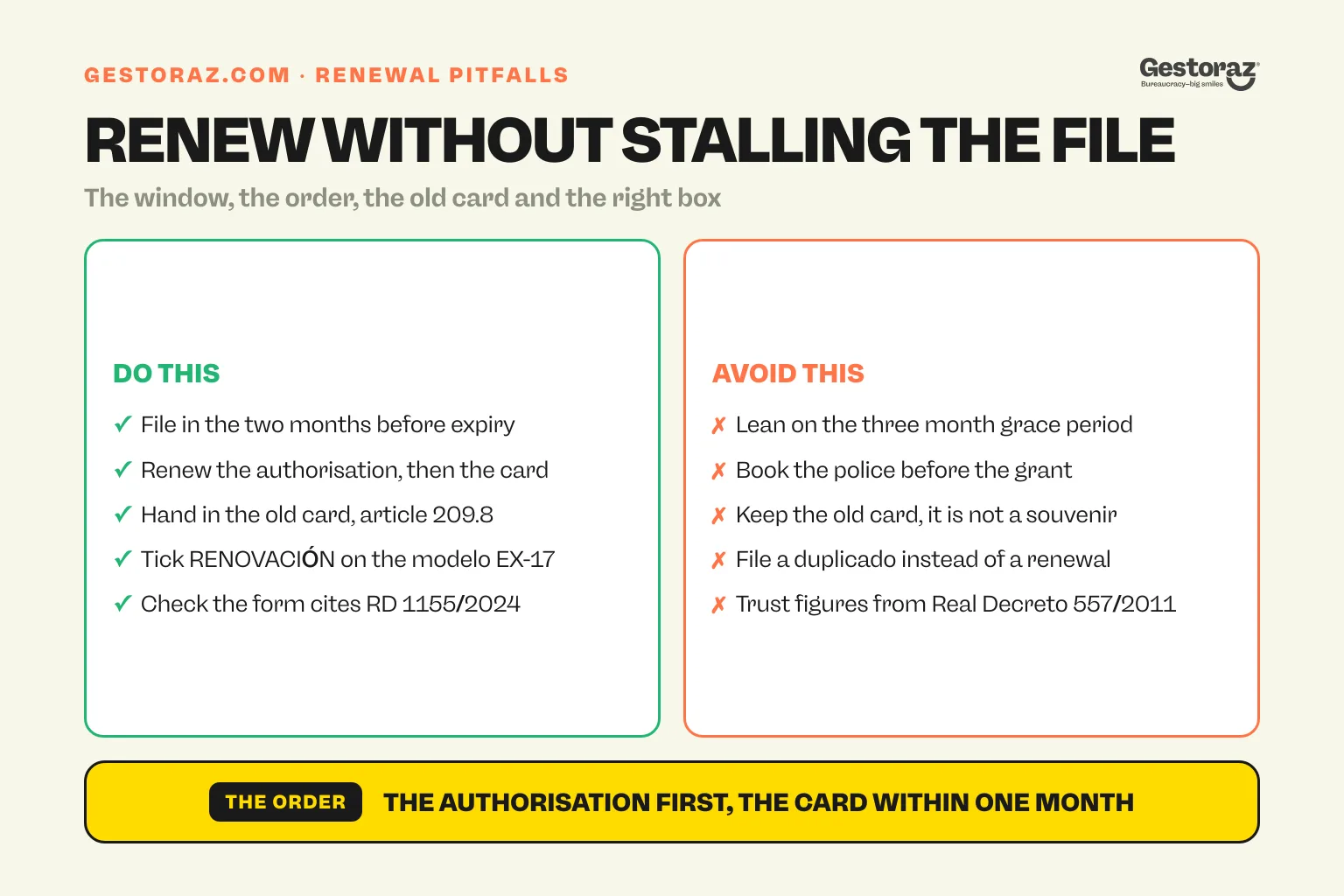
So if you lose the card near the end of its life and you are inside the two month window, ask the office whether to file the renewal instead of, or alongside, the duplicado. On the EX-17 that is a different box, and the wrong box stops the file.
None of this touches your NIE. The number is not on a clock, only the documents carrying it are, which is the point of renewing your NIE. If the card is gone and it is the number you need back, finding your NIE number handles that separately.
The order to work in
- Count two months back from the expiry printed on the card. That is your filing date, not a reminder.
- Establish your family: temporary permit (authorisation first, card second), or larga duración and EU family card (card only).
- If the authorisation step applies, file it at the Oficina de Extranjería and keep the receipt.
- Then pay the 790 código 012 under the right heading and file the EX-17 with RENOVACIÓN ticked, inside one month.
- Attend in person with the passport and its full copy, the validated tasa, the photographs and the old card.
At Gestoraz we prepare and file Spanish administrative applications remotely, including the modelo 790 código 012 under the correct heading, and we coordinate what surrounds a residence file: padrón registration, digital certificate and bank account.
Official sources
- Real Decreto 1155/2024, boe.es: in force since 20 May 2025. Article 80.1, the window; 178 and 185, larga duración; 209, the card.
- Orden PJC/617/2025, boe.es: the fee order in force since 16 June 2025, headings 4.2, 4.3, 4.5 and 4.6.
- Ley Orgánica 4/2000, boe.es: articles 52.b, 53.1.a and 55.1.a, the infringement brackets.
- Policía Nacional, sede.policia.gob.es: the modelo 790 código 012 and the information sheet for the card appointment.


Obtain your Digital Certificate entirely remotely.
Request your Digital Certificate completely remotely.

