



Renewing your NIE in Spain: what actually expires
Every month, thousands of people look for how to renew their NIE. The procedure they are searching for does not exist. The NIE is allocated once and never expires, so there is no renewal form, no renewal fee and no renewal appointment for the number itself.
What does expire is the piece of paper or plastic that carries the number, and, for non-EU citizens, the residence permit behind it. Those are two different problems with two different fixes. This article sorts out which one you actually have. If you need the definition first, start with what an NIE number is.
Why "renewing your NIE" does not exist
The NIE (Número de Identidad de Extranjero) is a personal identifier issued by the Dirección General de la Policía: one letter (X, Y or Z), seven digits, one check letter. Once allocated, it is yours for life. It does not expire, it is never reissued with a different value, and you cannot hold two of them, even if you change nationality or leave Spain for twenty years.
So there is nothing to renew. Anyone telling you otherwise is either selling you a duplicate of a document or confusing the NIE with the TIE. We list that confusion among the nine misconceptions about the NIE.
The practical consequence is reassuring: if your NIE appears on an old certificate, in an old contract or in the file of a Spanish bank, it is still valid today. A number does not go stale.
What actually expires: the green A4, the TIE, the permit
Three things get mixed up under the word "NIE", and only two of them ever run out.

- The NIE number. Permanent. Never renewed, never replaced.
- The document carrying it. For EU and EEA citizens, the green A4 certificado de registro de ciudadano de la Unión. For non-EU citizens, the TIE, a plastic card showing the NIE, a photo and the residence expiry date. Documents get lost, torn and, in the case of the TIE, carry a printed end date.
- The residence permit underneath (non-EU citizens). This is the real deadline. The TIE is only the physical proof of a permit granted on a specific basis, and when the permit ends, the card ends with it. The renewal rules belong to your permit type, not to your NIE, and we cover them in everything you need to know about residency in Spain.
Whatever happens to the card, the number printed on it does not move. A renewed TIE carries exactly the same NIE as the first one.
When a bank, a notary or an employer asks for an "up to date NIE"
This is usually where the search starts. Someone in Spain has said your NIE is out of date and you assume there is a renewal to run. In practice the request is always one of three things.
- They want a legible document. Your green A4 is torn, faded, or you only have a phone photo of it. They want a clean certificate, not a new number.
- They want proof that you are still legally in Spain. Typical of an employer, or of a bank running a compliance check on a non-EU client. What they need is a valid TIE, and the NIE has nothing to do with it.
- They want the número de soporte. Common in online identity checks. That code belongs to the document, and it genuinely does change. See the section below.
The right reflex is to ask which of the three they mean before booking anything. "NIE caducado" in the mouth of a bank employee almost always means "the document you showed me has a date on it that has passed".
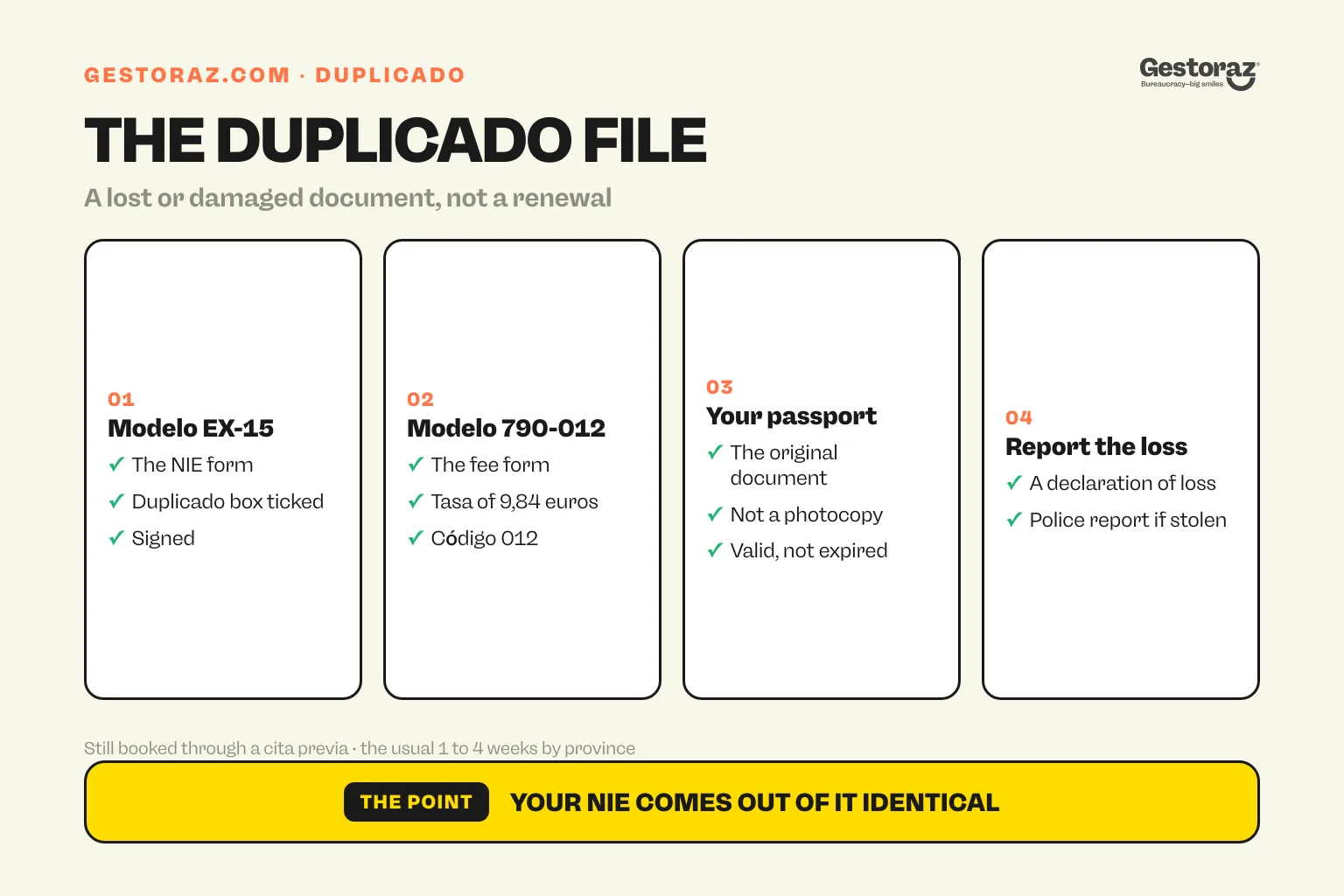
If the answer is that the document is unreadable, lost or stolen, the fix is a duplicado, not a renewal: modelo EX-15 with the duplicado box ticked, the tasa of 9,84 euros paid through the modelo 790 código 012, your original passport, and a loss declaration (plus the police report if it was stolen). It still goes through a cita previa, so the wait is the usual 1 to 4 weeks depending on the province. Your NIE comes out of it identical.
Coming back to Spain years later: your old NIE still works
Student in Barcelona in 2011, back now for a job or a property purchase? You already have an NIE. Applying again is not merely wasteful, it is not possible: one person, one number, for life. The task ahead of you is retrieval, not renewal.
- Search your own records first. The NIE appears on an old rental or employment contract, on Spanish bank statements, on any tax filing, on a modelo 790 receipt, on a photo of the green A4.
- If your old Spanish bank account still exists, the branch has the number in its client file.
- Otherwise ask the Policía Nacional, or the consulate that handled the original application, to look up your record. Checking is free.
Only when you are certain that no number was ever allocated to you should you file a first application. A second request costs the tasa and a single-use appointment to be told what the register already knows. The full budget is in what an NIE number costs.
What genuinely needs renewing
The short list of what really carries an end date in a foreigner's Spanish paperwork.
- The residence permit and its TIE, for non-EU citizens. Filed on the basis of your permit type, before its expiry date. A residence procedure, not an NIE procedure.
- Your passport. Spanish counters compare the passport number in the file with the one you hand over. An expired passport blocks more procedures than people expect.
- Your FNMT digital certificate. It has a limited validity and needs renewing before it lapses. Miss it and you lose online access at exactly the wrong moment.
- Nothing on the NIE side. Not the number, and not your NIF either: for a foreign individual the NIE serves as the NIF, so there is no separate tax number to keep alive.
Notice what these have in common. Each one is a document or a status with its own calendar. The identifier that ties them together is the only element with no calendar at all.
The número de soporte changes, the NIE does not
One number on your document really does get replaced, and it explains a good share of the confusion.
The soporte is a security code identifying the physical document, not the person. On a TIE it starts with E, such as E12345678. On a green A4 it starts with IXESP or AXESP. Every time a new document is issued, whether a TIE renewal or a duplicado of the green certificate, the soporte changes while the NIE stays the same.
Two consequences. First, the soporte on an old photocopy dies the moment the new document is issued, so an FNMT digital certificate request or a Cl@ve activation using the old code is rejected. Second, after any reissue you have to note the new soporte and redo the digital steps that rely on it. Where to find it on each document is explained in the número de soporte and where to find it.
The reverse is worth remembering too: for a notarial signing, a bank account, a modelo 210 or a padrón registration, nobody asks for the soporte. They ask for the NIE, which never changed.
The mistakes that cost time and money
- Applying for a second NIE. It cannot be granted, and the money is spent for nothing.
- Booking a cita previa "to renew the NIE". No such procedure exists in the list. Choosing the wrong one means being turned away on the day, and the appointment is single use: you start the queue again.
- Treating the permit deadline as an NIE deadline. The number is permanent, the permit is not. Only one of the two has a date to watch.
- Assuming a valid NIE means valid residence. It gives no residence right, no work authorisation and no access to public healthcare. Those come from separate procedures.
- Using an old número de soporte after a reissue. Instant rejection on the FNMT and Cl@ve forms, with an error message that explains nothing.
- Paying an intermediary for an "NIE renewal". There is no such product. What can legitimately be delegated is a duplicado, a TIE renewal or a first application.
Where to start
Two questions settle almost every case that begins with "I need to renew my NIE".
First, do you have the number? If yes, there is nothing to renew: use it as it is, on every form, indefinitely. If no, retrieve it from your own records, your Spanish bank, or the Policía Nacional before considering any new application.
Second, is a document or a permit involved? A lost or damaged document means a duplicado through the EX-15 and the 9,84 euro tasa, with the NIE unchanged and the soporte replaced. A residence permit approaching its end date means a renewal filed on the basis of your status, with your NIE simply carried over.
At Gestoraz we handle NIE files remotely, including duplicados of a lost document, and we coordinate the steps that usually go with them: bank account, digital certificate and padrón registration.
Official sources
- Policía Nacional, sede electrónica, sede.policia.gob.es: NIE assignment, TIE, EU citizen certificate and duplicados.
- Ministerio de Inclusión, Seguridad Social y Migraciones, Extranjería portal, extranjeros.inclusion.gob.es: residence permits, renewals and foreigners' status.
- Agencia Tributaria, sede.agenciatributaria.gob.es: recognition of the NIE as NIF for tax purposes.
- FNMT, sede.fnmt.gob.es: digital certificate request, where the número de soporte is required.


Obtain your Digital Certificate entirely remotely.
Request your Digital Certificate completely remotely.

