



Modelo EX-15: how to fill in the NIE form
The EX-15 is a single sheet of paper, and it is the only part of an NIE application that you write yourself. Everything else in the file is either bought (the tasa) or copied (your passport). The form is where your own mistakes go, and where a counter clerk finds them.

This guide is about the form itself: what it covers, how each block works, and what gets a file sent back. The procedure around it, choosing your route and booking the cita previa, is covered in how to obtain an NIE number. If you need the definition of the number first, start with what an NIE number is.
What the EX-15 is, and what it covers besides the NIE
The EX-15 is the official application form of the Spanish administration for the identification of foreign nationals, titled Solicitud de Número de Identidad de Extranjero (NIE) y Certificados. It is published free of charge on the Extranjería portal, it has to be completed in Spanish, and it has to be signed by hand.
The second half of that title is the part most guides skip. The same form covers three different requests.
- Assignment of an NIE. The first-time allocation of the number, for someone who has never had one.
- Certificates. The Policía Nacional issues certificates about your situation in the foreigners register, and they are requested through this same form rather than a separate one.
- A duplicado. When the document carrying your NIE is lost, stolen or unreadable, you do not reapply for the number, you ask for a new document with the same number on it. Same EX-15, different purpose requested. The número de soporte on the new document changes, as explained in the número de soporte and where to find it.
One form, three outcomes. Which of the three you request decides what the officer actually processes, so that block deserves reading twice before you print anything.
Where to download it, and which version to use
There are two legitimate sources: the Extranjería portal of the Spanish government, in its section of application models, and the sede electrónica of the Policía Nacional. Both host the current PDF, and both are free.
- Download it the same week you file. Official models are updated without announcement, and an outdated layout is a reason to be sent away to print a new one.
- Ignore copies hosted on blogs, forums or agency sites. They are often old scans, and nothing on them tells you which version you are holding.
- Never pay for the form. Any site charging for the PDF is reselling a free document.
- Complete it on screen if you can. The PDF is normally fillable, and typed answers remove the whole category of handwriting errors. Print it afterwards and sign the paper by hand.
Filling it in, section by section
The form is organised in blocks that follow a simple logic: who you are, who is filing if it is not you, what you are asking for, why, and your signature. Field numbering changes between versions of the model, so work block by block rather than by box number.
Your identity
This block asks for your names and surnames, your date and place of birth, your nationality, the names of your parents, your travel document number, an address and contact details. One rule governs all of it: every field that has an equivalent on your passport is copied from the passport, character for character, not from memory and not from another document.
- Spanish forms expect a first and a second surname. If you have only one, write it in the first field and leave the second empty. Do not split a compound surname to fill both.
- Write your given names in full, in the same order as the passport identity page. A dropped middle name is one of the most common mismatches.
- Use the number of the passport you will physically present, and check that the document is still valid on the day you file.
- Give an address where post actually reaches you and an email address you read. That is where a request for a missing document lands.
The motive
Somewhere on the form you state why you need the number, and this is not a formality. Spanish rules require an economic, professional or social reason, so write a specific one that matches the document you are attaching: the purchase of a named property, a contract with a named employer, enrolment at a named university, an inheritance file. "Personal reasons" is not a motive, and neither is a plan for next year.
Place, date and signature
The form is signed by hand, in ink, on the printed copy. A typed name inside a fillable PDF is not a signature. The date is the date you file, and the place is the town where you sign. An unsigned or undated form is refused before anyone reads the rest of it.
The purpose block: request the wrong thing and you lose the appointment
Of everything on the EX-15, this is the block that decides the outcome, because it has to agree with two things that sit outside the form.
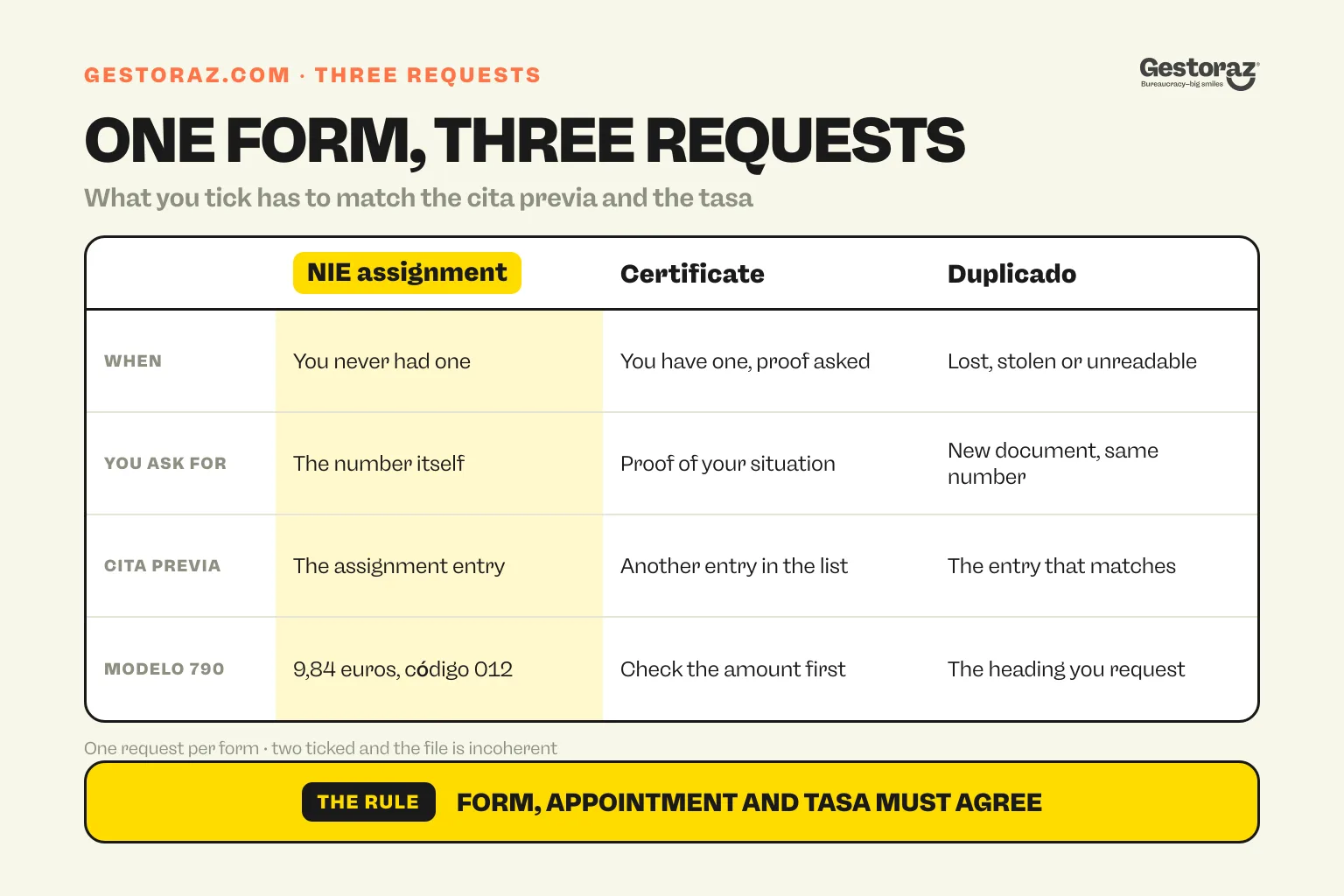
- The procedure you booked in the cita previa system. NIE assignment and certificates are not the same entry in the list, and neither is the residence card procedure.
- The heading you paid on the modelo 790 código 012. The proof of payment has to correspond to what you are requesting.
Make the three agree and the appointment is a formality. Let them contradict each other and the file is not processed, whatever else is in your folder. Concretely: no NIE yet means assignment, you have an NIE and someone wants official proof of your situation means a certificate, you have the number but the paper is gone means a duplicado.
Do not tick two options hoping to cover yourself. A form asking for two different things is simply incoherent, and the officer will not choose for you.
The representative block, when a gestoría files for you
Most applicants leave this block empty. It exists for one situation: someone other than you signs or files the application, typically a gestoría acting under a notarial power of attorney, or the legal representative of a minor.
- It asks for the identity and document number of the representative, and the capacity in which that person acts.
- The authority comes from the document attached, not from the box. A power of attorney signed outside Spain generally needs an apostille, and a sworn translation into Spanish if it is not drafted in Spanish.
- The power of attorney has to actually cover the request. One drafted only for a property purchase does not authorise an NIE filing.
If you are looking at this route because appointments in your province are impossible to find, the three ways of filing are compared in how to obtain an NIE number.
The fields that get an EX-15 rejected
Rejections at the counter are rarely about the substance of the request. They are about the form not matching the documents lying next to it.

- A name that differs from the passport. A missing middle name, surnames in the wrong order, a married name used instead of the one printed on the document.
- One wrong character in the passport number. It is compared field by field with the document you hand over.
- No handwritten signature, or a signature that bears no resemblance to the one on the passport.
- No date, or a date that does not match the day of filing.
- A vague motive with no dated document naming you to back it up. This causes more refusals than any formatting problem.
- Fields left blank out of doubt. Nationality, purpose and motive are not optional.
- Crossings-out and correction fluid. Reprint the page: it costs a sheet of paper and saves the appointment.
- A form completed in English. It has to be in Spanish.
None of these is a legal problem. Every one of them is a single-use appointment spent for nothing.
What you hand in with the form
The EX-15 on its own is not a file. For a first NIE application, four items travel together.
- The EX-15, completed in Spanish, signed and dated.
- Your passport, original plus a photocopy of the identity page.
- The modelo 790 código 012, paid, with the stamped proof of payment. The tasa is 9,84 euros.
- Proof of your motive, dated and naming you: a signed sale agreement, an employment contract, an enrolment letter, a notarial deed.
For a duplicado, add a declaration of loss, and the police report if the document was stolen. If you are requesting a certificate rather than an NIE assignment, check the amount due on the modelo 790 código 012 for that specific option before paying, because the tasa is not identical for every request the form covers.
The full budget, including the cases where an apostille or a sworn translation is added on top, is in what an NIE number costs.
Printing, copies and language
- Spanish, and only Spanish. The form is completed in Spanish, and supporting documents in another language normally need a sworn translation.
- Print it as the PDF is laid out, on A4. Black and white is fine.
- Print more than one copy. The form is filed in duplicate, and you want a stamped copy back as proof that the application exists.
- Photocopy everything you bring. Originals are checked, copies are kept.
- Sign in ink on the paper, blue or black.
- Photograph the stamped copy before you leave the building. Until the resolution arrives, it is your only trace of the filing.
Where to start
If this is a first NIE, decide your route before touching the form, because the route decides where the EX-15 goes: a Policía Nacional station in Spain, a Spanish consulate, or a gestoría acting under a power of attorney.
Then download the current PDF from the official site in the same week you file, complete it on screen in Spanish, print it in duplicate, sign it by hand, and check three things one last time: the names against the passport, the purpose against the procedure you booked, and the motive against the dated document in your folder.
At Gestoraz we prepare and file NIE applications remotely, including the EX-15, the modelo 790 código 012 and duplicados of a lost document, and we coordinate what usually follows: bank account, digital certificate and padrón registration.
Official sources
- Extranjería portal, extranjeros.inclusion.gob.es: official download of the application models, including the EX-15.
- Policía Nacional, sede electrónica, sede.policia.gob.es: cita previa, NIE and certificate procedures, and download of the modelo 790 código 012.
- Agencia Tributaria, sede.agenciatributaria.gob.es: recognition of the NIE as NIF for tax purposes.
- Spanish consular network, exteriores.gob.es: filing an NIE application from abroad.


Obtain your Digital Certificate entirely remotely.
Request your Digital Certificate completely remotely.

