



Buying a car in Spain as a foreigner: NIE, DGT and tax
For many owners of a holiday home in Spain, renting a car on every stay ends up costing more than owning one. Then comes the real question: can a non-resident put a Spanish car in their own name? We found no text that forbids it. The DGT (Dirección General de Tráfico) lets any individual apply for a change of ownership, and from a foreigner it asks for a passport plus an NIE, and an address in Spain.
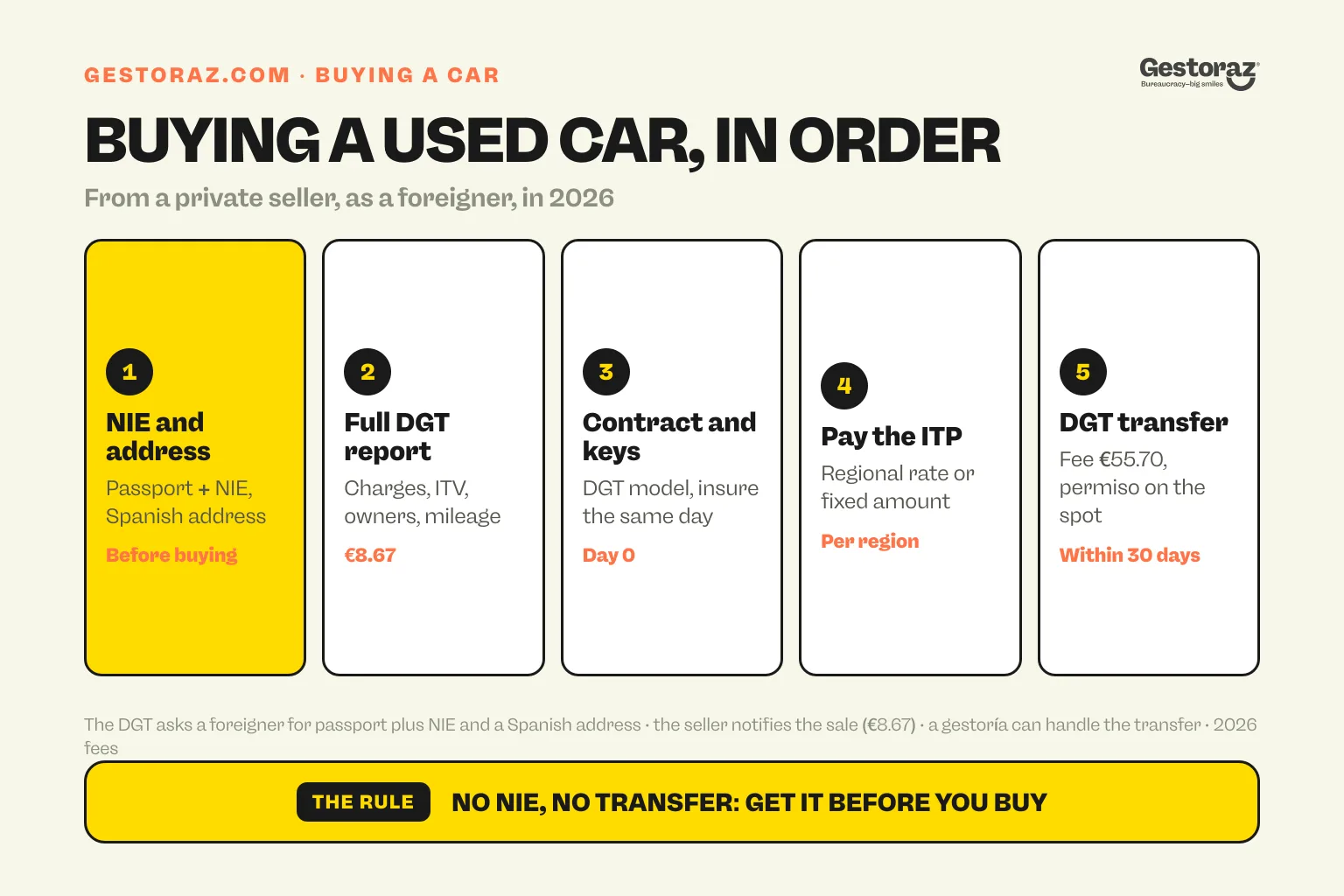
What matters is the order: NIE and proof of address first, then the car's record, the contract, the transfer tax, the DGT transfer within 30 days, and insurance before you drive. This guide follows that order with the 2026 fees. Rates and value tables change every year.
Before you buy: an NIE and an address in Spain
The NIE is your identification number as a foreigner in Spain, and buying a vehicle is one of the reasons to apply for it. For the transfer, the DGT asks for an identity document plus proof of address, which for a foreigner means "pasaporte más Número de Identificación de Extranjeros". The online form asks for the NIE of seller and buyer. If you have none yet, see what an NIE number is and how long the application takes: start there.
Which address counts
The Reglamento General de Vehículos (Anexo XIII) asks foreigners without a residence card to prove an address in Spain with any document that shows it, and gives three examples: owning a home, renting one, or being registered in a municipality. A property deed (escritura) or a rental contract is therefore admitted by the regulation itself.
The padrón is the route the DGT itself cites. Its page on the vehicle's tax address (domicilio fiscal), which decides where the yearly road tax is paid, says it must match the municipality where the owner is empadronado. If you own a home but are not registered, ask the Jefatura or your gestoría how that address will be recorded. Registering is explained in empadronamiento: volante vs certificado.
Check the car before you pay
A Spanish car can carry problems that pass to the next owner: an embargo, a seizure order (precinto) or a finance company's retention of title (reserva de dominio). The DGT advises requesting a vehicle report "antes de adquirir el vehículo", and anyone can request one for a car registered in Spain.
- Basic report (free): date of first registration in Spain, incidents that block a transfer or the use of the car, and pending recalls, shown as a green, orange or red light. Online or in the miDGT app, not by phone.
- Full report (€8.67, tasa 4.1): the owner's identity, the municipality where the car is registered, ITV history, mileage, number of previous owners and charges on the vehicle.
Pay for the full report and compare it with the seller's ID, the odometer and the ITV card. Online, it needs a digital certificate or Cl@ve; otherwise, request it at a Jefatura.
Private seller, dealer or new car: which tax applies
Private seller: ITP, paid by you
Between private individuals, the buyer pays the transfer tax (Impuesto sobre Transmisiones Patrimoniales, ITP) to the region, with modelo 620 or the regional form, before the DGT transfer. Hacienda publishes value tables (Orden HAC/1501/2025) giving an average price per model, reduced by age: 84 % between one and two years, 47 % between four and five, 28 % between seven and eight, 10 % after twelve.
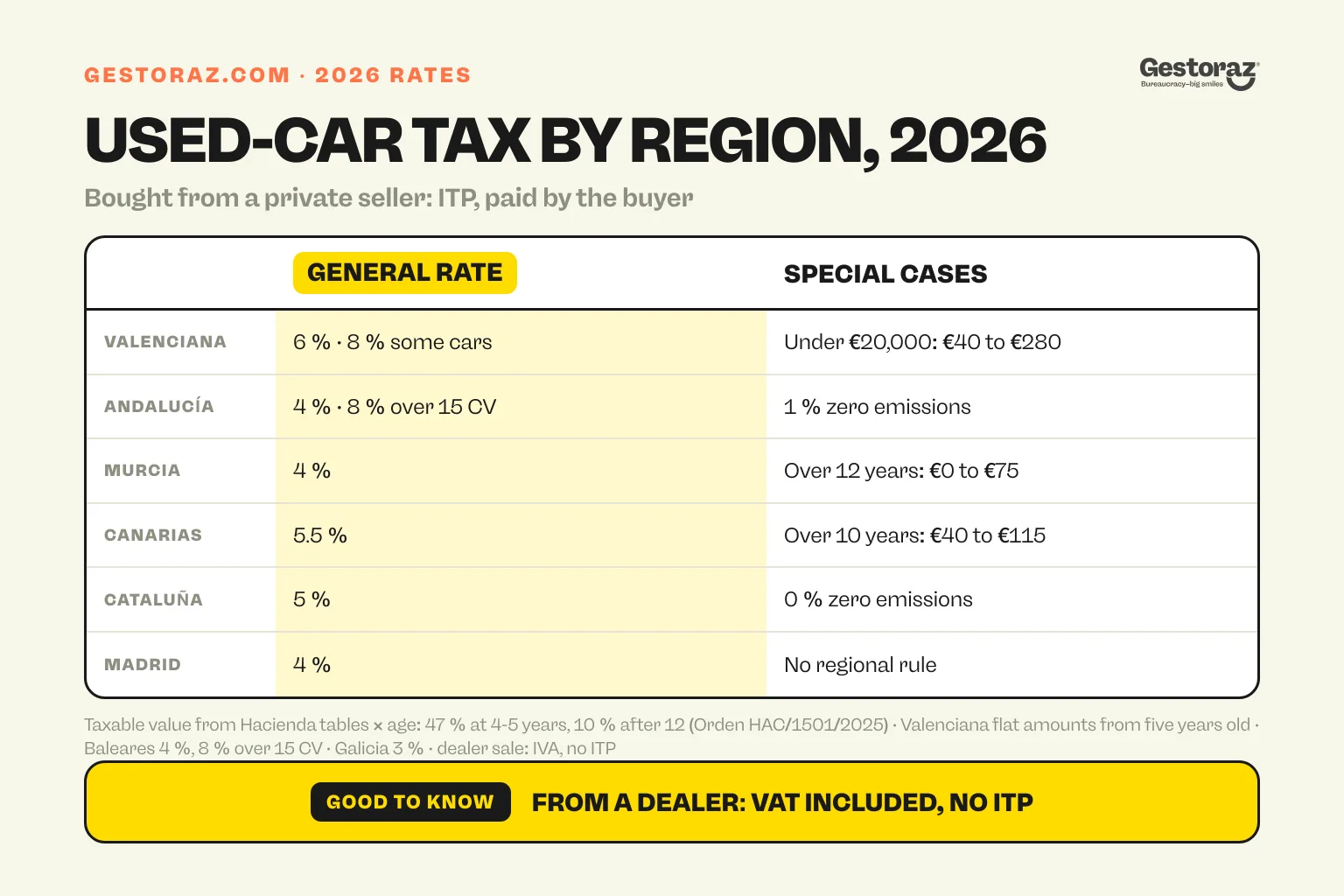
- Comunitat Valenciana: 6 %, or 8 % for cars up to five years old above 2,000 cc or worth €20,000 or more. Under €20,000, fixed amounts: €120, €180 or €280 from five to twelve years (up to 1,500 cc, up to 2,000 cc, above), €40, €60 or €140 beyond.
- Andalucía: 4 %, 8 % above 15 fiscal horsepower, 1 % for zero-emission cars.
- Región de Murcia: 4 %; beyond twelve years, €0 to €75 depending on engine size.
- Canarias: 5.5 %; beyond ten years, €40 to €115 depending on engine size.
- Illes Balears: 4 %, 8 % above 15 fiscal horsepower.
- Cataluña: 5 %, 0 % for zero-emission cars. Comunidad de Madrid: 4 %. Galicia: 3 %.
Deadlines vary too: one month in the Comunitat Valenciana and Canarias, two months in Andalucía, 30 working days under the state regulation. If you pay online, keep the Código Electrónico de Transferencia (CET): the DGT asks for it.
Dealer: VAT included, no ITP
When a business sells in the course of its activity, there is no ITP. The price includes VAT at 21 %, or a used-car dealer may apply VAT to its margin only, under the second-hand scheme (REBU). The DGT asks for the invoice, and your 30-day deadline is the same.
New car: VAT plus registration tax
A new car carries 21 % VAT and the registration tax (IEDMT), by CO2 emissions: 0 % up to 120 g/km and for electric cars, 4.75 % up to 160, 9.75 % up to 200, 14.75 % above (one point lower in Canarias, up to 16 % in some regions). First registration costs €99.77 (tasa 1.1), and the dealer usually handles it.
The transfer at the DGT, step by step
The buyer must request the change of ownership (cambio de titularidad) within 30 days of signing the contract. After that, the regulation provides for the car to be immobilised and a penalty procedure to start. What to bring to the Jefatura:
- The application form signed by buyer and seller (the contract then becomes optional), or the contract or invoice.
- Passport or national ID card, NIE and proof of your Spanish address.
- The ITP receipt, or the dealer's invoice.
- The DGT fee: €55.70 (tasa 1.5), paid by card, never in cash.
- The ITV card with a valid inspection, and proof the car is registered for road tax.
Book online or by calling 060 (+34 902 887 060 from abroad); the new registration certificate (permiso de circulación) is handed over on the spot. Online, you need a digital certificate, DNIe or Cl@ve and scanned documents, and the DGT cannot guarantee a processing time. A gestoría can handle everything, using the DGT's free authorisation form.
What blocks a transfer
The DGT refuses the transfer if last year's road tax (IVTM) is unpaid, if fines are outstanding, or if a reserva de dominio is registered without the finance company's cancellation letter. With an embargo, the transfer goes through only if you sign that you are aware of it; with a precinto, no new permiso is issued.
The seller's part
The seller notifies the sale (notificación de venta) within ten days under the regulation, immediately according to the DGT, for €8.67. Until then, they remain the owner on record and keep receiving fines. The contract, ideally the DGT model, is signed on every page and states the exact handover time.
What it costs on top of the price
- Full DGT report: €8.67.
- ITP: regional rate or fixed amount, see above. Nothing from a dealer.
- DGT transfer fee: €55.70.
- Road tax (IVTM): yearly, set by the town hall, due from the owner on 1 January. The legal minimum for a car runs from €12.62 (under 8 fiscal horsepower) to €112 (20 or more), and town halls can apply up to twice that.
- Insurance: compulsory, priced by each insurer.
- Gestoría fees: only if you use one.
Insurance, ITV and your licence before you drive
Insurance is compulsory for any car normally kept in Spain, which a Spanish plate implies. Driving uninsured means a fine of €601 to €3,005 and the car held for a month at the owner's cost. Insure from the day you take the keys.
Insurers may not charge more because of your nationality, or solely because of the EU country where you lived before, and you are entitled to a certificate of your last five years of claims within 15 working days. Ask each insurer whether it counts a foreign record.
Cars are exempt from the ITV for four years, then inspected every two years until ten, and yearly after that. If the ITV has expired, the Jefatura records the new owner but issues no permiso until the car passes, and driving without a valid ITV is a €200 fine.
An EU or EEA licence stays valid while it is in force; exchanging it is voluntary. A UK or other non-EU licence is valid for six months from the date you become normally resident in Spain.
Worked example: a German couple in Torrevieja
Anna and Jürgen live in Munich and own a flat in Torrevieja (Alicante, Comunitat Valenciana), so both already have an NIE from buying the property. They are not on the padrón. In October 2026, Anna buys a petrol hatchback from a private seller: 1,400 cc, first registered in spring 2020, €9,500.
- Address: the escritura proves her Spanish address under the regulation. Because the DGT ties the tax address to the padrón, she asks the Jefatura about it before booking.
- Check: full DGT report, €8.67. One previous owner, no charges, ITV passed in spring 2026.
- Contract: DGT model, signed on every page with the handover time. She insures the car that day.
- ITP: worth under €20,000, between five and twelve years old, under 1,500 cc: the Valencian fixed amount, €120, paid within one month.
- Transfer: Jefatura in Alicante within 30 days, €55.70 by card, permiso issued on the spot.
- Seller: notifies the sale and pays his own €8.67.
Anna pays €184.37 on top of the price (€8.67 + €120 + €55.70), plus insurance and, from 1 January 2027, Torrevieja's road tax. In a region that taxes a percentage instead of a fixed amount, the calculation starts from the Hacienda value tables, so ask the regional tax office or a gestoría for the exact figure before you sign.
Mistakes that cost money
- Paying before the report. A precinto or an uncancelled reserva de dominio can block the transfer.
- Letting the 30 days pass, or skipping the ITP: no transfer, and possible immobilisation.
- Not asking for last year's road tax receipt. If it is unpaid, the transfer is refused.
- Buying with an expired ITV. The car is yours on paper, but unusable until it passes.
- Selling later without notifying. The next owner's fines reach you.
Gestoraz handles one step of this: we obtain your NIE by power of attorney, without you travelling to Spain. We do not register vehicle transfers, pay the ITP or arrange insurance: a gestoría that handles vehicle paperwork, or the dealer when you buy from one, can do the DGT transfer.
Official sources
- DGT, change of ownership (transferencias de vehículos): https://sede.dgt.gob.es/es/vehiculos/transferencias-de-vehiculos/
- DGT, vehicle report (informe de un vehículo): https://sede.dgt.gob.es/es/vehiculos/informacion-de-vehiculos/informe-de-un-vehiculo/
- Real Decreto 2822/1998, Reglamento General de Vehículos: https://www.boe.es/buscar/act.php?id=BOE-A-1999-1826
- Orden HAC/1501/2025, used-vehicle value tables for 2026: https://www.boe.es/buscar/doc.php?id=BOE-A-2025-26357
- Ministerio de Hacienda, regional taxation 2026, chapter IV: https://www.hacienda.gob.es/sgfal/financiacionterritorial/autonomica/capitulo-iv-tributacion-autonomica-2026.pdf


Obtain your Digital Certificate entirely remotely.
Request your Digital Certificate completely remotely.

