



Power of attorney for Spain: notary, apostille, translation
A power of attorney for Spain (poder notarial) lets someone act in your name while you stay at home: apply for your NIE, sign a purchase or a sale, accept an inheritance. The catch is that not every power of attorney is accepted for every act. A power that is fine for an NIE application can be turned down by the Spanish notary who receives a property deed.
This guide covers which form each act needs, how to sign from the Netherlands, Germany, Belgium, France, Italy or the UK, what the apostille costs in each, how to handle the translation, and what no power can do for you. It describes the rules. The wording of your own power is for your lawyer or the Spanish notary to validate.
Which power of attorney for which act
The line runs between administrative procedures and acts that end up in a public deed. Whatever country you sign in, Spanish law governs what the power allows unless it says otherwise (Civil Code, art. 10.11).
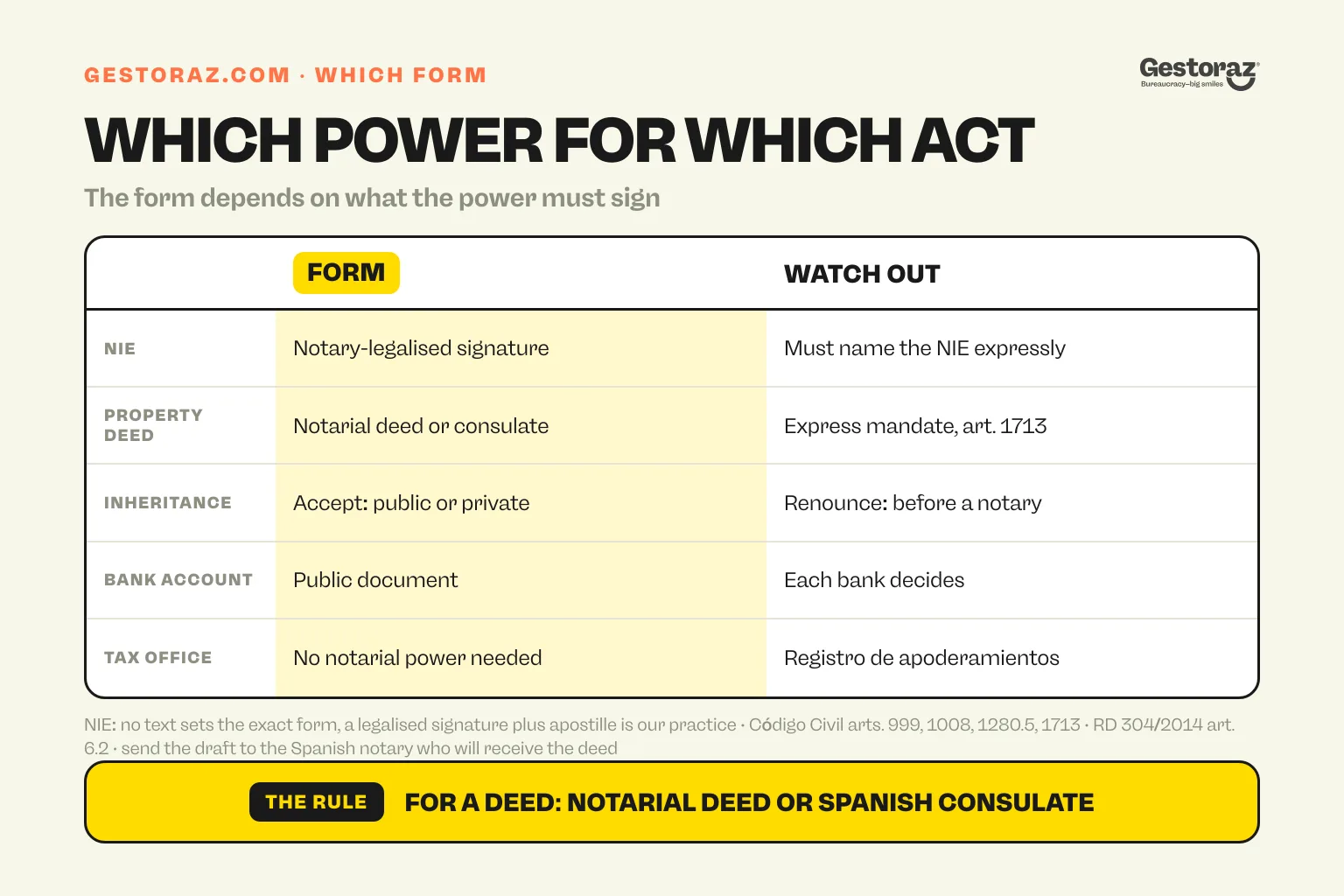
- NIE application. An administrative procedure, where representation can be proved by "any valid means in law" that leaves a reliable record (Ley 39/2015, art. 5.4). The Spanish consulate in Paris states that you can apply "personally or through a duly accredited representative", with a power that expressly mentions the NIE application. No text sets the exact form the police expect. Our practice is a personalised power with its translation, the signature legalised by a notary, plus an apostille. The NIE itself is explained in what an NIE number is.
- Buying or selling property. The power must be a public document (Civil Code, art. 1280.5) and expressly cover acts of ownership such as selling or mortgaging (art. 1713). The Spanish notary must also judge it sufficient and equivalent to a Spanish power.
- Inheritance. Acceptance can be made in a public or private document (art. 999), but renouncing is done before a notary (art. 1008).
- Opening a bank account. When a representative opens it, the bank must collect both identity documents and "the public document proving the powers" (RD 304/2014, art. 6.2). Whether it accepts a foreign power is each bank's policy: ask first.
- Spanish tax office. No notarial power is needed in the standard case: representation is registered in the AEAT Registro de apoderamientos online with an electronic signature, in person, or with a document bearing a notarially legitimised signature.
Why a legalised signature is not always enough for a deed
For a deed, two tests apply. The Spanish notary identifies the power in the deed and judges that it gives sufficient authority, and the land registrar only checks that this judgement is there (Ley 24/2001, art. 98). A foreign document is registrable when the foreign authority performed functions equivalent to those of Spanish authorities (Ley 29/2015, art. 60).
The registry authority (DGSJFP) has spelled this out. In a June 2020 decision on an apostilled power from an English notary, it held that equivalence requires the foreign authority to guarantee the identity and the capacity of the signer, and that the apostille proves authenticity, not equivalence. In a September 2023 decision, registration was refused and the authority repeated that the documents must reflect the checks of identity and capacity, though a notarial certificate or declaration with the same effect under foreign law can do. Back in 2003, a German Beglaubigung was admitted because the German notary had to verify the signers' capacity.
So a bare signature legalisation is not automatically refused, but it depends on what the foreign notary certifies. The safe route for a deed is a power granted as a notarial deed (notariële akte, notarielle Urkunde, acte authentique) or at a Spanish consulate. Before you sign, send the draft to the Spanish notary who will receive the deed: that is the person who will judge it.
Special or general: what the power must name
The Civil Code knows general powers and special powers for one or more specific transactions (art. 1712). A power in general terms only covers acts of administration. To sell, mortgage or perform any other "act of strict ownership", you need an express mandate (art. 1713).
From abroad, a special power is the norm. The Consejo General del Notariado describes it as covering a concrete type of act, such as buying a property or accepting an inheritance, and advises telling the notary why and for what you need it. Name every act: a power drafted only for a property purchase does not authorise an NIE filing, and an NIE power says nothing about buying.
Signing it from abroad: three routes
1. A local notary, then an apostille
The most common route. Your notary legalises your signature or draws up a notarial deed, the competent authority adds the apostille, and the document gets an official Spanish translation. In the words of the Spanish consulate in Düsseldorf, a foreign notary's act is effective in Spain if it is "duly legalised or apostilled and accompanied by an official translation into Spanish". Our cost overview puts the notary at 60 to 120 € (what an NIE costs).
2. The Spanish consulate
Spanish consuls exercise notarial functions "like notaries in Spain" and grant powers to Spaniards and foreigners alike. Personal appearance on the day of signing is always required, after a request by email or post. Fees: 30.05 € for powers in Düsseldorf (2026 schedule), and in Paris 39.08 € for a power to sell, 42.09 € for a general power. The catch: Düsseldorf and Brussels ask a foreign grantor for their NIE, and Düsseldorf writes in capitals that it must be requested beforehand.
3. An online notary
Signature legalisation and apostille can also be done fully online through an online notary. That fits an NIE power. For a deed, the equivalence question above applies, so check with the Spanish notary first.
Worked example: a German couple buying in Málaga
Anna and Jonas live in Cologne and are buying a flat in Málaga. Neither has an NIE, so the consulate is closed to them for now.
- Step 1, the NIE. Each signs a power for the NIE application before a German notary, who legalises the signature. The Präsident des Landgerichts adds the apostille, 25 € per document. Each application carries the 9.84 € tasa.
- Step 2, the purchase. With their NIE numbers, they book the Spanish consulate in Düsseldorf, appear in person and sign one special power to buy: 30.05 € on the 2026 schedule. The alternative is a notarielle Urkunde before their German notary, apostilled and given a sworn translation.
- Before step 2, their lawyer sends the draft to the notary in Málaga who will receive the deed.
The purchase itself is covered in buying property in Spain from abroad.
The apostille, country by country
Spain and the six countries below apply the 1961 Hague Apostille Convention, which covers notarial acts. The apostille certifies the signature, the capacity of the signer and the seal. It does not authenticate the content. EU Regulation 2016/1191 does not exempt you either: it covers civil-status documents such as birth or marriage certificates, not a power of attorney.
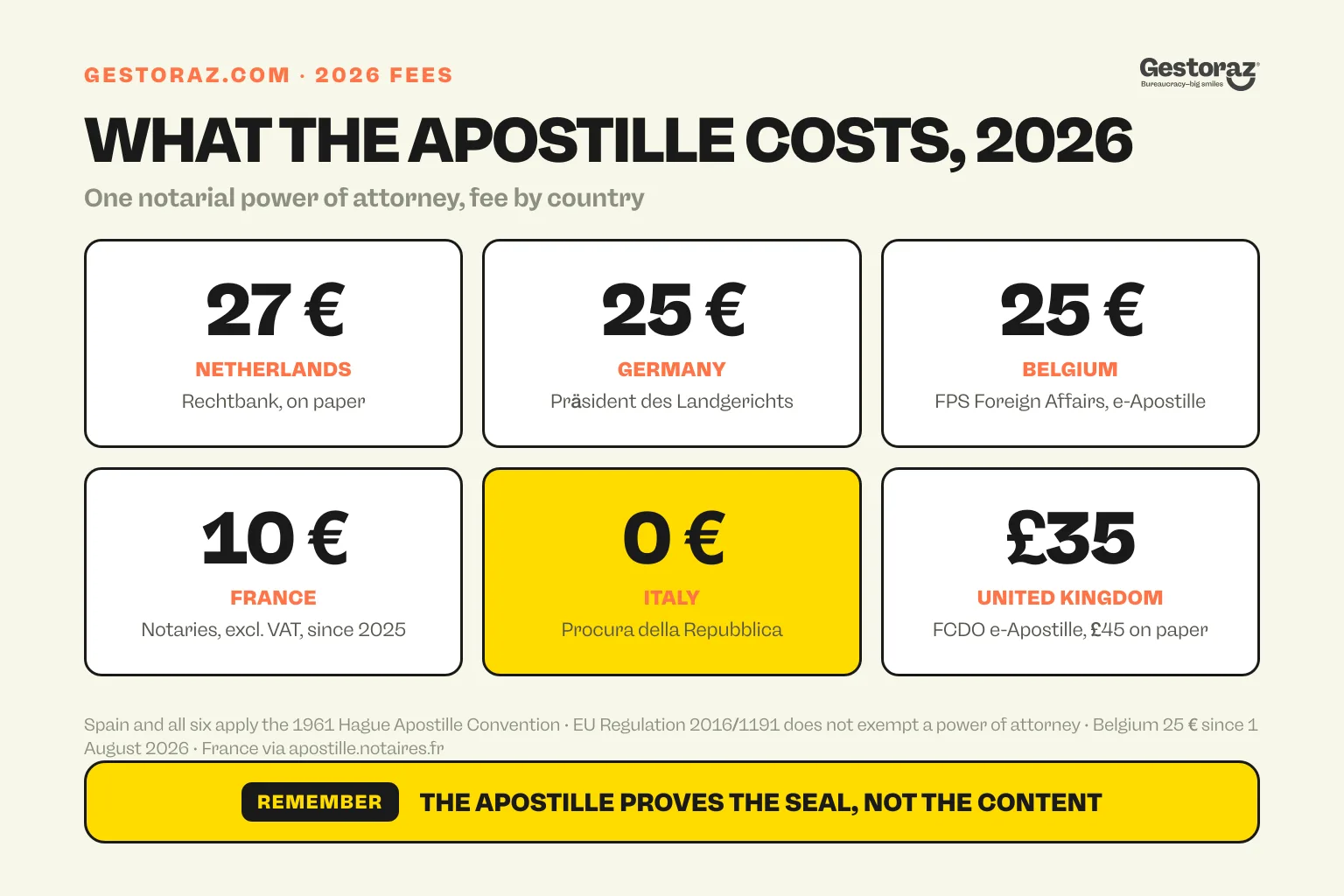
- Netherlands: a designated rechtbank of your choice, on paper, 27 € in 2026.
- Germany: the Präsident or Präsidentin of the Landgericht for the notary's district, 25 €.
- Belgium: FPS Foreign Affairs, e-Apostille only since 2018, requested by the notary, 25 € since 1 August 2026, normally within 48 hours.
- France: notaries since 1 May 2025, via apostille.notaires.fr, 10 € excl. VAT per document at the standard rate, within 3 working days.
- Italy: the Procura della Repubblica, free of charge.
- United Kingdom: the FCDO Legalisation Office, for a document certified by a UK notary or solicitor, £45 on paper or £35 as an e-Apostille.
A power without a valid apostille is rejected on arrival in Spain, and redoing it can cost two to three weeks.
Translation into Spanish
Spanish is the language of procedures before the state administration (Ley 39/2015, art. 15). The official route is a sworn translator (traductor-intérprete jurado) appointed by the Spanish Ministry of Foreign Affairs under RD 724/2020. Expect 40 to 80 € per page. The ministry warns that translations made abroad may not be accepted by some Spanish administrations.
- Bilingual powers exist in practice: a 2024 registry decision dealt with a Dublin notary's power "drawn up in Spanish and English" and duly apostilled.
- The apostille itself does not need translating: the Hague handbook says it cannot be rejected only for being in another language. The power underneath may still need one.
- At the Spanish notary, the deed can be translated orally, drawn up in two columns, or signed with an interpreter you choose (Reglamento Notarial, art. 150). The registrar may waive a translation if they know the language (Reglamento Hipotecario, art. 37).
What a power of attorney cannot do
- The TIE. It is applied for in person (RD 1155/2024, art. 209.1), with fingerprints taken when you file. See the TIE card.
- The FNMT digital certificate. Identity is accredited in person at a registration office, or at a Spanish career consulate abroad. The FNMT is explicit: "a notarial power does not work in this case". A third party can only go with your signature on the contract legitimised by a notary. Video-identification requires a valid Spanish electronic DNI, so it is closed to someone with only an NIE. More in digital certificate and Cl@ve.
- Signing a power at a consulate. You must appear yourself.
- A will. Nobody can make it for you.
Validity and revocation
Spanish law sets no expiry date for a power. Civil Code art. 1732 lists what ends it: revocation, renunciation by the representative, death, insolvency and certain support measures. Writing a time limit into the power is possible and common practice.
You can revoke at will (art. 1733), always by a deed of revocation before a notary. Then tell everyone who relies on the power: revocation cannot be raised against third parties who were not informed (art. 1734), and acts done in good faith before the representative learned of it remain valid (art. 1738).
Mistakes that get a power rejected
- No apostille, or believing it validates the content or that the EU regulation exempts you.
- A general power used to sell or mortgage. Article 1713 requires an express mandate.
- A power that does not name the act. An NIE power must mention the NIE application expressly. See filling in the EX-15.
- A bare signature legalisation for a deed, where the Spanish notary needs evidence that identity and capacity were checked.
- No official Spanish translation.
- Booking the consulate without an NIE.
- A revocation nobody was told about.
For the NIE, Gestoraz sends you a personalised power of attorney ready to sign, translation included. Your signature is legalised by a notary and apostilled, both fully online through our partner online notary for 69 €, or with any notary you choose. That power is for the NIE application only, not for a property deed. Lead times for the NIE are in how long an NIE application takes.
Official sources
- Código Civil, arts. 1280, 1712 to 1738: https://www.boe.es/buscar/act.php?id=BOE-A-1889-4763
- DGSJFP, resolution of 4 June 2020 on a foreign power used for a purchase: https://www.boe.es/diario_boe/txt.php?id=BOE-A-2020-8799
- Consulado de España en Düsseldorf, poderes notariales: https://www.exteriores.gob.es/Consulados/dusseldorf/es/ServiciosConsulares/Paginas/index.aspx?scca=Notar%C3%ADa&scco=Alemania&scd=138&scs=Poderes+notariales
- HCCH, Apostille Convention: https://www.hcch.net/en/instruments/conventions/full-text/?cid=41
- Ministerio de Asuntos Exteriores, sworn translation: https://www.exteriores.gob.es/es/ServiciosAlCiudadano/Oficina-de-Interpretacion-de-Lenguas/Paginas/Traduccion-e-interpretacion-jurada.aspx


Obtain your Digital Certificate entirely remotely.
Request your Digital Certificate completely remotely.

