



Inheriting property in Spain from abroad: tax and deadlines
When a parent or partner dies leaving a flat, a holiday home or a bank account in Spain, heirs who live abroad usually discover two things at once: Spanish paperwork follows its own timetable, and that timetable starts on the date of death. Nothing has to happen in the first days, but a few dates matter, and missing them costs money.
This guide follows the order in which things happen, from the deadlines to the notary, the inheritance tax and what changes once the property is yours. It describes the procedure. Your own situation, and the tax calculation, belong with a lawyer, the notary or a tax adviser.
The clock starts on the date of death
Every deadline is counted from the day of death, not from the day you meet a notary.
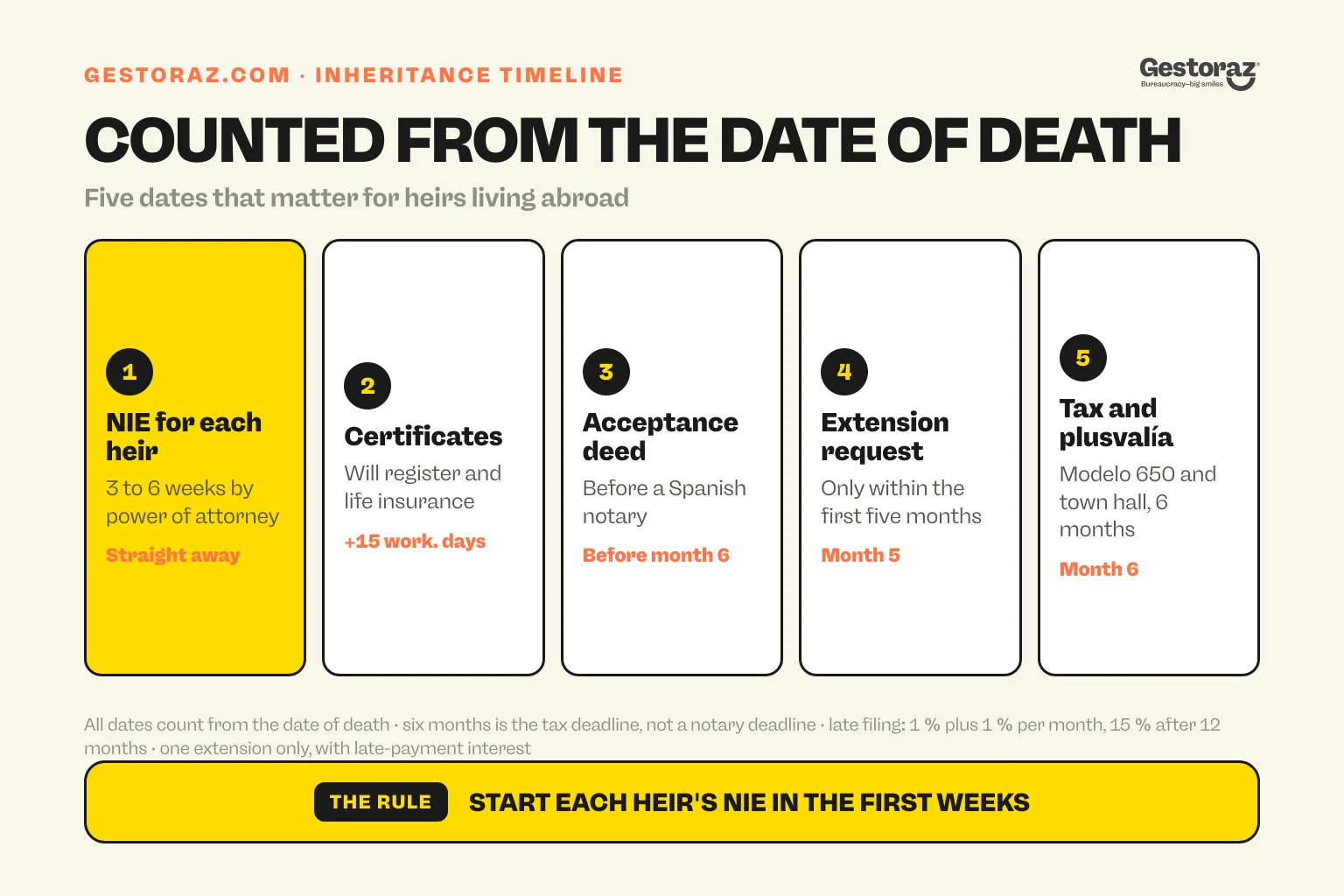
- After 15 working days: the earliest date to request the Certificado de Actos de Última Voluntad, which tells you whether a Spanish will exists, and the life insurance certificate.
- Within 5 months: the only window to ask for an extension of the inheritance tax deadline.
- Within 6 months: file and pay the inheritance tax (Impuesto sobre Sucesiones y Donaciones, ISD) and the municipal plusvalía.
One point is often misunderstood: six months is the tax deadline, not a deadline to sign at the notary. No rule sets a date for the acceptance deed. However, the tax office lists that deed among the documents filed with the tax return, so in practice the notary appointment has to fit inside the window, or inside the extension.
Asking for more time
The extension adds six months. Request it within the first five months, with the death certificate, the names of the heirs, the assets and their approximate value, and the reasons. Without an answer within a month, it is granted; after the fifth month, it is refused. Only one extension is possible, and late-payment interest runs over the extra period.
Filing late without an extension adds a surcharge of 1 % plus 1 % for each full month of delay, rising to 15 % plus interest after 12 months.
Which law governs the inheritance
For deaths since 17 August 2015, EU Regulation 650/2012 applies to the succession as a whole the law of the country where the deceased habitually lived, unless they chose the law of their nationality in a will. Spain applies the Regulation even when it points to a non-EU country's law, such as the UK's.
Two things stay Spanish whatever the succession law: the tax and the land registry. The optional European Certificate of Succession takes effect in Spain without any special procedure or legalisation and can be used to record the property in the registry (certified copies are valid six months). To register a specific property, a public deed allocating the assets is still expected, except for a sole heir with no forced heirs.
The documents Spain will ask for
- Death certificate. From an EU country, no apostille is needed, and the issuing office can provide a multilingual standard form, which can spare you a translation. From the UK: apostille plus sworn translation.
- Certificado de Actos de Última Voluntad. Issued by the Ministry of Justice and required for any succession step. Online with Cl@ve only if the death occurred after 2 April 2009 and is registered; otherwise by post or in person in Madrid, with the full (literal) death certificate and form 790 (code 006).
- Certificado de Seguros de Cobertura de Fallecimiento. Same rules. It shows which life insurance policies covered the deceased.
- The will, or what replaces it. A Spanish will: an authorised copy from the notary who holds it. A foreign will: apostilled (or legalised) and translated. Without a will, a Spanish notary draws up a declaración de herederos abintestato, with two witnesses, closed after 20 working days.
An NIE for every heir, even from abroad
Each foreign heir needs their own NIE before the acceptance deed. The notary must record the tax number of everyone appearing in a deed on property, and the tax office requires it for the inheritance tax. One heir's NIE does not cover a brother or a sister. What the number is, and why it lasts for life, is explained in what an NIE number is.
An inheritance file is a valid reason on the EX-15 form, and the fee is 9.84 €. Lead times depend on the route: see how long an NIE application takes. Start this step first, because the six-month count is already running.
Nobody has to travel. A special power of attorney lets a representative accept in your name; acceptance can be made in a public or private document, but renouncing requires a notarial instrument. See our guide to powers of attorney for Spain.
Accepting the inheritance at the notary
The central document is the escritura de aceptación y adjudicación de herencia: a public deed, signed before a Spanish notary, in which the heirs accept the inheritance and the assets are allocated to them. Two other options exist:
- *Renouncing (repudiación),* before a notary. If an interested party has a notary formally ask you to decide, you have 30 calendar days; silence then counts as acceptance.
- *Accepting a beneficio de inventario,* declared before a notary. Debts are then paid only up to the value of the estate, which protects you if you suspect the deceased owed money.
Which option fits is a legal decision: take it with the notary or a lawyer before signing.
Inheritance tax for non-resident heirs
In Spain, inheritance tax is paid by each heir on their own net share. An heir living abroad pays only on assets located in Spain, plus Spanish life insurance. A property is valued at its valor de referencia from the Catastro, or at the declared value if higher.
When the deceased or the heir did not live in Spain, the return goes to the Agencia Tributaria on modelo 650, online or on paper in Madrid, with the acceptance deed, the death certificate and the will or declaration of heirs.
Regional rules apply to you too
The state scale runs from 7.65 % to 34 %, but since an EU Court of Justice ruling of 3 September 2014 (C-127/12), non-residents can apply the regional rules, often far more generous (Ley 29/1987, second additional provision). If the deceased lived abroad, the region is the one holding the largest value of the Spanish assets; if they lived in Spain, their region. The tax office confirms the option is open to every heir, inside or outside the EU.
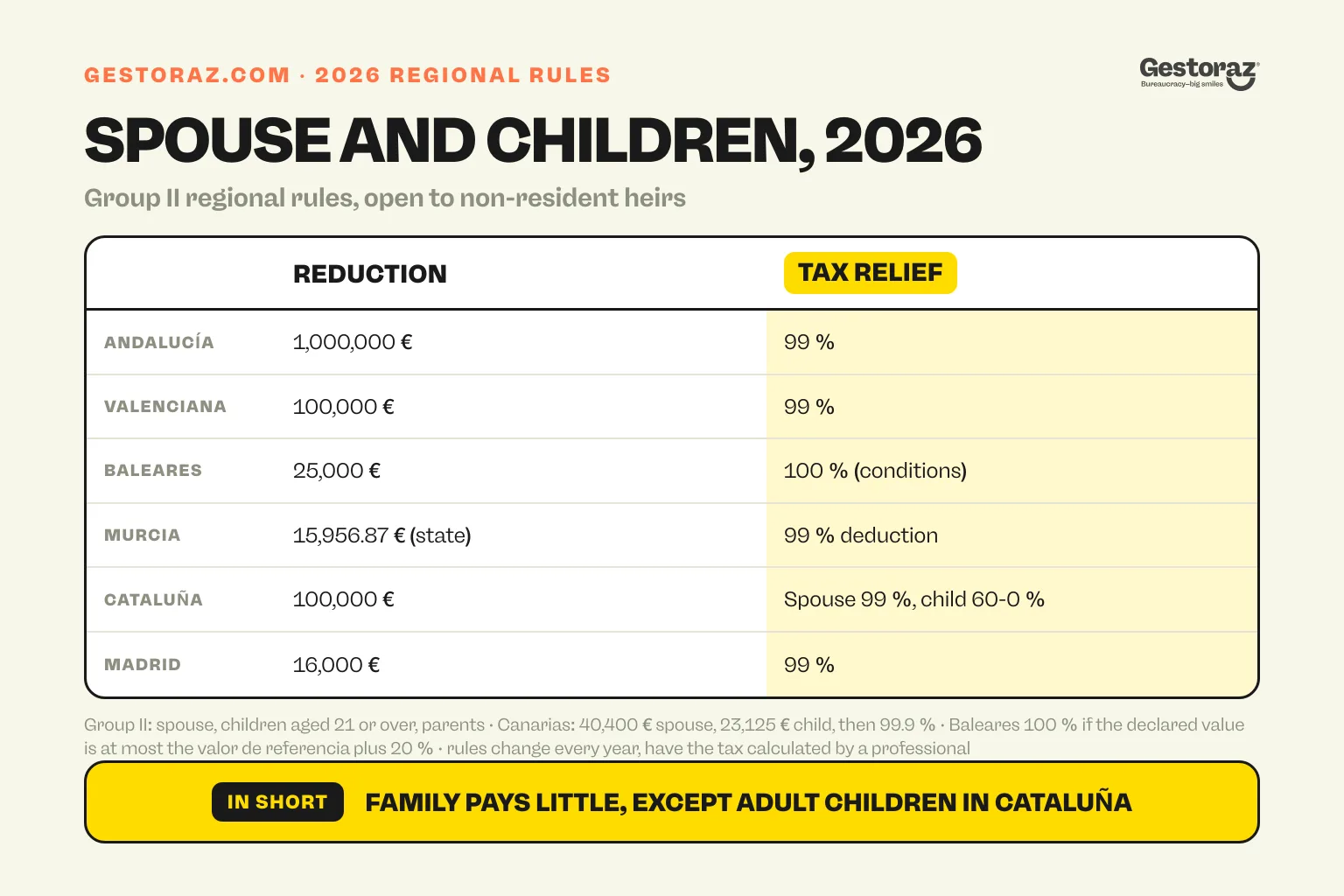
For a spouse or a child aged 21 or over (group II), the 2026 rules are:
- Andalucía: reduction of 1,000,000 €, then 99 % relief on the tax.
- Comunitat Valenciana: reduction of 100,000 €, then 99 % relief.
- Illes Balears: reduction of 25,000 €, then 100 % relief if the declared value does not exceed the valor de referencia by more than 20 %.
- Región de Murcia: state reduction of 15,956.87 €, then a 99 % deduction.
- Cataluña: reduction of 100,000 €. A spouse gets 99 % relief; for an adult child, relief falls from 60 % to 0 % as the taxable amount grows.
- Comunidad de Madrid: reduction of 16,000 €, then 99 % relief.
- Canarias: reduction of 40,400 € for a spouse, 23,125 € for a child, then 99.9 % relief.
Spouses and children pay little almost everywhere, adult children in Cataluña being the main exception. These figures change every year and come with conditions: have the tax calculated by a professional.
Your home country may tax it too
Spain's inheritance tax treaties cover only Sweden, France and Greece: none with the Netherlands, Germany, Belgium, Italy or the UK. A non-resident heir also cannot deduct foreign inheritance tax from the Spanish bill. Whether your own country taxes the property, and credits the Spanish tax, is a question for an adviser there.
Plusvalía, the Registro and the bank accounts
Plusvalía. The municipal tax on the increase in land value is paid by the heir within six months of the death, extendable to one year on request. Town halls can grant relief of up to 95 % to children, spouses and parents, if their bylaw provides for it. No gain in land value, no tax.
Registro de la Propiedad. There is no deadline to register the property in your name, but until you do, your ownership cannot be relied on against third parties. The registry only accepts the deed once it has been presented for inheritance tax and plusvalía.
Bank accounts. A Spanish bank that releases funds before the tax is settled becomes liable for it, so it waits for proof of payment or exemption. Two ways out exist: a bank cheque made out to the tax administration to pay the tax, or a partial self-assessment, agreed by all heirs, to withdraw the money as an advance on the final tax. Insurers pay a life policy on proof that the tax was filed or paid.
Example: two Dutch siblings and a flat in Alicante
Anna and Pieter, both over 21 and living in the Netherlands, inherit their mother's flat in Alicante. She lived in Utrecht and died on 15 March 2026.
- Straight away: an NIE each, for example through a power of attorney each.
- From early April: request the últimas voluntades and life insurance certificates.
- By 15 August 2026: request the extension if the deed will not be ready in time.
- By 15 September 2026: each files a modelo 650 for their half; the plusvalía goes to Alicante town hall, or its extension is requested.
- Which rules: the flat is in the Comunitat Valenciana, so each can apply the Valencian group II rules: a 100,000 € reduction and 99 % relief in 2026.
- Afterwards: a yearly modelo 210 each, at 19 % as EU residents. With no Dutch treaty, the Dutch side is checked with a Dutch adviser.
After inheriting: yearly tax and selling later
A property you do not rent out generates imputed income every year: 1.1 % or 2 % of the cadastral value, taxed at 19 % if you live in the EU or EEA and 24 % otherwise, on modelo 210, filed between 1 April and 31 December of the following year. Details in how much tax a non-resident pays in Spain. The town hall also charges the yearly IBI, at 0.4 % to 1.10 % of the cadastral value.
If you sell later, your purchase value for capital gains is the value declared for inheritance tax, capped at market value, so a low declared value means a higher taxable gain. The buyer also holds back 3 % of the price and pays it with modelo 211: see buying property in Spain from abroad.
Gestoraz handles the administrative side only. We obtain the NIE for each heir by power of attorney, without anyone travelling to Spain, and once the property is in your name we file the yearly modelo 210. We do not handle the will, the inheritance tax return or legal advice: that is work for a lawyer or the Spanish notary.
Official sources
- Ley 29/1987, Impuesto sobre Sucesiones y Donaciones: https://www.boe.es/buscar/act.php?id=BOE-A-1987-28141
- Real Decreto 1629/1991, Reglamento del Impuesto sobre Sucesiones: https://www.boe.es/buscar/act.php?id=BOE-A-1991-27678
- Agencia Tributaria, modelo 650 for non-residents: https://sede.agenciatributaria.gob.es/Sede/no-residentes/impuesto-sobre-sucesiones-donaciones/adquisiciones-mortis-causa-modelo-650.html
- Ministerio de Justicia, Certificado de Actos de Última Voluntad: https://sede.mjusticia.gob.es/es/tramites/certificado-actos-ultima
- Ministerio de Hacienda, regional taxation 2026, chapter IV: https://www.hacienda.gob.es/sgfal/financiacionterritorial/autonomica/capitulo-iv-tributacion-autonomica-2026.pdf


Obtain your Digital Certificate entirely remotely.
Request your Digital Certificate completely remotely.

