



Buying property in Spain from abroad: steps and timeline
Buying property in Spain from abroad follows a fixed sequence: reservation, contrato de arras, checks, signing before a notary, transfer tax, land registry. This guide plans it backwards from the day you sign the deed, because that date is fixed early and one item, the NIE, takes longer than everything else.
It is written for buyers living in the Netherlands, Germany, Belgium, France or elsewhere who are buying a second home in Spain. Figures are 2026 values from official sources.
The timeline, counted back from the notary date
Put the signing date (S) on the calendar first. The weeks below are a planning model based on our documented NIE lead times, not legal deadlines.
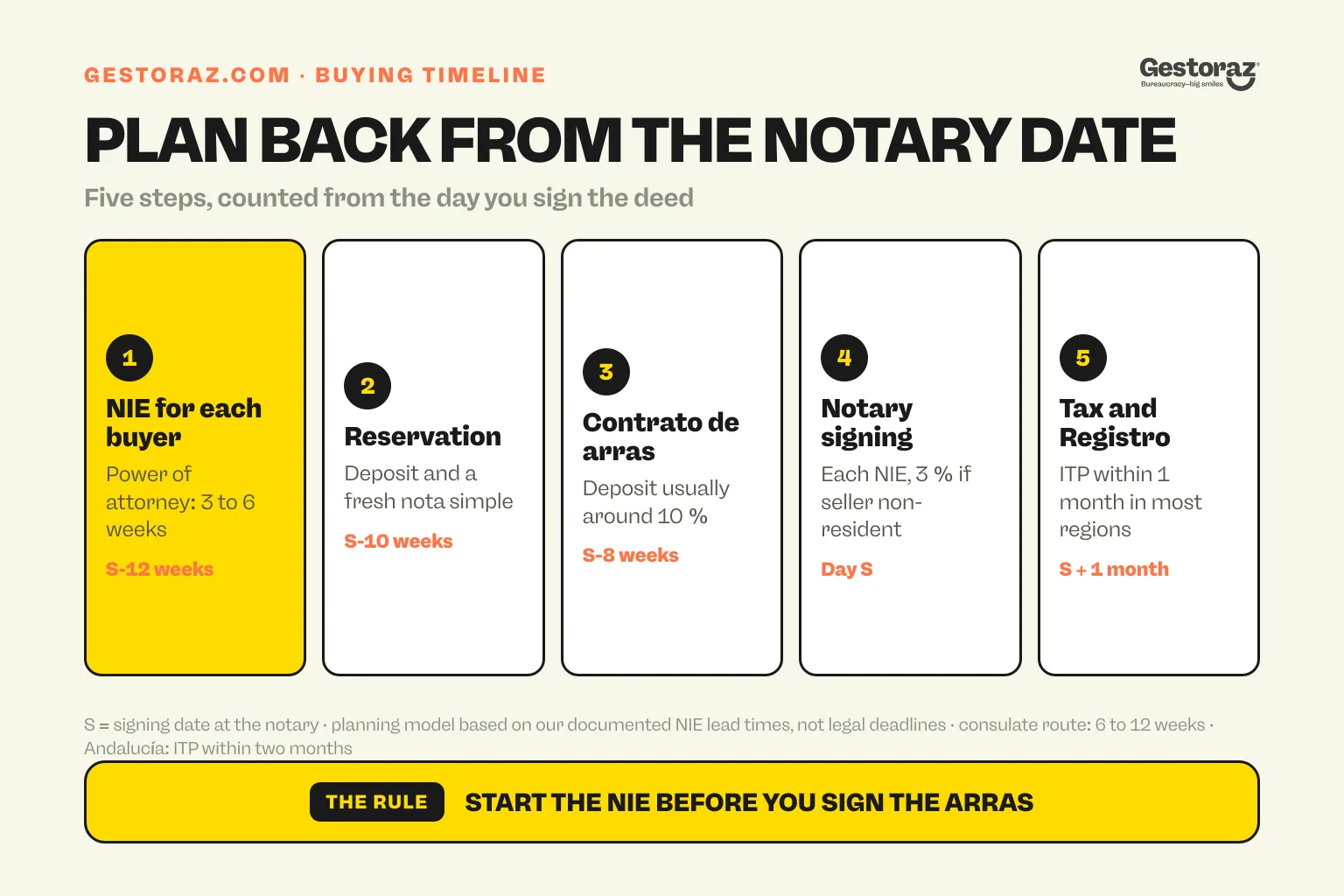
- S minus 10 to 12 weeks: start the NIE for every buyer. Power of attorney through a gestoría: 3 to 6 weeks. Spanish consulate: 6 to 12 weeks. Police station in Spain: 2 to 6 weeks from booking.
- S minus 8 to 10 weeks: reservation and nota simple.
- S minus 6 to 8 weeks: contrato de arras, with the signing date written in.
- S minus 2 to 4 weeks: NIE numbers in hand, community-debt certificate, IBI receipt, energy certificate, power of attorney if you will not travel.
- S: signing. If the seller is non-resident, 3 % of the price is held back.
- Within one month (two in Andalucía, 30 working days in Madrid and Murcia): transfer tax, plus modelo 211 for a non-resident seller. Then inscription at the Registro.
- 1 April to 31 December of the following year: first modelo 210, then every year.
The practical rule: if no NIE application has started when you sign the arras, the signing date in the arras is a guess.
Before you make an offer
Each buyer needs their own NIE. The notary must record the tax number of every person appearing on the deed (Ley del Notariado, art. 23), and for a foreigner that number is the NIE. The Registro will not inscribe a deed where one is missing. A couple buying together needs two NIE, even if only one of them signs.
The procedure is in what an NIE number is, lead times per route in how long an NIE application takes. Two points matter for a buyer. The application needs a dated document naming you as the reason, and a signed reservation agreement does that job. With less than six weeks to signing, the power of attorney route is the realistic one, and July to September are the slowest months.
Payment. No rule we have found requires a Spanish bank account to buy. The deed must identify how the price was paid, for a transfer the accounts debited and credited (Reglamento Notarial, art. 177), so a transfer from your Dutch or German account works. Refusing to identify payment blocks the inscription. Cash is capped when you buy from a developer: a buyer without tax residence in Spain cannot pay 10,000 € or more in cash. For IBI and community fees you will still want a Spanish account: many banks open a non-resident account before the NIE exists, some charging 60 to 120 € a year.
Reservation and the contrato de arras
Two documents usually come before the deed. A reservation agreement takes the property off the market against a deposit of a few thousand euros, by market practice. The contrato de arras is the real commitment, with a deposit usually around 10 % of the price.
What you can lose depends on the type, and the Civil Code defines only one: arras penitenciales (art. 1454). The buyer can walk away by forfeiting the deposit, the seller by returning it doubled. Confirmatory and penal arras come from case law and give no such exit. If you want the 1454 regime, the contract should say arras penitenciales del artículo 1454 del Código Civil in those words.
Have an independent lawyer review the arras, in particular what happens if your NIE is not ready (one Dutch buyer in our examples made his agreement conditional on obtaining it within six weeks), who pays which costs (by default the seller pays for executing the deed and the buyer for the first copy, Civil Code art. 1455, unless agreed otherwise), and, with a non-resident seller, how the 3 % and the plusvalía are held back.
Checks before you sign anything binding
- Nota simple from the Registro de la Propiedad: owner, mortgages, charges. Online at registradores.org, 9.02 € per property. Order it before the arras and again before signing.
- Community-debt certificate. Unpaid community fees follow the property for the current year and the three previous calendar years (Ley de Propiedad Horizontal, art. 9.1.e). The seller must bring a certificate to the deed unless you expressly waive it. Do not waive it.
- IBI. The property stays liable for unpaid IBI after the sale (TRLRHL, art. 64.1). Ask for the last paid receipt.
- Energy certificate. For a resale, a registered copy is annexed to the sale contract (RD 390/2021, art. 17.2).
- Referencia catastral. It must appear in the deed and is printed on the IBI receipt. Check it matches the property you visited.
What it costs on top of the price
Resale: ITP, the regional transfer tax. New build from the developer: 10 % IVA plus AJD (stamp duty), except in the Canary Islands, where IGIC replaces IVA. The rate follows where the property is, not where you live.
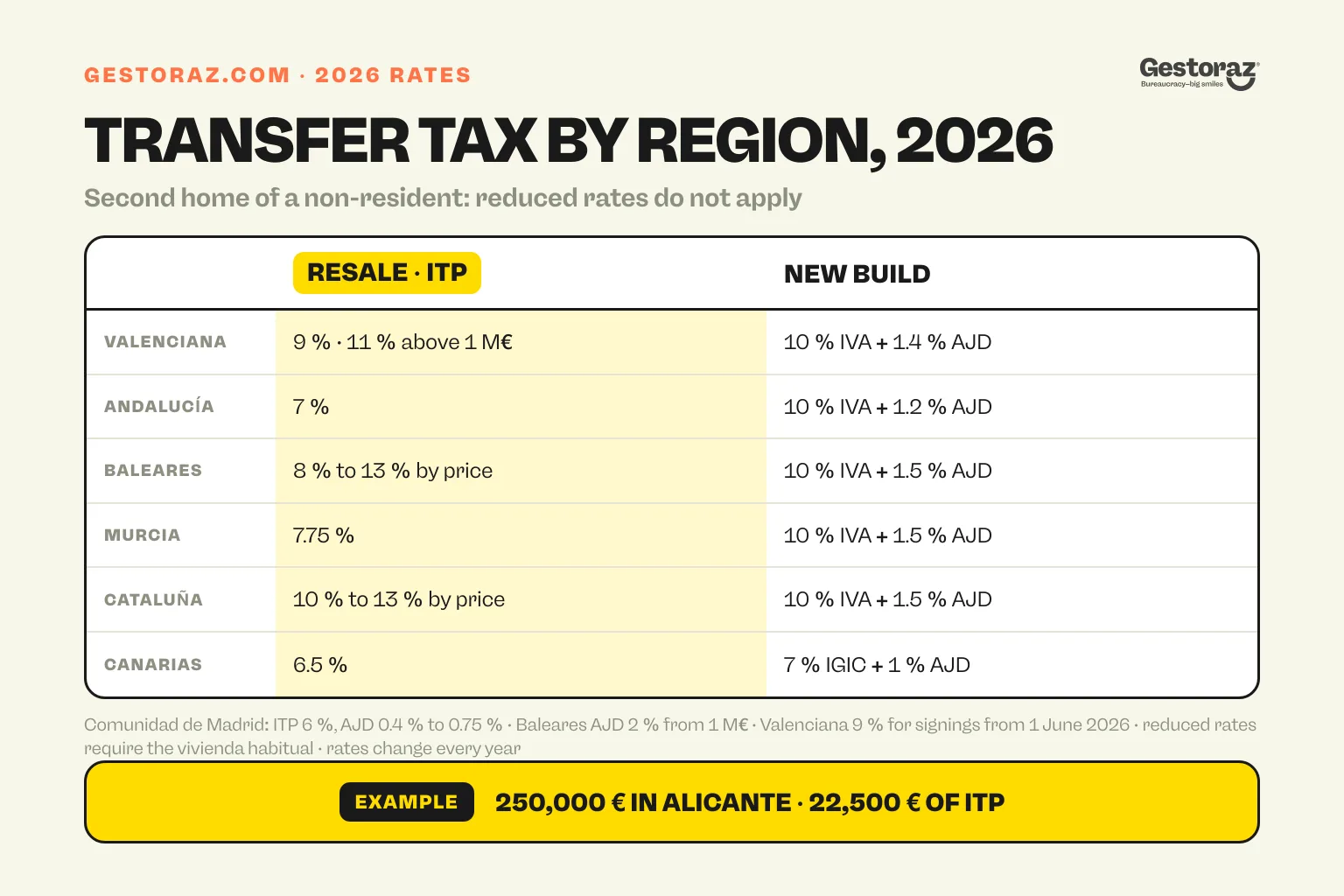
Regions change these rates every year. Below are the 2026 rates for homes. Apart from the Madrid AJD bands below, the reduced rates you may see advertised are reserved for the buyer's vivienda habitual, so they do not apply to a non-resident's second home.
- Comunitat Valenciana: ITP 9 % for signings from 1 June 2026 (10 % before), 11 % above 1 million €. AJD 1.4 %. Deadline one month.
- Andalucía: ITP 7 %. AJD 1.2 %. Deadline two months.
- Illes Balears: ITP by bands, 8 % up to 400,000 €, 9 % to 600,000 €, 10 % to 1 million €, 12 % to 2 million €, 13 % above. AJD 1.5 %, 2 % from 1 million €. Deadline one month.
- Región de Murcia: ITP 7.75 %. AJD 1.5 %. Deadline 30 working days.
- Cataluña: ITP by bands, 10 % up to 600,000 €, 11 % to 900,000 €, 12 % to 1.5 million €, 13 % above. AJD 1.5 %. Deadline one month.
- Comunidad de Madrid: ITP 6 %. AJD 0.75 %, or 0.4 % up to 120,000 € and 0.5 % up to 180,000 € for an individual buyer. Deadline 30 working days.
- Canarias: ITP 6.5 %. New build: IGIC 7 % plus AJD 1 %. Deadline one month.
Notary and registry charge by government tariff (arancel). The notary tariff dates from 1989 and is the same everywhere in Spain, with a possible 10 % discount. Neither body publishes an all-in figure: copies, pages and VAT come on top of the base.
Worked example: a couple from Utrecht buying in Alicante
A Dutch couple living in Utrecht buys a 250,000 € resale flat in Alicante (Comunitat Valenciana) in autumn 2026.
- ITP at 9 %: 22,500 €, due within one month.
- Notary: about 364 € base tariff, plus 21 % VAT, pages and copies.
- Registro: about 191 € base tariff, plus VAT.
- NIE: two applications, each with the 9.84 € tasa, plus a power of attorney if they apply from the Netherlands.
- From 2027: a yearly modelo 210 at 19 %, because they live in the EU.
A little over 23,000 € on top of the price, before VAT on fees and a lawyer. Nearly all of it is transfer tax.
If the seller is not resident in Spain
Find this out before the arras. When the seller is non-resident without a permanent establishment in Spain, the buyer must withhold 3 % of the agreed price and pay it to the Agencia Tributaria (TRLIRNR, art. 25.2), as an advance on the seller's capital gains tax.
- Modelo 211, filed by the buyer within one month of the transfer. The seller gets the copy for the non-resident transferor.
- In practice the notary has the 3 % retained at signing. On 250,000 €, that is 7,500 € paid to the tax office, not the seller.
- Skip it and the property remains liable for the lower of the 3 % and the seller's tax.
- Plusvalía municipal. Normally the seller's tax. When the seller is a non-resident individual, the buyer owes it in the seller's place as sustituto (TRLRHL, art. 106.2), so the arras should say how it is held back from the price.
Signing day at the notary
- In person or by power of attorney. Spanish consulates grant powers to foreigners, including one special power to buy and to obtain the NIE. At the consulate in Paris it costs 24.06 to 42.09 €. A power signed before your local notary needs an apostille and a Spanish translation. The Netherlands, Germany, Belgium and France all apply the Hague Apostille Convention, and a power without a valid apostille is rejected.
- Identity. Passport or EU identity card, and each buyer's NIE.
- Language. A notary who speaks your language can translate orally. You can ask for a two-column deed in Spanish and your language, or bring an interpreter of your choice, who also signs.
- Bring transfer or bank cheque details, the community-debt certificate, the IBI receipt, and the 3 % arrangement if the seller is non-resident.
After the signing: the first month, then every year
- Pay the ITP (or AJD for a new build) within the regional deadline above, and the modelo 211 within one month if the seller was non-resident.
- Register the deed. No legal deadline, but an unregistered deed cannot be relied on against third parties (Ley Hipotecaria, art. 32). The Registro will not inscribe until the transfer tax is paid and the plusvalía reported.
- IBI every year: the town hall sets a rate on the cadastral value, from 0.4 % to 1.10 % for urban property, with surcharges in some municipalities.
Modelo 210, every year, even if you never rent. A second home that is not let generates imputed income: 2 % of the cadastral value, or 1.1 % if values were revised in that year or the ten before. The tax is 19 % if you are resident in another EU or EEA country, 24 % otherwise. Residence counts, not nationality: a British citizen living in France pays 19 %.
You file the following year: imputed income for 2026 between 1 April and 31 December 2027. On a cadastral value of 100,000 € revised in 2018, that is 1,100 € of imputed income and 209 € of tax at 19 %. Renting changes the rules, see how much tax a non-resident pays in Spain, and a holiday let needs the rental registration. Filing online yourself requires a digital certificate or Cl@ve.
Gestoraz handles the administrative side, not the legal one. We obtain the NIE for each buyer by power of attorney, without you travelling to Spain, and file the modelo 210 once you own the property. Contract review stays with your lawyer.
Official sources
- Ley del Notariado, arts. 23 and 24: https://www.boe.es/buscar/act.php?id=BOE-A-1862-4073
- Ministerio de Hacienda, Tributación Autonómica. Medidas 2026: https://www.hacienda.gob.es/sgfal/financiacionterritorial/autonomica/capitulo-iv-tributacion-autonomica-2026.pdf
- Agencia Tributaria, modelo 211 instructions: https://sede.agenciatributaria.gob.es/Sede/todas-gestiones/impuestos-tasas/impuesto-sobre-renta-no-residentes/modelo-211-irnr______es-no-residentes-permanente_/instrucciones.html
- Agencia Tributaria, modelo 210 filing periods: https://sede.agenciatributaria.gob.es/Sede/todas-gestiones/impuestos-tasas/impuesto-sobre-renta-no-residentes/modelo-210-irnr______a-no-residentes-permanente_/nota-modificaciones-plazos-presentacion-modelo-210.html
- Consejo General del Notariado, notary fees: https://notariado.org/portal/en/what-does-it-cost


Obtain your Digital Certificate entirely remotely.
Request your Digital Certificate completely remotely.

