



What is the TIE card in Spain?
The TIE, Tarjeta de Identidad de Extranjero, is the plastic card issued to a non-EU national who holds a Spanish visa or residence authorisation. It is what a bank, a town hall, an employer or a border officer actually asks to see.
This article covers the first card: what it is in law, who is obliged to get one, what you file, pay and bring. The regulation behind it was replaced in 2025, so much of what is published about the TIE is out of date.
What the TIE is, in law
Article 209.2 of Real Decreto 1155/2024 defines the card by its two jobs: it is issued to identify the foreign national and to evidence their legal situation in Spain. Article 209.3 adds that it is personal and non-transferable: not lent, not deposited as a guarantee, not held by an employer or a landlord.
The frame is recent. Real Decreto 1155/2024 of 19 November has been in force since 20 May 2025 and repealed Real Decreto 557/2011, which almost every older guide still cites. Real Decreto 316/2026 amended it but changed nothing on the TIE or the fees. A guide quoting an article number from the 2011 text is quoting repealed law.
The number printed on the card, the NIE, is a separate object: assigned once, and carrying no expiry date at all. It has its own article, what is an NIE number.
Who has to get one: the trigger is duration
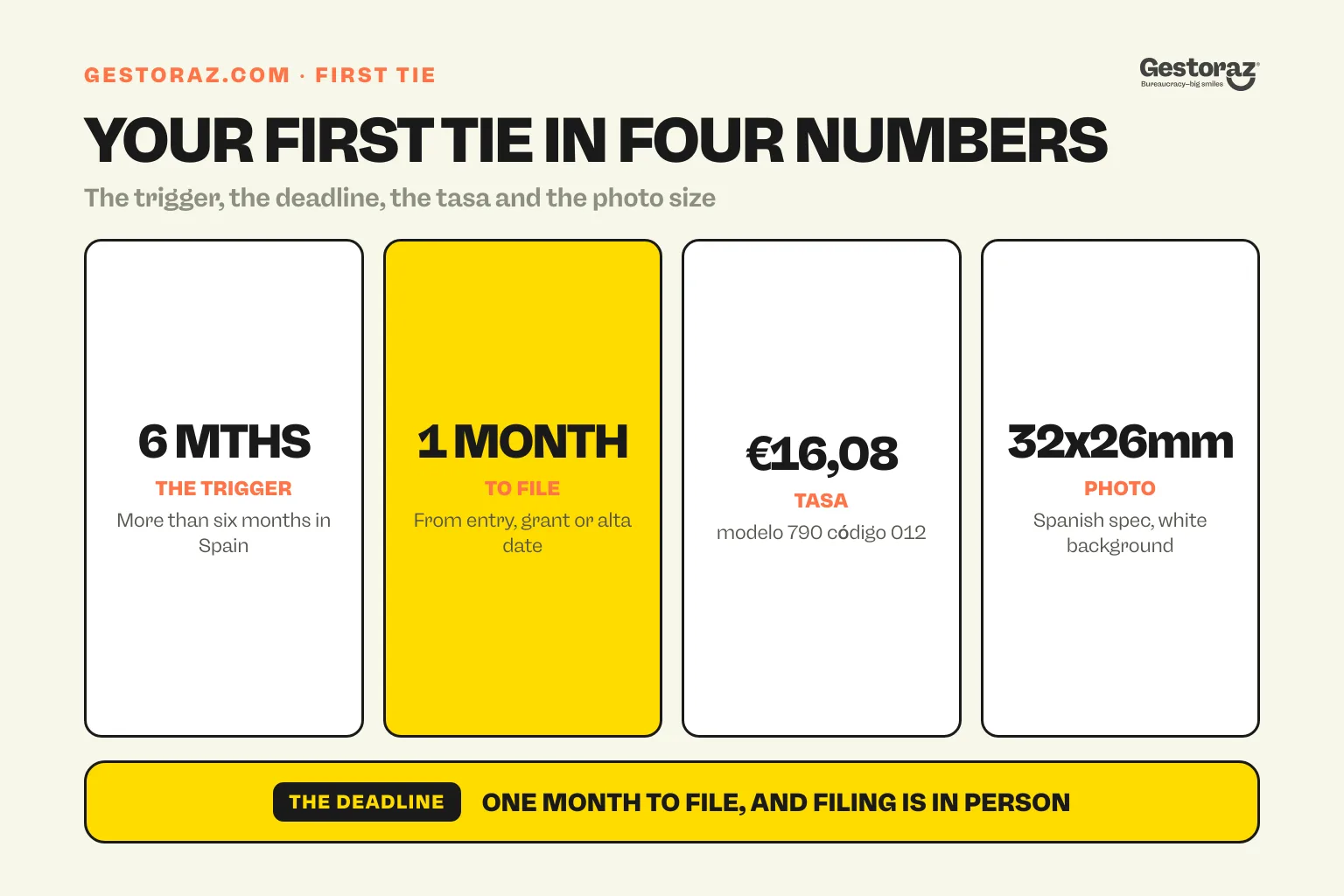
Article 209.1 uses one criterion. A foreign national granted a visa or an authorisation to remain in Spain for more than six months must obtain the card. Duration triggers it, not permit type: a course of study over six months produces a card exactly as an employment permit does, which is why it sits on our checklist for students.
The same article frames it as a right and a duty: you are entitled to the card and required to obtain it. It does not become optional because the permit is already granted.
Nationality and situation decide which document you get, and the TIE is only one of them.
- EU, EEA or Swiss citizen staying beyond three months: the certificado de registro de ciudadano de la Unión, applied for on the modelo EX-18. Not a TIE, and a different fee.
- Non-EU family member of an EU citizen: the tarjeta de familiar de ciudadano de la Unión, form EX-19, valid five years, ten for the permanent version. Not a TIE, and treating it as one is how this file most often goes wrong.
- Non-resident with only an economic interest in Spain, a property or a company stake: the NIE number alone, on an EX-15. No card, because there is no authorisation to document.
- British citizen covered by the withdrawal agreement: a TIE, but under its own fee heading at 12,00 euros.
One month, counted from one of three things
Article 209.1 gives you one month to apply. What it runs from depends on your case, and that is where people lose weeks.
- From your entry into Spain, when you arrived on a long stay visa granted abroad.
- From the grant of the authorisation, when the permit was resolved while you were already in Spain.
- From the date the authorisation takes effect, where that effect is tied to your alta in the Seguridad Social. The registration comes first and the clock starts there, one more reason to sort out the NUSS number early.
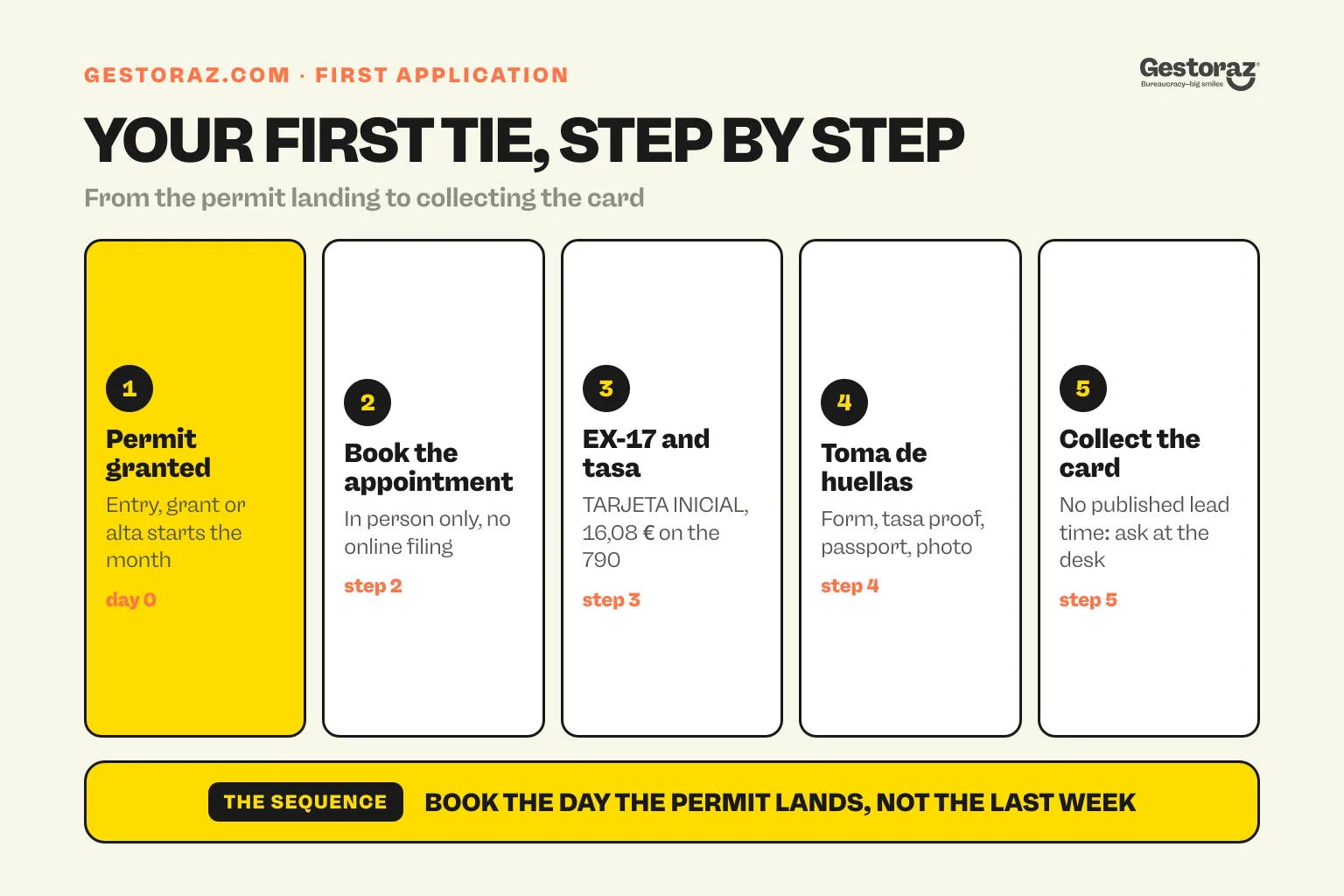
Work out which of the three applies from the wording of your own resolution. And note what the deadline is: a month to file, and filing means appearing in person. Nothing guarantees an appointment exists when you need one, so book the day the permit lands, not the week the month runs out.
The EX-17, and why it cannot be filed online
The application form is the EX-17, currently version 03. Check its header: it should cite LO 4/2000 y RD 1155/2024; a PDF still naming RD 557/2011 is superseded. Three boxes sit at the top, TARJETA INICIAL, RENOVACIÓN and DUPLICADO. A first card is TARJETA INICIAL, completed in Spanish.
The form states its own filing rule, worth reading before you hunt for a portal: presentation is exclusively in person. No telematic route, and not through a general public register. That is printed on the document, not an office habit.
Where it goes: the Oficina de Extranjería or a Comisaría de Policía, depending on the province; the police procedure code is 994694. One exception: applicants under Ley 14/2013, investors, entrepreneurs, researchers and intra-company transfers, use a different form, the MI-TIE, and a different unit.
The tasa: 16,08 euros for a first card
The fee for a first TIE covering temporary residence, a stay, or cross-border work is 16,08 euros, epígrafe 4.2 of Orden PJC/617/2025, in force since 16 June 2025, paid on the modelo 790 código 012.
You generate the form yourself on the sede electrónica of the Policía Nacional, at sede.policia.gob.es/Tasa790_012/. It is self-assessed: the site prints the amount for the option you selected, and that figure beats any guide, this one included. The mechanics are in the modelo 790 código 012.
It can be paid at any bank in Spain, without holding an account there. And there is a clock on it: the voluntary payment period runs ten working days from filing, and the proof has to reach the office within fifteen days.
The other TIE headings, so you budget the right one:
- Renewal of a temporary residence card: 19,30 euros.
- Larga duración, national or EU: 21,87 euros.
- Family member of a Spanish national: 12,00 euros.
- EU family member card, and the Brexit TIE: 12,00 euros.
These amounts are revised by successive finance acts, so read your own PDF rather than a table. And the código, 012 or 052, depends on which body handles your file, Police or Oficina de Extranjería, not on the procedure. The amount is the same either way.
What to bring to the toma de huellas
The appointment where your fingerprints are taken is where the file is actually lodged. The sourced list, from the police information sheet and article 178.4, is short.
- The EX-17, completed and signed, TARJETA INICIAL ticked.
- Proof of the paid tasa. The validated document, not an unpaid printout of the PDF.
- Your passport, valid, original plus a complete photocopy. Complete means the whole booklet, not only the photo page.
- A photo to the Spanish specification: 32 x 26 mm, plain white background, face on, head uncovered, no tinted glasses (Real Decreto 1553/2005, article 5.1.b).
Also carry your appointment confirmation and the resolution granting your permit: sensible practice, not a documented requirement.
That size is not what most European booths produce by default, so photos ordered before you travel are usually wrong. Get them in Spain, from a shop that knows the spec.
The number of photos is genuinely inconsistent. The police information sheet for the TIE says one, the page for the EU family member card says three. Offices differ and we found no authoritative answer, so bring three: two spares cost less than a lost appointment.
When the card is ready: what is not officially published
There is no officially published lead time for collecting a TIE. Not on the police sede electrónica, not in Real Decreto 1155/2024, not in the fee order. The regulation sets a deadline for you to apply and none for the administration to produce the card.
The "30 to 45 days" that circulates on blogs and forums is not traceable to any .gob.es page. It varies by comisaría, and by season. We are not going to repeat a figure we cannot source. Ask at the counter on the day your fingerprints are taken, and treat that as the only estimate that applies to your office.
You will normally leave with a resguardo, the receipt of the application. We could not source its legal nature, or what it is worth if you need to leave Spain before the card is ready. Do not build travel plans on it without written confirmation from your office.
How long the card lasts
Article 209.7 is unambiguous: the TIE is valid for exactly the validity of the authorisation it documents. The card has no duration of its own. A one year permit produces a one year card. A larga duración card runs five years (article 179.7), because the authorisation behind it is indefinite and only the card is periodic.
So the card is the thing you diary, not the authorisation. It is what an officer, a bank or an employer physically checks, and its date is the one that stops you.
Two rules for later. Article 209.8 obliges you to hand back the old card when it expires, is renewed, or the right behind it ends. And article 209.9 is misread constantly: a duplicado, issued when a card is lost, stolen or unusable, is not a renewal, and runs only for the time left on the card it replaces.
What the TIE is not
Most of the trouble comes from expecting it to do things it does not do.
- It does not grant you the right to stay. Article 209.2 says it evidences your legal situation. The right comes from the resolution; the card documents it.
- It is not your NIE. The NIE is the number printed on it, and it outlives every card you hold.
- It is not the card a non-EU family member of an EU citizen gets. That is the tarjeta de familiar de ciudadano de la Unión, a different regime under Real Decreto 240/2007, with its own validity and fee.
- It is not proof of tax residence. Holding a residence card and being a tax resident are separate questions, untangled in everything you need to know about residency.
- The long number on it is not the NIE either. The número de soporte identifies the plastic, changes with every new card, and is the one the FNMT asks for: what the número de soporte is.
At Gestoraz we prepare and file Spanish administrative applications remotely: the NIE, the NIF, the NUSS, the digital certificate and the padrón registration most residence files rest on. The TIE itself is filed in person by the form's own instruction, so it is one of the few procedures nobody can attend for you.
Official sources
- Real Decreto 1155/2024, boe.es/buscar/act.php?id=BOE-A-2024-24099: the Reglamento de Extranjería in force since 20 May 2025, article 209.
- Orden PJC/617/2025 of 13 June, boe.es/buscar/doc.php?id=BOE-A-2025-12056: the extranjería fees in force since 16 June 2025, epígrafe 4.2.
- Policía Nacional, sede electrónica, sede.policia.gob.es: the modelo 790 código 012 and the TIE procedure, code 994694.
- Ministerio de Inclusión, Seguridad Social y Migraciones, extranjeros.inclusion.gob.es: the EX-17 form and its hoja informativa.


Obtain your Digital Certificate entirely remotely.
Request your Digital Certificate completely remotely.

