



Certificado de concordancia in Spain
You renewed your passport, or you became Spanish, or a form somewhere spelled your surname differently. Now a counter is telling you that the number on file does not belong to the document in your hand. Search for the fix and every result gives it the same name: certificado de concordancia.
That name is the problem. It circulates as though it were a standard, named certificate with its own form, its own appointment type and its own processing time. It is not one, and there are three separate places where it would have to appear if it were.
The situation that sends people looking for it
The trigger always has the same shape. Spanish administration holds a record about you keyed to one identity document, and you are now standing in front of it with a different one. The number itself has not changed, because an NIE is assigned once and carries no expiry date, a point developed in renewing your NIE. What changed is the document it was originally attached to, or the way your name was written on it.
The record and the person are the same. The paperwork no longer says so, and no clerk is authorised to assume it on your behalf.
Why the records stop matching
Three causes account for nearly all of it.
- Naturalisation. You held an NIE, you obtained Spanish nationality, and you now hold a DNI. The file at your bank, at the property registry or at Seguridad Social was opened under the NIE. The DNI is a different number, and nothing automatically rewrites the older entries.
- A renewed passport. Many NIE files were opened with the passport recorded as the identifying document. Renew the passport and that number changes. The NIE did not, but the pairing printed on your old certificate now points at a document that no longer exists.
- A name transliterated differently. Spanish records are built around two surnames. A great many countries record one. Add an alphabet that has to be transcribed, an accent a system dropped, or a middle name that one office promoted to a second surname, and you end up with two spellings of one person.
None of these is a mistake you made. They are what happens when a register designed around one naming convention meets people who arrive with another.
Where the mismatch actually stops you
You rarely discover this at a police station. You discover it at a counter that will not move until the two identities are reconciled.
- Banks. An account opened years ago under the NIE, now being reviewed against a DNI or a new passport.
- Seguridad Social. Contributions credited under the NIE, and an affiliation number that has to keep pointing at them. What that number is and how it works is set out in the NUSS number.
- Hacienda. Tax history filed under one identifier, current filings under another. The relationship between the two numbers is its own source of confusion, untangled in NIE vs NIF.
- The Registro de la Propiedad. A property bought under the NIE and sold under the DNI. The registrar needs the two to be demonstrably the same person before the transfer is inscribed.
- Pension and employment records. Decades of contributions keyed to a number you no longer use as your primary identifier.
In each case the institution is not being obstructive. It is being asked to accept that two identifiers belong to one person, and it wants a public document that says so.
Three checks, three negatives
This is where we part company with most of what is published on the subject. We looked for the certificate in the three places it would have to appear if it were an official certificate type. It is in none of them.
- The regulation. The word concordancia appears zero times in the full consolidated text of Real Decreto 1155/2024, the Reglamento de Extranjería in force since 20 May 2025. Not in the articles on the NIE, not anywhere else in the text.
- The form. The current official EX-15, in section 4.1, offers exactly two families of request: NIE, or CERTIFICADO with the sub-options de residente and de no residente. There is no concordancia checkbox. The layout of that form is covered in the modelo EX-15.
- The catalogue of procedures. The Policía Nacional publishes its own list of extranjería procedures. It lists the certificado de residente, the certificado de no residente and the EU registration certificate. There is no entry for a certificado de concordancia.
Three independent sources, three negatives. A named procedure that genuinely exists leaves a trace in at least one of them.
So what is it, then
It is a practitioner nickname. Gestores, lawyers and office staff use it for a certificate issued under a generic heading in the fee schedule: "Certificados o informes emitidos a instancia del interesado", certificates or reports issued at the request of the interested party. That heading is deliberately open. It is the line the administration uses for a document about your situation in the foreigners register that has no form of its own.
The nickname describes what people use it for, which is to link two administrative identities belonging to the same person: an old NIE and a new DNI, an NIE and a new passport number, or two spellings of one name.
We have to be explicit about the status of that last sentence. That purpose is the observed practice of practitioners. It is not stated by any official source we were able to find. No .gob.es page defines a certificate of concordance, describes what it contains, or says which situations it covers. We are reporting a usage, not a rule.
What we can state: the fee, its heading and who issues it
The parts that are sourceable are sourceable precisely, so here they are.
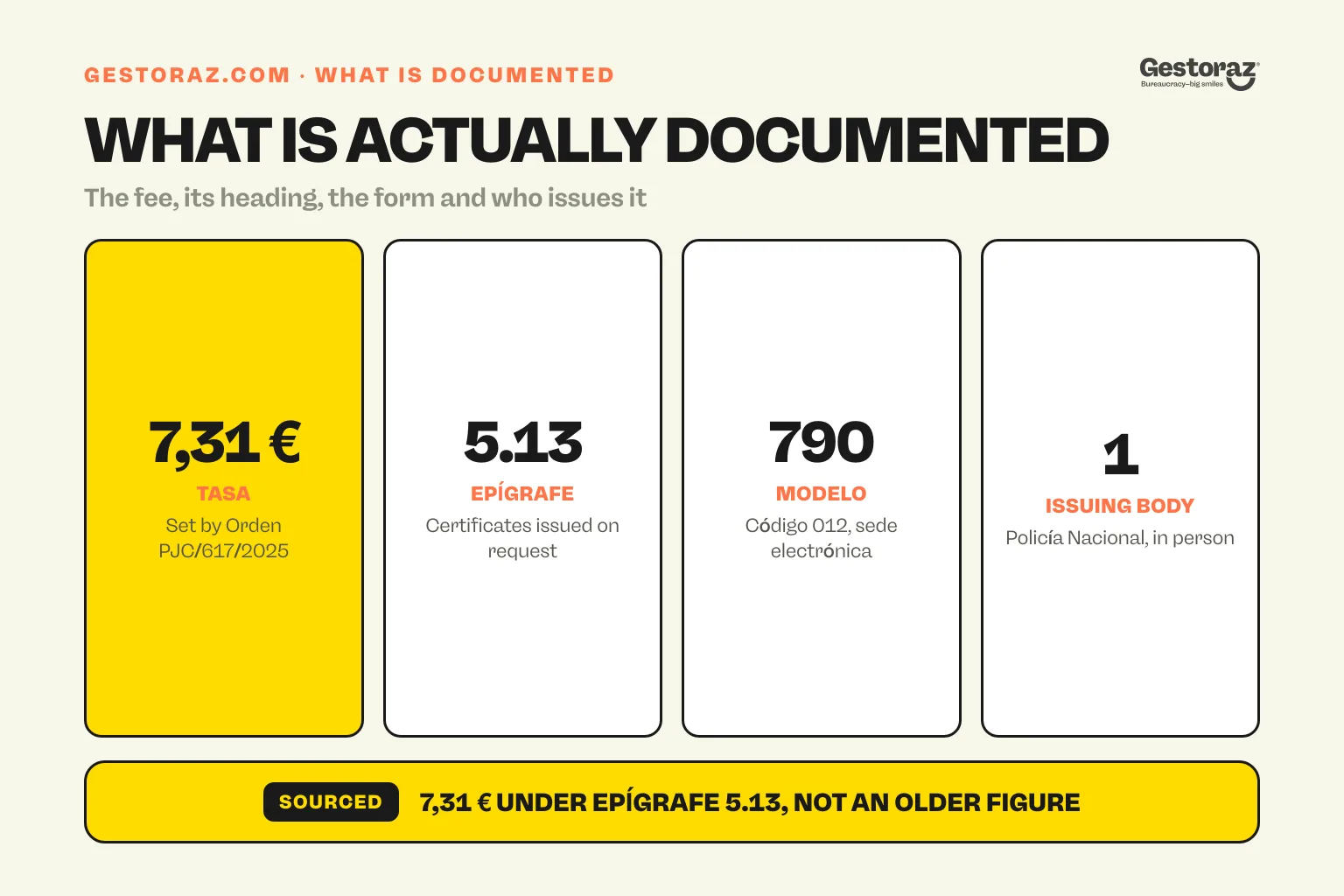
- The fee is 7,31 euros. It is epígrafe 5.13 of the fee schedule, "certificados o informes emitidos a instancia del interesado", fixed by Orden PJC/617/2025 of 13 June, in force since 16 June 2025.
- It is paid on the modelo 790 código 012, generated on the sede electrónica of the Policía Nacional. How to generate it, pay it and what counts as valid proof is in the modelo 790 código 012.
- The issuing body is the Policía Nacional, which holds the foreigners register the certificate reports on.
- It is requested in person. Certificates drawn from the foreigners register are counter procedures, and we cannot point you at a telematic route.
One correction, because the error is live. Many sites publish a lower amount for this certificate, an older figure still circulating. It comes from Orden PRE/1803/2011, the fee order repealed in June 2025, and it is not the amount currently due. A page still showing it has not been updated since the repeal, which tells you what to think of the rest of it.
What we cannot state, and are not going to invent
This is the part competing articles fill in confidently. Four things about this request are not documented anywhere we are willing to cite.
- That the EX-15 is the mandated vehicle. It is the form most practitioners reach for, and section 4.1 does contain a CERTIFICADO option. But nothing official says a request to reconcile two identities is filed on it, and the two sub-options actually printed there are de residente and de no residente, neither of which is what you are asking for.
- The cita previa category to book. We cannot tell you which entry in the appointment menu corresponds to this request. Appointments are single use, so booking the wrong entry costs you the slot and the wait behind it.
- The processing time. The five working day rule that circulates is documented for the certificado de residente, not for this. There is no published deadline for a certificate issued under epígrafe 5.13.
- Any validity period. We found nothing that sets one. The certificado de residente and the certificado de no residente carry "periodo de validez: 3 meses desde su expedición" printed on them. Those are different documents. The advice to use this one within three months is blog folklore, repeated until it started to sound official.
One note on that. Where a three month rule genuinely bites in Spain, it is normally imposed by the body receiving the document, not by the body issuing it. A bank can require a recently issued certificate as internal policy, which is not the same as a legal expiry date. Ask the receiving office which of the two it means.
What to do in practice
Not knowing the procedure does not leave you stuck. It means you invert the usual order and start from the destination instead of the counter.

- Ask the body refusing you what it actually wants, in writing if you can. "A public document linking my former NIE to my current DNI" is a request an office can answer. "A certificado de concordancia" is a nickname it may not recognise.
- Have both identifiers in hand before going anywhere. The old number and the current document. If the old number is the thing you have lost, that is a separate task, handled in finding your NIE number.
- Ask the office, not the search engine. Because the request has no form of its own, what a counter accepts varies. Put the question to the comisaría or extranjería office covering your province before you generate anything.
- Generate the tasa only once you know the heading. A 790 paid under the wrong epígrafe is a real payment for a different procedure, and it does not convert.
- Bring originals and full copies. Passport, DNI if you have one, and any older certificate carrying the NIE. You are asking an officer to link two identities, so hand them both ends of the link.
Keep the expectation proportionate. This is a 7,31 euro certificate under a generic heading, not a complex authorisation. The hard part is not the document. It is establishing which counter issues it and under what name.
At Gestoraz we prepare and file Spanish administrative applications remotely, including NIE applications and the modelo 790 código 012 under the correct heading. For this particular certificate we do not publish a fixed procedure, for the reasons set out above.
Official sources
- Real Decreto 1155/2024, boe.es: the Reglamento de Extranjería in force since 20 May 2025. Search the consolidated text for "concordancia" and it returns nothing.
- Orden PJC/617/2025 of 13 June, boe.es: the fee schedule in force since 16 June 2025, epígrafe 5.13 for certificates or reports issued at the request of the interested party.
- Policía Nacional, sede electrónica, sede.policia.gob.es: the catalogue of extranjería procedures, and the generator for the modelo 790 código 012.
- Ministerio de Inclusión, Seguridad Social y Migraciones, extranjeros.inclusion.gob.es: the official EX-15 form, whose section 4.1 lists the requests that are actually available.


Obtain your Digital Certificate entirely remotely.
Request your Digital Certificate completely remotely.

