



Modelo 720 in Spain: declaring your foreign assets
Once you become tax resident in Spain, you take on a return that few other countries have in this form: the modelo 720. In it you report what you own outside Spain (bank accounts, investments, life insurance and property) as soon as one of those categories exceeds €50,000. No tax is paid with it, but you must file it between 1 January and 31 March.
If you became tax resident in 2026, your first filing window therefore runs from 1 January to 31 March 2027, based on what you owned on 31 December 2026. This guide explains who has to file, how to calculate the threshold per category, what you do not need to report, when you have to file again and what you still risk if you forget. Crypto held on a foreign platform has its own form, the modelo 721, which we cover separately.
What is the modelo 720?
The modelo 720 is the declaración informativa sobre bienes y derechos situados en el extranjero, the information return on assets held abroad. The obligation is laid down in the General Tax Law (Ley 58/2003, additional provision 18) and set out in detail in Real Decreto 1065/2007. The first returns covered the year 2012. The form combines three obligations that stand on their own:
- Accounts with banks and credit institutions outside Spain (article 42 bis).
- Securities, insurance and annuities: shares, bonds and investment funds held abroad, life insurance with a foreign insurer and annuities from a foreign institution (article 42 ter).
- Property and rights over property outside Spain (article 54 bis).
There is no amount to pay. What those assets earn (interest, dividends or rent) you declare as a resident in your income tax return, the modelo 100, applying the tax treaty. The modelo 720 only tells the Agencia Tributaria what exists and where it is.
Who has to file the modelo 720?
Everyone who is tax resident in Spain, including in the first year. Under the income tax law (Ley 35/2006, art. 9) you are resident if you spend more than 183 days in Spain in a calendar year, or if the main centre of your activities or economic interests is there. If your spouse (not legally separated) and your minor children live in Spain, the law presumes that you live there too. Spain does not split the year: if you move in March and stay for the rest of the year, you are resident for the whole of that year. More on this in our guide to tax residency in Spain.
You do not have to be the owner yourself. For accounts, anyone who is an authorised signatory, a beneficiary or otherwise able to dispose of the money also counts. If you hold a power of attorney over your parents' account back home, that account belongs in your accounts category.
If you own something jointly, for example with your partner, each of you reports the full balance or the full value, with your own percentage. The €50,000 threshold applies to the whole asset, not to your share.
Who does not have to file
- Non-residents. If you own a home in Spain but remain tax resident in another country, you file the modelo 210, not the modelo 720. See our guide to tax as a non-resident.
- Anyone under the Beckham regime, the special regime for employees who move to Spain (art. 93 of the income tax law). The Agencia Tributaria confirms this in its frequently asked questions. The regime applies per person: your spouse and children are only covered if they opt in themselves, which has been possible under conditions since 2023 (art. 93.3). If they do not and they are tax resident, they may well have to file.
The three categories and the €50,000 threshold
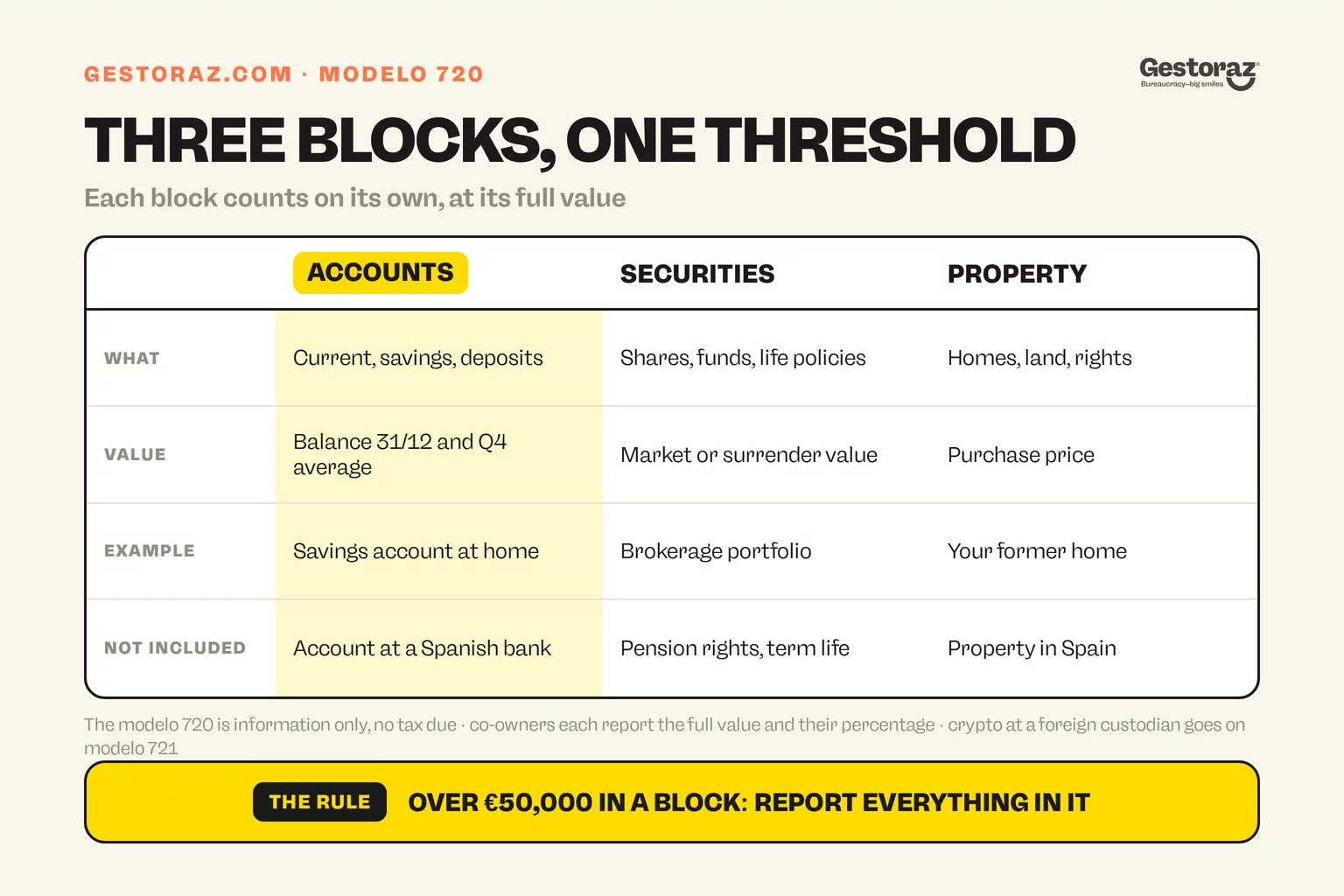
The threshold applies per category, and per category it is all or nothing. If a category stays below €50,000 in total, you report nothing from it. If it goes over, you report every asset in that category, including the small ones. Each category is a separate obligation, with its own penalty if you forget it.
1. Accounts
Current accounts, savings accounts, deposits and credit accounts with a bank outside Spain. You look at two totals: the balances on 31 December and the average balances of the fourth quarter. If either total exceeds €50,000, you report all your foreign accounts, with the bank, the account number, the opening date and both balances.
2. Securities, funds, insurance and annuities
Shares and bonds held in custody abroad, holdings in foreign investment funds, life insurance with a foreign insurer and annuities you receive from a foreign institution. Listed shares are reported at their price on 31 December, funds at their liquidation value on that day, life insurance at its surrender value and an annuity at its capitalised value.
3. Property
A home, land, a garage or a right over property outside Spain. What counts here is not today's market value or a local tax valuation, but the purchase value: what you paid for it. You report the address, the purchase date and that value. Usufruct, bare ownership and timeshares have their own valuation rules.
Amounts in another currency, including the purchase price of a property, are converted to euros at the exchange rate on 31 December of the year you report on.
What you do not need to report
- Pension rights. Rights built up in a foreign pension plan are not reported as long as you are not receiving benefits, the Agencia Tributaria writes. If you already receive a pension as a periodic payment from a foreign institution, have it checked whether it falls under category 2.
- Pure term life insurance, with no surrender value.
- What is in Spain. An account with a Spanish bank or property in Spain does not go on the modelo 720.
- Crypto. That goes on the modelo 721, further down this guide.
- A category that does not exceed €50,000 in total.
When and how do you file it?
The filing window runs from 1 January to 31 March and covers the situation on 31 December of the previous year. For the year 2026, that means by 31 March 2027 at the latest. If a technical problem at the Agencia Tributaria prevents you from filing on time, you can still file in the four calendar days that follow.
The modelo 720 exists online only, through the Sede electrónica of the Agencia Tributaria. You identify yourself with a digital certificate or with Cl@ve, and your NIE is your tax number in the return. If you do not have a certificate or Cl@ve yet, arrange it well before March: how it works is explained in our guide to the digital certificate and Cl@ve.
What to have ready
- Accounts: the bank's name and address, the account number (IBAN) and the BIC, the opening date, the balance on 31 December and the average balance from October to December. Ask your bank for that average if it is not on your annual statement.
- Securities and funds: the issuer or the fund, the ISIN, the number of units and the value on 31 December.
- Insurance and annuities: the insurer's name and address and the surrender value or capitalised value on 31 December.
- Property: the address, the type of property, the purchase date, the purchase price and your ownership percentage.
After the first year: the €20,000 rule and sales
The modelo 720 is not a yearly routine. After your first return, you only file a category again if its total value has risen by more than €20,000 compared with the value in your last return for that category. So you compare with the last figure you filed, not with last year: an increase of €15,000 means nothing this year, but if another €13,000 is added the year after, you are €28,000 higher and have to file again.
One rule always applies: if you sold, closed or gave away something that was already in a return, you report that in the return for that year, with the date and the balance or the sale price. That also applies if it takes the category below €50,000.
If you were never required to report an account, for example because the category always stayed below the threshold, you do not need to report its closure either.
Worked example: a couple from Dublin in Alicante
Aoife and Conor move from Dublin to Alicante in March 2026 and stay for the rest of the year: they are tax resident for the whole of 2026. In Ireland they keep a joint savings account, Conor has an investment account in his name, and for now they keep their house, which they bought together in 2012 for €260,000.

- Savings account: a balance of €64,000 on 31 December 2026, an average of €61,000 in the fourth quarter. Above the threshold, so Aoife and Conor each report the full account, with 50% ownership.
- Investment account: €38,000 on 31 December. Below the threshold, so Conor does not report it.
- House: purchase value €260,000. Each reports the full value, with 50%.
- By 31 March 2027: Aoife and Conor each file a modelo 720, with the account and the house.
- End of 2027: the savings account stands at €71,000, with an average of €69,000. That is €7,000 and €8,000 more than in their return, so less than €20,000: no new return for the account. The investment account rises to €52,000: Conor reports it for the first time, by 31 March 2028.
- June 2028: they sell the house for €395,000. In the return for 2028, by 31 March 2029, each reports the sale, with the date and the price.
The gain on the house is a matter for their income tax and the tax treaty. The modelo 720 only reports that the house has been sold.
Crypto: the modelo 721
For cryptocurrencies on a foreign platform there is a separate form: the modelo 721, introduced for the return on 2023 (article 42 quater of Real Decreto 1065/2007). It works like the modelo 720: the same window from 1 January to 31 March, the same €50,000 threshold and the same €20,000 rule in the following years.
It only covers crypto that a custodian manages for you, holding the private keys, and that does not report on its clients in Spain: in practice, a foreign platform. Crypto in your own wallet, where only you hold the keys, is not included. You add up the value of all your crypto with such custodians on 31 December, at that day's price. The modelo 721 is information only too: gains on crypto go in your income tax return.
What do you risk if you forget?
Until 2022 the modelo 720 was notorious for its penalties: at least €10,000 per category if you did not file, and undeclared assets could be taxed as income without any limitation period, with a 150% penalty. On 27 January 2022 the Court of Justice of the European Union ruled (case C-788/19) that this breached the free movement of capital. Spain abolished those rules in March 2022 (Ley 5/2022).
Since then, the ordinary penalties for information returns apply, from articles 198 and 199 of the General Tax Law, separately for each category:
- Not filed: €20 per item or set of data that should have been in it, with a minimum of €300 and a maximum of €20,000.
- Filed late, but on your own initiative before the Agencia Tributaria asks for it: half, so €10 per item, at least €150 and at most €10,000.
- Filed incomplete, inaccurate or with false data: a separate penalty under article 199.
Forgot? Then file it as soon as possible: a letter from the tax office doubles the penalty. And do not count on silence. Banks in the EU, and in the more than 100 jurisdictions that apply the OECD Common Reporting Standard, report the accounts of clients who are tax resident in another country to their tax authority, which passes them on to the country of residence (within the EU under Directive 2014/107/EU). That does not replace the modelo 720, but it does make a missing return stand out.
Common mistakes
- Counting your share instead of the whole. A joint account of €80,000 is an account of €80,000 for both of you, not of €40,000.
- Only looking at 31 December. The average balance of the fourth quarter counts too. If you transferred money to Spain in December, that average may still be above €50,000.
- Forgetting your parents' account. A power of attorney over their account makes that account part of your return.
- Entering the market value or a tax valuation. For property, the purchase price counts.
- Not reporting a sale or closure. What was reported must also be reported as gone, even below the threshold.
- Thinking your family is covered by your Beckham regime. The regime applies per person: anyone who has not opted in themselves may have to file.
- Putting crypto on the modelo 720. Crypto on a foreign platform goes on the modelo 721.
The modelo 720 at a glance
- Who: tax residents of Spain, from the first year, including authorised signatories and co-owners. Not: non-residents and anyone under the Beckham regime.
- What: accounts, securities and insurance, and property outside Spain, per category above €50,000.
- When: from 1 January to 31 March, on the situation on 31 December. For 2026: by 31 March 2027.
- How: online with the Agencia Tributaria, with a digital certificate or Cl@ve.
- After that: only again if a category rises by more than €20,000, or if you sell or close something that was already reported.
- Crypto: on a foreign platform above €50,000, through the modelo 721.
- Penalty: €20 per item, at least €300, half if you file late on your own initiative.
Just moved? The other steps, in the right order, are in our checklist for moving to Spain.
Official sources
- Ley 58/2003, General Tax Law, additional provision 18 and articles 198 and 199: https://www.boe.es/buscar/act.php?id=BOE-A-2003-23186
- Real Decreto 1065/2007, articles 42 bis, 42 ter, 42 quater and 54 bis: https://www.boe.es/buscar/act.php?id=BOE-A-2007-15984
- Ley 35/2006, income tax, tax residency (article 9) and Beckham regime (article 93): https://www.boe.es/buscar/act.php?id=BOE-A-2006-20764
- Ley 5/2022, new penalty regime for the modelo 720: https://www.boe.es/buscar/doc.php?id=BOE-A-2022-3712
- Agencia Tributaria, frequently asked questions on the modelo 720: https://sede.agenciatributaria.gob.es/Sede/todas-gestiones/impuestos-tasas/declaraciones-informativas/modelo-720-decla_____sobre-bienes-derechos-extranjero_/preguntas-frecuentes.html
- Agencia Tributaria, modelo 721, crypto held abroad: https://sede.agenciatributaria.gob.es/Sede/procedimientoini/GI55.shtml
- Court of Justice of the EU, judgment C-788/19 of 27 January 2022: https://curia.europa.eu/juris/liste.jsf?num=C-788/19
- Directive 2014/107/EU, automatic exchange of account information: https://eur-lex.europa.eu/eli/dir/2014/107/oj


Obtain your Digital Certificate entirely remotely.
Request your Digital Certificate completely remotely.

