



Moving to Spain checklist: paperwork for EU citizens
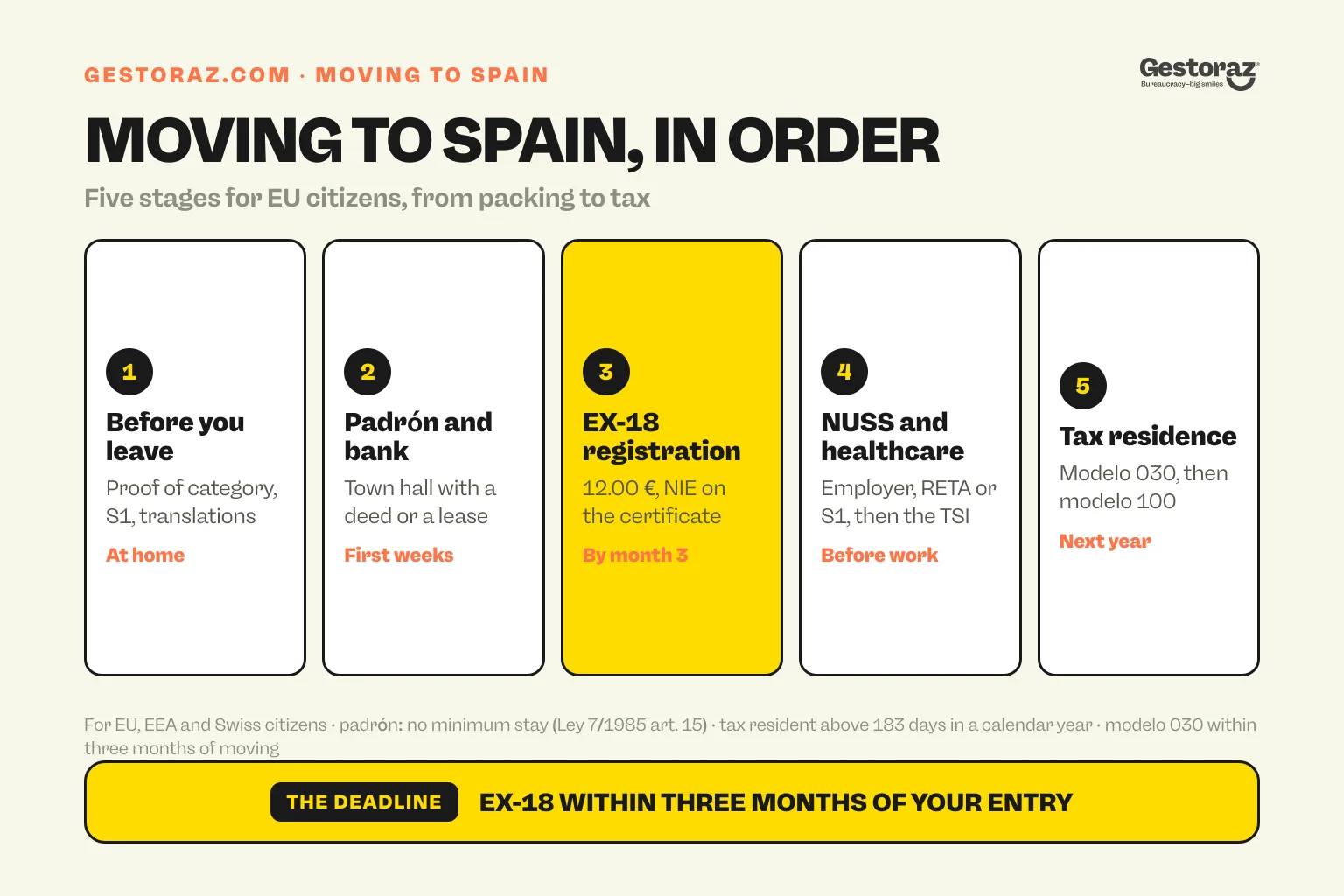
Moving to Spain as a citizen of the EU, the EEA or Switzerland takes no visa, but it does take a string of registrations that depend on each other. Your housing gives you an address, the address gets you on the padrón, the EU registration certificate carries your NIE, and that certificate is what you need for the digital certificate. Done in the wrong order, each step costs you an appointment.
This checklist follows the order in which things actually happen: before you leave, the first weeks, the three-month deadline, then work, healthcare, taxes and the car. Each step gives the deadline, fee or form that matters, then points to our detailed guide. It is written for employees, remote workers, retirees and the self-employed. If you are not an EU, EEA or Swiss national, you need a visa before you travel, which is outside the scope of this article.
Before you leave: proofs, S1 and the NIE question
Most of the work before departure is gathering paper. Your registration in Spain asks you to prove which category you belong to, so collect that proof now.
Decide your category and gather the proof
- Employee: an employment contract or a declaration from your Spanish employer.
- Self-employed: you will register on arrival, so plan your activity and start date.
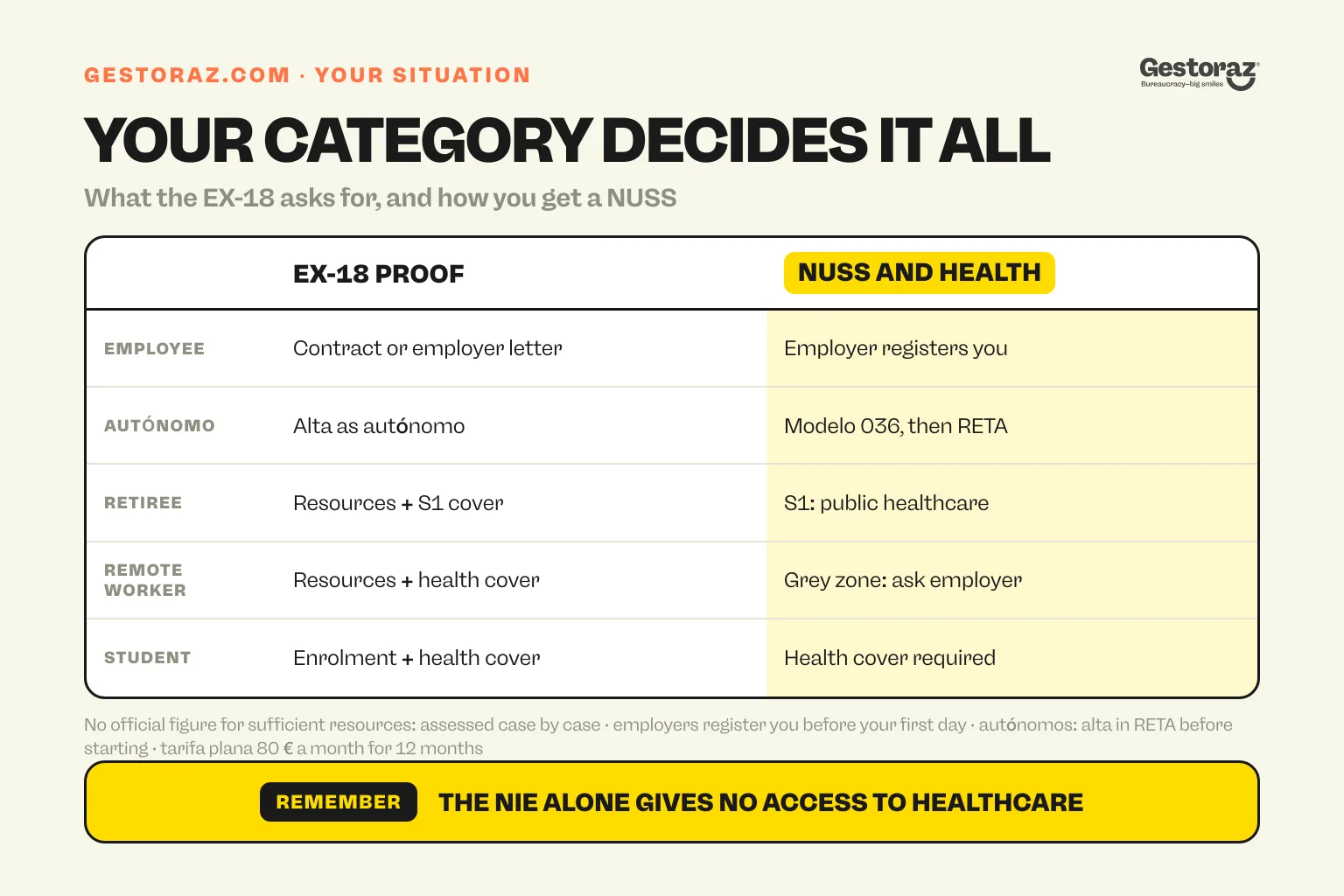
- Retiree, person living off savings or working remotely without a Spanish contract: proof of sufficient resources and full health cover in Spain. No official figure is fixed for the resources: they are assessed case by case.
- Student: enrolment in a recognised establishment, health cover and a declaration of sufficient resources.
Documents issued abroad and not written in Spanish generally need a sworn translation, and some foreign public documents an apostille: start both before booking anything. EU retirees should also request the S1 form from the pension fund in their home country. In Spain, the S1 counts as health cover for your registration and later gives you access to public healthcare without contributing.
Do you need an NIE before you go?
Only if something in Spain needs it before you arrive, typically buying a property or signing before a notary. Otherwise the EU registration allocates your NIE at the same time, and applying separately first only adds an appointment and a fee. If you got an NIE years ago, it never expires and stays valid. For what the number is and when you need one, see what an NIE number is.
Last point: your move date matters for tax, because Spain does not split the year (see the taxes step below).
The first weeks in Spain: padrón and bank account
Register on the padrón
Spanish law (Ley 7/1985, art. 15) obliges everyone who lives in Spain to register on the padrón of the municipality where they usually live, with no minimum length of stay. You go to the town hall with your passport or identity card and proof that you occupy the home: a deed, a rental contract with a recent receipt, or an authorisation from someone already registered there. Ask for a certificado, not just a volante, when an authority needs it, and see volante vs certificado for the difference.
The padrón proves where you live. It does not make you a tax resident, and it does not inform the tax agency of anything.
Open a bank account
Many banks open a non-resident account on a passport and convert it later. Expect fees on a non-resident account, commonly 60 to 120 € a year. Once you hold your NIE and padrón, ask to switch to a resident account: banks routinely want to see the EU registration certificate first, which is one more reason not to delay it.
Within three months: register as an EU resident
This is the step with a legal deadline. If you stay in Spain for more than three months, you must register in person, within three months of your entry into Spain, at the Oficina de Extranjería of your province or, failing that, the competent Policía Nacional station (Real Decreto 240/2007, art. 7). The form is the modelo EX-18, and the registration is personal: each adult files their own, so a couple pays two fees.
- Appointment: a free cita previa, usually 1 to 4 weeks away, 4 to 6 weeks in Madrid, Barcelona, Málaga and Marbella. Book as soon as you have an address.
- Fee: 12.00 € through the modelo 790 código 012, ticking the line for the certificado de registro de residente comunitario, not the NIE line.
- What you bring: the EX-18, a valid passport or national identity card, the proof of your category, the paid fee and proof of your address (the padrón certificate, a rental contract or a deed).
- What you get: the certificate is issued on the spot. It states your name, nationality, address, NIE and registration date. If a document is missing, the office gives you 10 days to complete the file.
The certificate is a green sheet, not a card, and not an identity document: keep carrying your passport or identity card. It also carries the número de soporte (starting IXESP or AXESP), which you need later for the digital certificate. The full procedure, category by category, is in our EX-18 guide. Registration makes you an administrative resident, which is not the same thing as a tax resident: our residency guide separates the two. After five years of continuous legal residence, you can move to permanent residence.
Work, social security and healthcare
Your social security number, the NUSS, is a lifelong 12-digit identifier from the Tesorería General de la Seguridad Social. It is not your NIE, and confusing the two is the most common mistake: the NIE alone gives you no access to public healthcare. How you get a NUSS depends on your situation.
Employees
Your employer must register you with social security before your first day of work, and creates your affiliation if it is your first job in Spain. You have nothing to file: the NUSS appears on your first payslip. As an EU citizen you need no work permit. The details are in our guide to the NUSS number.
Self-employed (autónomo)
Two steps, in this order: the modelo 036 with the Agencia Tributaria (your activity, its tax heading and your VAT regime), then the alta in the RETA, the self-employed scheme, which creates your NUSS if you do not have one. The alta must be done before you start the activity: a late alta takes effect from the first of the month and carries surcharges. New autónomos can use the tarifa plana of 80 € a month for 12 months. See how to become an autónomo.
Retirees, remote workers and healthcare
An EU retiree with an S1 gets a NUSS and access to public healthcare without contributing, as the home country pays. Without a Spanish job, a Spanish self-employed activity or an S1, you get no NUSS and need private health insurance. Remote workers employed by a foreign company sit in a grey zone (becoming autónomo, an A1 certificate, or an employer registered in Spain): settle it with your employer before moving.
With a NUSS, your padrón and your identity document, you register at your local centro de salud to obtain the health card, the TSI. How it works by status and by region is in our guide to the Spanish healthcare system.
Taxes: when you become a tax resident
Under the Spanish income tax law (Ley 35/2006, art. 9), you are a tax resident if you spend more than 183 days in Spain in a calendar year, or if the main centre of your activities or economic interests is in Spain. You are presumed resident if your spouse (not legally separated) and minor children live in Spain. The tax year is the calendar year, so a resident is resident for the whole year, income earned before the move included. The criteria and how to plan the switch are in how to become a tax resident in Spain.
- Modelo 030: tells the tax agency your new tax address, within three months of the change. Neither the padrón nor your bank does it for you. Autónomos report it within one month through the modelo 036.
- First return: the modelo 100, filed between April and June of the following year, on your worldwide income.
- Modelo 720: an information return, due before 31 March, if you hold foreign assets above 50,000 € in a category (accounts, securities, property).
Car, driving licence and digital certificate
Your driving licence
A licence issued in another EU country remains valid in Spain for as long as it is in force, and exchanging it is voluntary. Once you live here, Spanish rules on validity, medical fitness and points apply to you. If your licence has no expiry date, you must renew it in Spain two years after taking up normal residence (Real Decreto 818/2009, art. 15).
A car with foreign plates
A resident who uses a car in Spain must register it on Spanish plates. The registration tax is due if you do not apply within 30 days of starting to use the car in Spain, with a longer window when you move your habitual residence and qualify for the relocation exemption: at least 12 months of residence abroad, a car used for at least six months before the move, and no resale for 12 months (Ley 38/1992, arts. 65 and 66).
The digital certificate
The free FNMT certificate opens most Spanish administrations online. You request it online with your NIE and the número de soporte printed on your EU registration certificate, confirm your identity in person at a registration office, then download it in the same browser you used for the request. The Cl@ve system is the free alternative. Both are explained in digital certificate and Cl@ve.
The checklist at a glance
- Before you leave: proof of your category, sworn translations and apostilles, S1 for retirees, an NIE only if you buy or sign before arriving.
- First weeks: housing, then the padrón, then a bank account, and book the EX-18 appointment.
- Before your first day of work: alta with social security by your employer, or modelo 036 and RETA if you are autónomo.
- Within 30 days of using it in Spain: Spanish registration of a foreign car, unless the relocation exemption gives you longer.
- Within three months of entry: EX-18 registration, 12.00 € fee.
- Within three months of moving: modelo 030 (one month via the modelo 036 for autónomos).
- Once registered: digital certificate or Cl@ve, and the TSI at your centro de salud.
- The following year: modelo 720 before 31 March, modelo 100 between April and June.
- After two years: renew an EU licence without an expiry date. After five years: permanent residence.
Gestoraz handles part of this list: we obtain your NIE, and we take care of the EU registration, the NUSS, the digital certificate and the autónomo registration. We do not handle visas or vehicle registration.
Official sources
- Real Decreto 240/2007, registration of EU citizens: https://www.boe.es/buscar/act.php?id=BOE-A-2007-4184
- Orden PRE/1490/2012, documents for the EU registration certificate: https://www.boe.es/eli/es/o/2012/07/09/pre1490
- Ley 7/1985, padrón (articles 15 and 16): https://www.boe.es/buscar/act.php?id=BOE-A-1985-5392
- Ley 35/2006, income tax, tax residency (article 9): https://www.boe.es/buscar/act.php?id=BOE-A-2006-20764
- Real Decreto 818/2009, Reglamento General de Conductores: https://www.boe.es/buscar/act.php?id=BOE-A-2009-9481


Obtain your Digital Certificate entirely remotely.
Request your Digital Certificate completely remotely.

